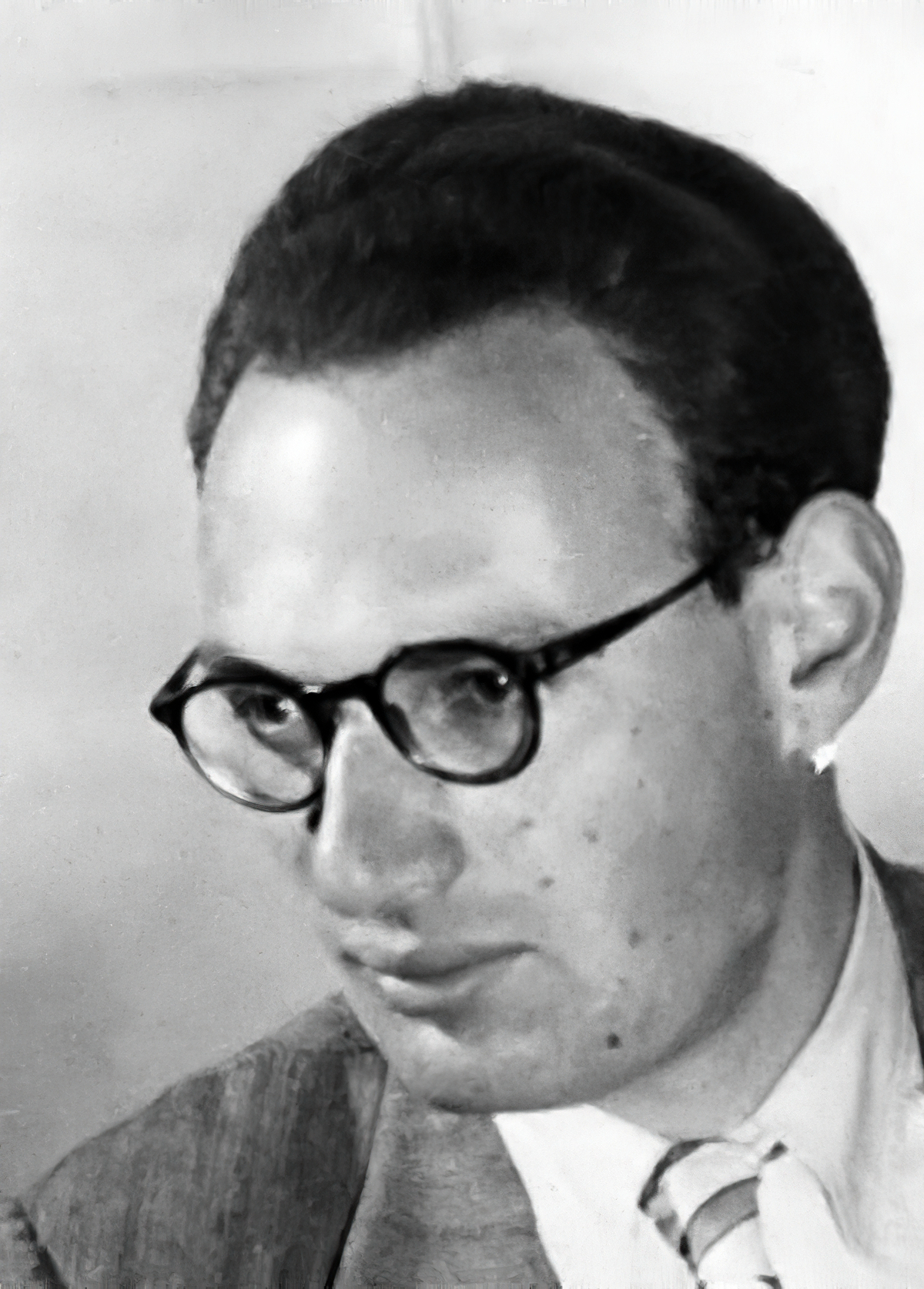


Dick Kattenburg (1919–1944)
Dick Kattenburg was a Dutch Jewish composer, murdered at Auschwitz in 1944 aged 24, whose music then went unheard for more than half a century. He wrote fluent, jazz-inflected chamber music that owed as much to the dance bands of the 1930s as to Ravel or Stravinsky. Most of the surviving work dates from 1942 to 1944, when he was moving between hiding places in Amsterdam and Utrecht, and it records a double life. He stripped his name from his earlier scores and signed new ones with invented Christian-sounding names, while turning towards Jewish material and labelling Hebrew melodies “Romanian”, “Palestinian” or even “Mexican” so that the manuscripts would not betray him. He studied composition by post with Leo Smit until Smit was deported and killed at Sobibor. For decades it was thought that a single Kattenburg work had survived: a flute sonata he had given, unplayed, to a young woman he was in love with. When it began to be performed after 2000, his niece went up to her attic and found a box holding most of the rest.
Kattenburg was born on 11 November 1919, the second of Louis and Heleen Kattenburg’s three children; his sister Daisy was older, his brother Tom born in 1922. The family had money from textiles, and his father worked at a raincoat factory owned by a cousin. The household moved from Amsterdam to Bussum, where Dick attended the Hogere Burgerschool, the Dutch academic secondary school, and took his first violin lessons from the composer Hugo Godron, who also guided his earliest attempts at composition. An andante for string quartet and two Hebrew songs, his first numbered works, are probably lost. After school he enrolled at the Collège Musical Belge in Antwerp and took diplomas in theory and violin at the age of 17. From that year, 1936, comes Tap Dance, for piano four hands and tap dancer.
Back in the Netherlands he was often in Amsterdam, where he met Ima van Esso, a flute student at the Amsterdam Music Lyceum. In May 1937 he dedicated his Sonata for flute and piano to her and handed over the manuscript. Other works followed quickly, among them a Divertimento for wind quintet, the Escapades pour deux violons of 1938, and a second piece for Ima, the Pièce pour flûte et piano of June 1939. A string trio was first performed at a house concert at Godron’s home in December 1938. The reviewer for the Gooi en Eemlander called it:
“A fairly compact piece showing remarkable mastery and a very personal style; looking forward with great interest to his further development.”
— Gooi en Eemlander, 19 December 1938
The trio is signed with the pseudonym “Van Assendelft Van Wijk”, and its back cover carries small sketches of Hitler and of a soldier saluting. For the autumn of 1939 Kattenburg planned to complete his violin studies at the École Normale in Paris. That never happened.
A month after the German invasion of May 1940 he wrote Lied ohne Worte for his mother’s fiftieth birthday. Louis Kattenburg died that September, the first anti-Jewish measures followed, and in January 1941 all Jews in the Netherlands were ordered to register. Kattenburg nonetheless passed the state examinations in theory and violin at The Hague that year,
prepared under Willem Pijper, and an advertisement in Het Joodsche Weekblad of 5 September 1941 gives his parents’ home as the address at which he taught violin and theory. From May 1942 Jews had to wear the yellow star and the deportations began. The family separated: Heleen and Tom hid in Deventer, while Dick appears to have moved first to Amsterdam and then underground. That November the Sicherheitspolizei raided the Hollandia-Kattenburg factory, where his father had worked, arresting 367 Jewish employees; 359 did not return.
Confronting his origins drew Kattenburg into Jewish musical culture. He orchestrated four horras, hasidic dances, from a collection by Solomon Rosowski, and in July 1943 began Zes Mexicaanse liederen (“Six Mexican Songs”), an unfinished setting for voice and orchestra of six songs by Joel Engel whose texts are in fact Hebrew. Movements of a suite for violin and piano were retitled “Nigun” and “A Redl”, titles were written in Hebrew characters, dates were sometimes given by the Jewish calendar, and the segno sign was replaced by a Star of David. He signed the new scores C. J. van Assendelft van Wijck, or simply “KvD”.
In the summer of 1942 Kattenburg turned to orchestration and took private lessons from Leo Smit at his home on the Eendrachtstraat in Amsterdam. The meetings soon became too dangerous and the lessons continued by post, manuscripts travelling in both directions, probably carried by a resistance courier. Smit’s comments were blunt, one trombone passage being “like a bull in a china shop”, and Kattenburg gave as good as he got. An undated letter to Smit describes the conditions he was working in:
“I apologise for my poor handwriting, but my paper and pencil are of deplorable quality. […] I sincerely hope to resume the lessons at your home, but I fear I have to accept this substitute for a long time to come (although excellent in content, the delivery takes forever).”
— Dick Kattenburg to Leo Smit, undated
The lessons ended when Smit and his wife were summoned in March 1943 and sent to Westerbork. Smit was deported to Sobibor on 27 April 1943 and killed three days later. The two never met again.
At some point Kattenburg hid in Utrecht at the home of the pianist Ytia Walburg Schmidt; a draft dated December 1942 and dedicated to “YCWS” places him there. Theo Kroeze recalled after the war escorting him, disguised as a bricklayer, to a hiding place on the Nachtegaalstraat. Concealment did not stop the composing: he wrote cadenzas for the Beethoven and Mozart violin concertos, finished a virtuoso Rhapsody for solo violin in August 1943, and completed the first movement of a viola sonata in Utrecht on 27 February 1944, the last music of his that is known and by some distance the darkest in mood.
His hiding place was betrayed and he moved between temporary shelters; Red Cross records give his last known address as Uiterwaardenstraat 387 in Amsterdam. He was arrested on 5 May 1944, possibly during a raid on a cinema, and on 8 May got a note out of Westerbork to an aunt and uncle. Within a fortnight he was transported to Auschwitz. His death certificate records 30 September 1944, “somewhere in Central Europe”; neither the date nor the circumstances can be confirmed.
Ima van Esso survived the camps. She never studied the sonata Kattenburg wrote for her and never played it, but she kept the manuscript for more than sixty years. In 2000 she posted it to the flutist Eleonore Pameijer, co-founder of the Leo Smit Foundation, set up in 1996 to research and perform music suppressed under the occupation. It arrived on Pameijer’s birthday, with a note: “I heard about the Leo Smit Stichting on the radio and thought this should go to you.” Pameijer recorded the sonata and sent her a cassette. Hearing it for the first time, Ima Spanjaard-van Esso, as she then was, said: “Now I understand, it was a love letter.”
Browsing the internet a few years later, Joyce Bergman-van Hessen, the daughter of Kattenburg’s sister Daisy, came across an announcement for a concert including her uncle’s flute sonata and remembered a box of manuscripts in her late mother’s effects in the attic. It held some two dozen further scores from 1936 to 1944, among them the quartet for flute, violin, cello and piano, the string trio, the orchestrated horras and the viola sonata. Much of this music was heard for the first time in the Uilenburg concert series in Amsterdam, and around a dozen of his works are now recorded and played internationally.
Hannah Creviston, August 2026
Sources
Alders, Carine. “Dick Kattenburg.” Forbidden Music Regained. Leo Smit Foundation. https://www.forbiddenmusicregained.org/search/composer/id/100003
“Zes Mexicaanse liederen (Six Mexican songs), 1943.” Forbidden Music Regained. Leo Smit Foundation. https://www.forbiddenmusicregained.org/search/composition/id/100044
“A love letter.” Leo Smit Foundation, 23 February 2020. leosmitfoundation.org/stories/the-loveletter
Coleman, Randall. “Discovering Dick Kattenburg.” Medium, 5 July 2022. medium.com/@rcoleman78/discovering-dick-kattenburg-1ff21f3e1ec
“Leo Smit.” Music and the Holocaust. World ORT. https://holocaustmusic.ort.org/places/camps/death-camps/sobibor/leo-smit/
“Dick Kattenburg.” Donemus. donemus.nl/composer/dick-kattenburg/
“Hollandia-Kattenburg.” Joods Monument. www.joodsmonument.nl/en/page/750/hollandia-kattenburg
Micheels, Pauline, et al. Wat bleef was hun muziek: 10 jaar Leo Smit Stichting. The Hague, 2007.
Archives Dick Kattenburg, Nederlands Muziek Instituut, The Hague.
Newspaper archives, Koninklijke Bibliotheek, The Hague (including Gooi en Eemlander, 19 December 1938, and Het Joodsche Weekblad, 5 September 1941).