




Mikhail Nosyrev
Mikhail Iosifovich Nosyrev was a Soviet composer, violinist and pianist. Born in 1924 in Leningrad, his musical path was indelibly shaped by the war and most distinctly by detention in the “Vorkutlag” Gulag of the Soviet penal system. He died in 1981 in Voronezh, never fully rehabilitated by the USSR in his lifetime which has substantially affected the reception and dissemination of his works.
Upon graduation from Leningrad Conservatory, Nosyrev immediately became a soloist of the Radio Orchestra and the conductor of the Leningrad Musical Comedy Theatre until his arrest in late 1943. A prodigiously talented artist, his ability to securely work throughout his entire education as a soloist speaks to the depth of his talent even under duress. Mikhail Nosyrev’s early career was shaped by the Leningrad blockade where he was not only able to maintain a job as a violinist, but as a concert soloist for two years – a highly virtuosic and in demand performer. In September 1943 it seems that this virtuosity attracted jealousy and problems as he was likely denounced by his former conservatory teacher to the NKVD, ultimately arrested under article 58 of the RSFSR penal code for “counterrevolutionary” activities likely based on “anti-Soviet” writing in his diary. He was sentenced to death by firing squad on the 30th of September, 1941, and his sentence was commuted to ten years in the Gulag on the 31st of December the same year.[1] Nosyrev was sent to Vorkuta in January of 1944 to serve a ten-year term. Again, his talent seemed to benefit his survival as he was almost immediately assigned the concertmaster position of the theatre orchestra in the camp and also asked to compose for the ensemble, play piano, and conduct. Consistent with the theatrical stage productions on which Nosyrev primarily worked – his individual compositions from Vorkuta include a Fantasia on Russian Folk songs and Skazka – a symphonic poem based on fairy tales. The two outlier compositions from this period are concert works, a Sonatina in three parts for piano completed in 1950, and the Capriccio for violin started in Vorkuta and finished in Syktyvkar. In 1952, the theatre within the Gulag started transferring artistic control to the government of the Komi republic with the Komi ministry of culture completely taking over the theatre at Vorkuta by 1956. Nosyrev left Vorkuta in 1954 after serving his full term and was exiled in Syktyvkar until 1958. It is in Syktyvkar where he worked as the conductor of the Komi Drama Theatre where he finished the Capriccio for violin. The work wasn’t premiered until 1957 when Nosyrev moved to Voronezh with his family.
Voronezh was Nosyrev’s most prolific period compositionally from 1958 until his death in 1981. He was never fully rehabilitated in his lifetime, but rather posthumously in 1988. Nosyrev applied for union membership after the premiere of the violin concerto, and was rejected the first time but reconsidered after a “positive assessment by Shostakovich” and finally admitted and fully approved on the 26th of December, 1967.[2] Coupled with slights about his theatre training, the first reviews cited his time in the gulag time and associated work in the theatre to question his professionalism. The pieces Nosyrev selected the first time all contain marks of this theatre training or the Gulag including Skazka and Four Pieces for Piano which were composed in the camp and the Violin Capriccio. The support of Shostakovich in 1967 was not merely artistic, but seemingly a character reference. In Shostakovich’s request for reconsideration, he respectfully refers to Nosyrev by the title “comrade” in addition to his initials, and states that Nosyrev is not only a “gifted composer” but “quite professionally trained” and recommended that the committee listen to three works: Nosyrev’s Symphony, Ballade for a Dead Warrior, and The Unforgettables. Shostakovich’s formidable presence in Soviet classical music is coupled with a reference that Nosyrev is not merely a composer, but a serious classical one to whom the committee should give credence.[3]
Nosyrev also wrote a concerto for the violin in 1971. On closer inspection, the closer Nosyrev was to his period of detention, the more theatrical and narrative his concert works. This is reflected in his two appeals to join the Union of Composers, ,wherein his first works reviewed: Poem, Skazka, the Capriccio for Violin, and The Ballade of a the Dead Warrior were rejected with a note about their ”low professional level” in 1964, but his Symphony and dramatic Poem “The Unforgettable” were the works positively received by Shostakovich and the regional reviewers in 1967.[4] Nosyrev negotiates his post-Gulag identity in the Capriccio by including theatrical elements recalling incidental music from the stage, composing the piece over a period of several years and in fragments, and most significantly negotiating virtuosity and deploying it as a limited compositional technique. The schmalzy, dance-like, and even narrative characteristics of theatre composition are what remain in the Capriccio and to a lesser extent the 1970s violin concerto.
Nosyrev’s works remain basically unknown and reflect his technical proficiency as a violinist and a conductor. They contain lush orchestration and difficult writing for both the violin soloist and the string sections of the orchestra. Music as a compelled musical profession becomes another labour within the camp, albeit less physically brutal than mining or other tasks. It is worth considering this trauma to artists, where their pre-detention lives, Gulag experiences, and post-detention careers all were the same profession. This was profoundly distressing to performers as, like Nosyrev, they needed to negotiate their post-Gulag identity while carrying out the same tasks from the camp.
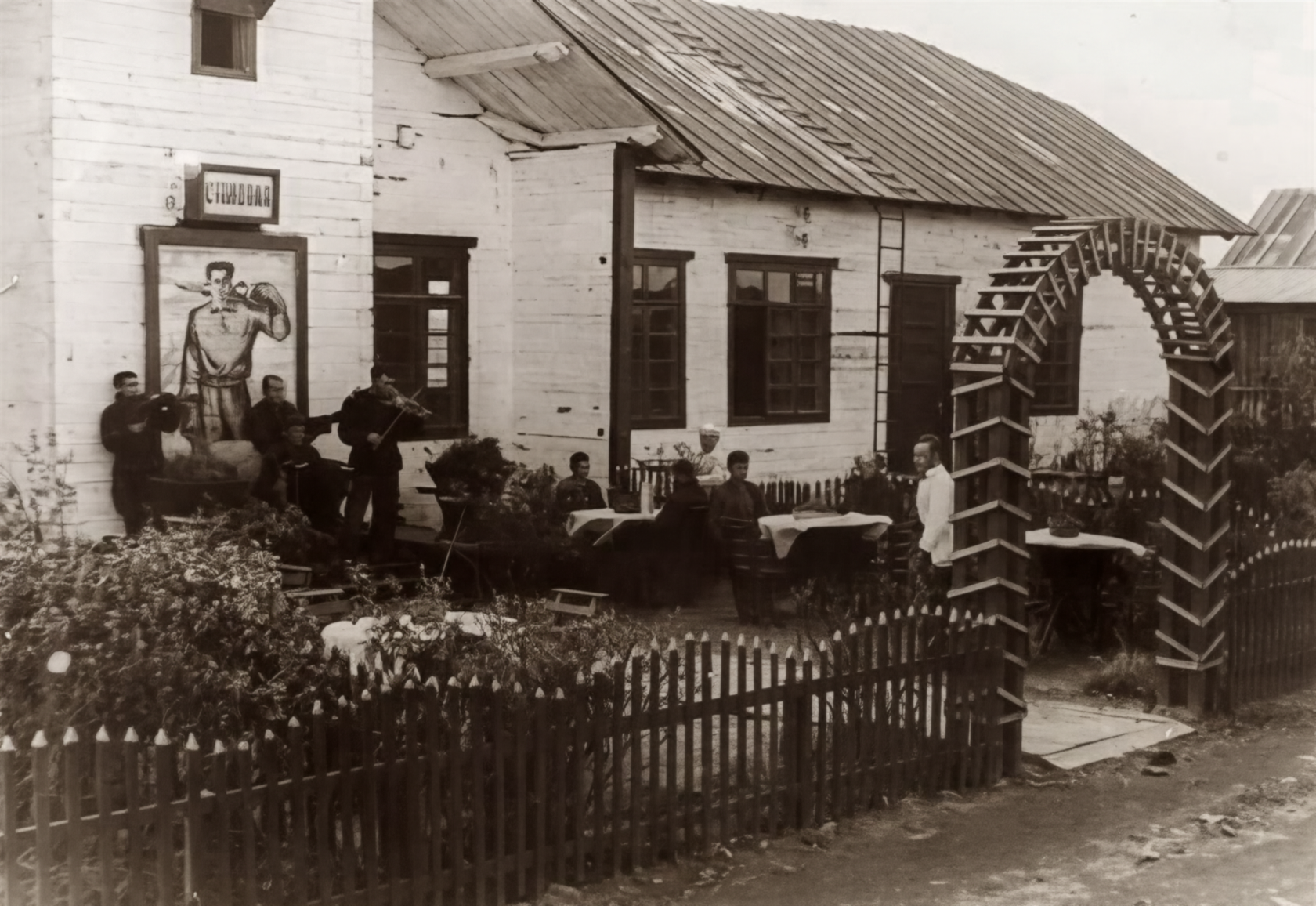
Summer canteen of a separate camp point No. 2. From the album “From the forced labour life of prisoners” of the Vorkutugol plant, NKVD of the USSR,” 1944 (GA RF)
Music and Vorkutlag
Few composers within the Gulag continued to compose or work artistically while detained. As Inna Klause discovered, between 1920 and 1950, only about two percent of prisoners participated in the music and theatrical life of the camps despite the foundation of numerous camp theatres in the same period.[5] Most musicians were subjected to the same physical labour as their peers, or were in constant fear of losing extremely rare and coveted theatre positions in the camps.[6] The organization of the Gulag was based on reeducative labour and bodily punishment.[7] However, music remained a key feature of cultural reeducation, where literature, music, and sport were essential to convey aspects of Soviet society. Such cultural presentations in the camps were intended to be consumed as a community – to present a unified, official, party line to inmates.[8] Nosyrev’s compositions from Vorkuta fall into this category, featuring banal plays for the stage with new Socialist messaging, or heroic epics and fairytales. The use of culture to reeducate intersected with the larger trend of the 1920s and 30s to create a New Soviet People, wherein the political enlightenment of communism was bolstered by cultural enlightenment.[9] As Klause correctly highlights, there has been more substantial discussion of literature and theaters within the Gulag and only minimal consideration of music as part of cultural reeducation.[10] Pieces from the camps were typically not newly created scores, but recycled dramas and pieces artists already knew. New compositions needed to adhere to strict aesthetic and textual guidelines to meet the standards of Socialist Realism – intelligible art accessible to the masses and packed with Socialist content.[11] New compositions within the camps were also rare, even in clandestine settings, given the draining and traumatic daily existence unconducive to creative output.
Klause divides music from the Gulag into two categories – the official music of reeducation which was encouraged and sanctioned by the authorities and clandestine music created by prisoners for themselves. However, her analysis omits several important points about sound and music creation in the camps. She has highlighted instances of forced singing, but largely maintains that music and artistic creation was beneficial to those interned.[12] Literature on music in the Nazi camps, including model camps like Theresienstadt with substantial artistic life, largely rejects this humanizing arc of music as a vestige of humanity for prisoners.[13] Still, music for professionals was a salvation in camps, and offered a path to less-dangerous labor even if through grotesquely compelled artistry.[14]
Vorkuta’s vibrant artistic and theatre culture consisted primarily of musicals and works which could involve the maximum number of intellectual prisoners in productions. The theatre released a seventy-year historical volume in 2013 where the majority of interviews were from the current company about contemporary shows and renovations with only three pages on their institutional Gulag origins.
Most famous for the revolt of prisoners in 1953 after the arrest of Lavrentii Beria, Vorkuta or Vorkutlag was also a significant hub of theatre and cultural detention within the Soviet Gulag system. During the Second World War, Vorkutlag was one of the most significant camps, first supplying Leningrad with essential coal, and later as a primary recipient camp of POWs.[15] The multinational nature of the camp was combined with an ideologically diverse population. The reeducative model of culture in the camps was particularly applicable to Vorkutlag where Trotskyists, Poles, German POWs, and a plethora of Soviet ethnicities could be indoctrinated in Soviet thought. This also mirrors the change in prisoner composition, where by the 1950s civilians equaled dangerous prisoners in the camp.[16]
In 1943 the theater was founded at Vorkuta by M.M. Maltsev with B.A. Mordvinov as the director who was a former principal of the Bolshoi Theater.[17] The theater was specifically built with an attached club building to make performances more social. Maltsev called it “the theater behind barbed wire,” and the great practitioner Konstantin Stanislavski said that Vorkuta “could only exist in the Gulag system that had sent uncountable people into the zone of everfrost and barbed wire.”[18] The theater was intended for camp performances in the reeducation model. This was not meant to be a respite for artistic prisoners; many like Nosyrev were separated from their valuable instruments when they were arrested and had their documents destroyed.[19] Prisoners in Vorkutlag and other nearby camps of the Komi region had the opportunity to attend theatrical performances containing appropriate Socialist content. Theatrical and musical indoctrination was utilized to instill further psychological and ideological reform of prisoners who were also subject to hard labor.
The theater at Vorkutlag further anchored the camp in the region, and after the camp was closed in 1962, the theater remained open with continuous productions. In the 70th anniversary volume, the majority of the history focuses on beautiful images of the restoration of the building today, and the diversity of their plays, most of which have sizeable musical components, and even some which are associated with prison subcultures like Puss and Boots. However, the continuation of the theater as an anchor for the surrounding community, broadly conceived, reveals the impact of the Gulag and imposed ideology on the space. There has been substantial and ongoing upkeep to the theater in Vorkuta far exceeding the time of the camp. Interestingly, the theater was transferred to the control of the regional government of the Komi republic in 1956 before the camp was closed. The limited focus on the Gulag in the publications on the theater reveals their desire to remain “a golden location for arctic theater” and to distance themselves artistically from the atrocities of the camp and forced, if artistic, labor. Stanislavski echoed the significance of the theater for the region saying, “but such a theater existed, and so made an impact on the layered history of the gulag and on the whole national culture.” Although great art was reproduced in the space, and great artists were interned in Vorkutlag, it is a cultural hub permanently tainted by detention.
Alexandra Birch, 2026
Sources
[1] “Biography,” Mikhail Nosyrev Website (Family managed), accessed 5/17/2023: http://www.nosyrev.com/biography.
[2] Vypiska iz protokola No. 13 zacadaniya Sekretariata Soyuza kompozitorov RSFSR. RGALI f. 2490 d. 4, 425, 22. And his approval signed by Shcherbakova: Telegrammy v g. Voronezh tov. Massaletinovu K. I. predsedatelyo Voronezhskogo otdeleniya Soyuza Kompozitorov SSSR, RGALI f. 2490 f. 4, 425 p. 25-26.
[3] Otzyv o sochyneniyakh M.I. Nosyreva by D. Shostakovich, 1967, RGALI f. 2490 d. 4, 425 p. 29-30.
[4] Vypiska iz protokala No. 11 zacedaniya Sekretariata Soyuza kompozitorov RSFSR, VG Fere and A.A. Kholodin’s comments on Nosyrev’s appeal to join the Composer’s Union in 1964, RGALI 2490/4/425/14-15 and Vypiska iz protokala No. 13 zasedaniya Sekretariata Soyuza kompozitorov RSFSR, S.. A Balasanyan, V.G. Fere and others reconsider Nosyrev’s music in Voronezh 1967, RGALI 2490/4/425/22.
[5] Inna Klause, Der Klang des Gulag: Musik und Musiker in den sowjetischen Zwangsarbeitslagern der 1920er-bis 1950er-Jahre (Göttingen, Germany: Vandenhoeck & Ruprecht, 2014).
[6] Vsevolod Zaderatsky for example worked in hard labor near Magadan, and only returned to compositional life after his sentence: Jascha Nemtsov, "„Ich bin schon längst tot “: Komponisten im Gulag: Vsevolod Zaderackij und Aleksandr Veprik," Osteuropa (2007): 315-339.
[7] Sobraniye uzakoneniy i rasporyazheniy rabochego i krest’yanskogo pravitel’stva. Moscow: Yuridicheskoye knigoizdatel’stvo; 3 June 1919; 20:257–61.
[8] Such events even contained contemporary news in an entertaining way for prisoners: Ispravitel’no-trudovoy kodeks RSFSR. Izdaniye VTsIK. Moscow: Kreml’; 1924:20.
[9] Rauzen M. Kul’turno-prosvetitel’naya rabota. In: Bol’shaya Sovetskaya Ėntsiklopediya, vol. 13. 1973:599.
[10] Consider the extensive publications of memoirs from Ginzburg to Shalamov but no musical score collections exist, especially of classical music.
[11] Marina Frolova Walker, Russian Music and Nationalism from Glinka to Stalin (New Haven, CT: Yale University Press, 2007),302-305.
[12] Inna Klause, "Music and ‘re-education’in the Soviet gulag," Torture: Quarterly Journal on Rehabilitation of Torture Victims and Prevention of Torture 23, no. 2 (2013): 24-33.
[13] Shirli Gilbert, Music in the Holocaust: confronting life in the Nazi ghettos and camps (New York, NY: Oxford University Press, 2005).
[14] Kellie D. Brown, The Sound of Hope: Music as Solace, Resistance and Salvation During the Holocaust and World War II (Jefferson, NC: McFarland, 2020) 9-21.
[15] Sistema ispravitel’no-trudnovikh lagerei v SSSR, 1923-1960: compiled by M.B. Smirnov, edited by N. G Okhotina and A.B. Roginskogo, 1998.
[16] “Vorkuta ITL,” on Karta Sovietskikh lagerei, https://gulagmap.ru/camp111.
[17] Vorkutinskii gosuudarstvennii dramaticheskii teatr. Drama severnikh shirot, 70 year publication of the Theater, 2013.
[18] Stanislavski was quoted in the same pamphlet about the 70 year anniversary of the Theater although he was never there himself.
[19] The only surviving piece we have from before the Gulag of Nosyrev’s is the Andante for piano. His other compositions including his student works were destroyed. It is unlikely that other compositions are attached to his arrest record unless they contain especially dissident language. This is the case with Zaderatsky, for example, where the text of one of his songs was considered pro-Tsarist. Prominent musicians, like Sergei Prokofiev, also had documents and scores destroyed during the arrest process. Consider the arrest of Lina Prokofieva: Simon Morrison, Lina and Serge: The Love and Wars of Lina Prokofiev (New York: Houghton Mifflin, 2013).
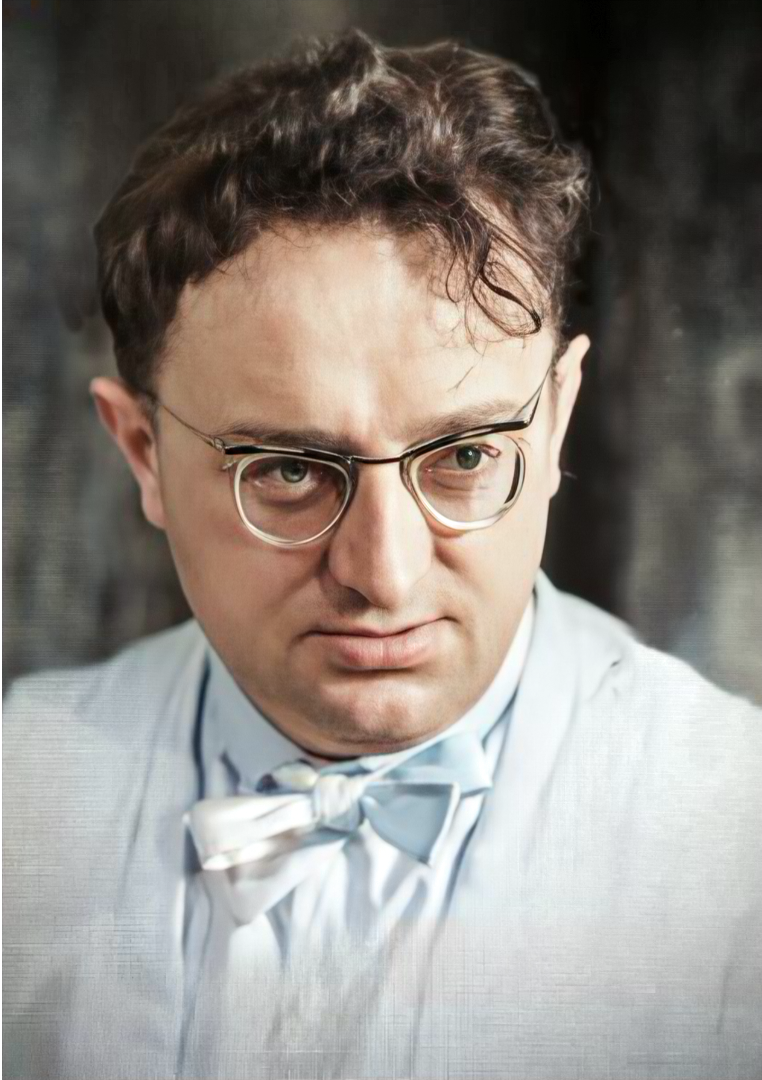
Mikhail Nosyrev, Voronezh, 1978. (colourised)