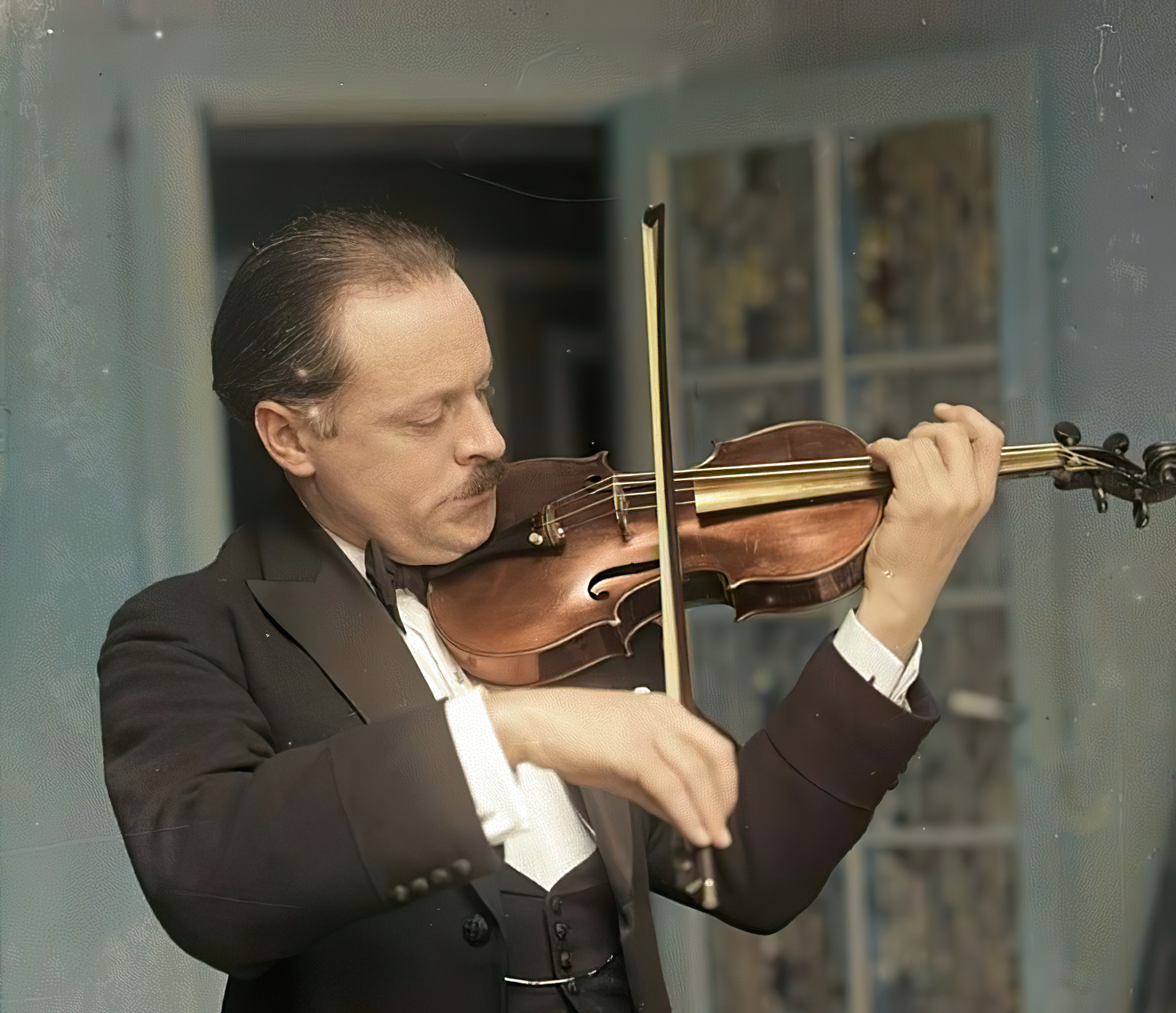



Maurice Hewitt
Maurice Hewitt (1884–1971) was a French violinist, conductor and teacher. He spent almost two decades as the second violinist in the Capet Quartet, widely regarded as one of the most admired string quartets of the early twentieth century. Following the quartet's dissolution upon the death of Lucien Capet in 1928, Hewitt taught in the United States, formed a string quartet under his own name, and established a chamber orchestra. During the German occupation of France, the orchestra recorded Rameau's works in an effort to promote French cultural heritage. At the same time, Hewitt worked for the Resistance as part of the Jean-Marie group, which was connected to the British Special Operations Executive's 'Buckmaster' network. He sheltered Allied airmen and helped them escape. He was denounced and arrested in November 1943 and, in January 1944, aged 59, he was deported to the Buchenwald concentration camp. While in the camp, he obtained a violin with the help of the prisoners' clandestine organisation and formed a string quartet. He gave concerts in the barracks. He was among the first French prisoners to be flown home after the camp's liberation in April 1945. Upon his return, he rebuilt his orchestra and quartet. He continued to perform and teach until retiring in the mid-1950s.
The Capet Quartet
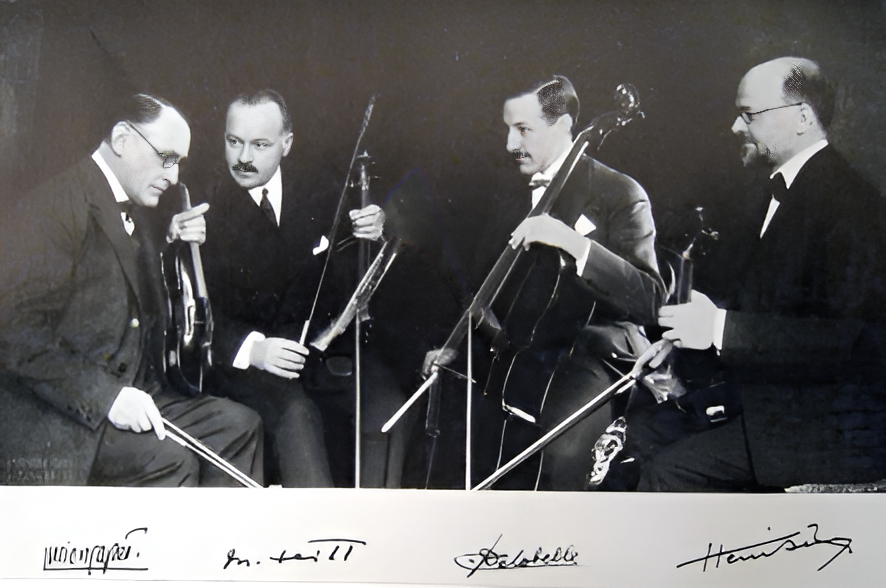
Lucien Capet (1873–1928) – First violin and founder of the ensemble, famous for his pioneering work on classical bow technique (Technique Supérieure de l'Archet), Maurice Hewitt (1884–1972) – Second violin, Camille Delobelle – Cello and Henri Benoît – Viola.
Hewitt was born on 6 October 1884 in Asnières (now Asnières-sur-Seine), a town near Paris. After studying the violin at the Paris Conservatoire, he worked as a violinist in early music ensembles before joining the quartet led by the violinist and teacher Lucien Capet. Sources provide different dates for his membership, but according to the music critic Jonathan Woolf, he played second violin from 1909 until the quartet's dissolution in 1928, with an interruption during the First World War.
The Capet Quartet was renowned for its cohesion and restrained use of vibrato, which later listeners regarded as austere. However, the violinist and historian Boris Schwarz, who heard the quartet play, believed that long passages without vibrato were rare and that the ensemble's strength lay elsewhere,
'The secret of the Capet Quartet was that each member had fully absorbed Capet's technical and musical approach. Their unanimity of technique, sound, and musical concept was unsurpassed. They spoke through one voice – that of Capet.'
Hewitt himself wrote an account to Ivan Mahaim, an author specialising in Beethoven's late quartets, of one of the quartet's best-known private performances. In the days leading up to Sunday, 13 April 1913, the Countess Joachim Murat informed Capet that she had had a disagreement with Felix Weingartner, the conductor who was in Paris at the time to perform Beethoven's nine symphonies. Weingartner believed that Beethoven had made a mistake by writing the 'Große Fuge' for string quartet rather than orchestra. The Countess invited a select audience and arranged for the quartet to begin playing Beethoven's quartet (in Hewitt's numbering, the 'Eighteenth') followed by the 'Grosse Fuge' as the guests moved into her salon, without warning. According to Hewitt, Weingartner listened with his head in his hands and, at the end, went straight to Capet.
'You are a sublime interpreter of Beethoven. You have, in addition, demonstrated my error to me… Beethoven was right. It is I who am wrong. The Great Fugue is right for a string quartet, but not for an orchestra. When I return to Vienna, I will write an article officially proclaiming my error.'
The evening went as planned, and Weingartner kept his word.
The First World War broke up the ensemble. Soon after, the cellist Marcel Casadesus enlisted in the French army and was killed in action in Pas-de-Calais on 10 October. The violist Henri Casadesus then left to focus on the Société des Instruments Anciens, which he had founded. This left Capet and Hewitt as the only remaining members of the ensemble. Capet increasingly devoted himself to teaching, taking a chamber music class and becoming an assistant professor in Henri Berthelier's violin studio.
In 1919, Capet formed a new quartet with Hewitt returning as second violin, Benoît on viola, and Delobelle on cello. The quartet recorded string quartets by Beethoven, Debussy and Ravel, and it is these recordings that have ensured Hewitt's legacy. From late 1927 to late 1928, the quartet was busy with concerts, teaching and recording. Columbia Records wanted to record the complete Beethoven cycle with the quartet, and they were still fulfilling engagements in Bonn. However, on 17 December 1928, Capet died eighteen days after his last concert in Brussels, having initially seemed to have only a minor cold. He was buried in the Batignolles Cemetery in Paris. As subscription concerts had been intended to cover the cost of his Guadagnini violin, purchased only eighteen months earlier, his widow Martha was forced to return the instrument. Hewitt attempted to keep the quartet together in order to honour its concert and recording commitments. However, as Schwarz notes, 'as soon as he died, the quartet fell apart'.
Teaching, the Hewitt Quartet and the Chamber Orchestra
In 1930 Hewitt went to the United States, where he taught in Cleveland. He returned to France four years later and became professor of violin at the American Academy near Paris. He also formed the Hewitt String Quartet, which was active before and after the Second World War.
In either 1939 or 1941 (the sources disagree) Hewitt founded the Hewitt Chamber Orchestra. Its repertoire concentrated on French Baroque composers, including Couperin, Corrette and Rameau and music of the court of Versailles, alongside Handel, Mozart and Schubert. During the Occupation the orchestra recorded Rameau, which Daisy Fancourt, writing for Music and the Holocaust, describes as part of an effort to promote France's cultural heritage. Selections from Rameau's opera-ballet Les Indes galantes were recorded in 1942 and released in 1943, with the singers Irène Joachim, Camille Maurane and Raymond Malvasio. In 1941 the orchestra recorded Mozart's Clarinet Concerto in A major, K. 622, with the clarinettist François Étienne for the label Les Discophiles Français (DF 7–10). The recording remained the standard version for many years, and Étienne re-recorded the work in 1953. Étienne played in the orchestra from 1942 to 1944. Hewitt also recorded with the Pasquier String Trio.
Resistance and Arrest
While working openly as a conductor, Hewitt joined the Jean-Marie resistance group, which was affiliated with the "Buckmaster" network, the French section of the British Special Operations Executive (SOE), named after its head Maurice Buckmaster. The network was dedicated to sabotage, propaganda and escape routes. Hewitt sheltered American paratroopers and provided them with false papers; according to Fancourt, the organisation helped Allied pilots escape into Spain.
He was denounced and arrested on 29 November 1943. After imprisonment at Fresnes and then at the Compiègne transit camp, he was deported on convoy I.173, which left Compiègne on 27 January 1944. He arrived at Buchenwald on 29 January 1944 and was registered as prisoner number 44007.
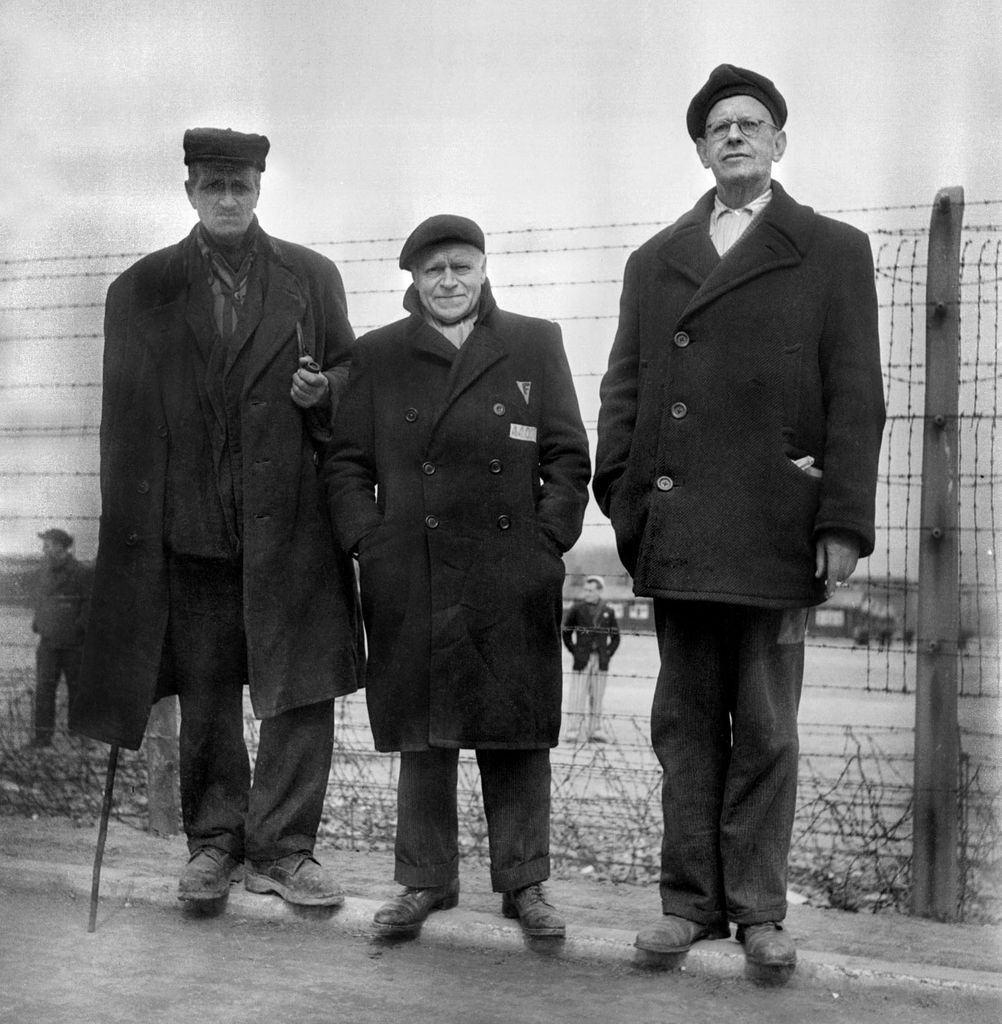
Maurice Hewitt (centre) Charles Sander (right) and Tex (left) after liberation from Buchenwald, April 1945. Éric Schwab, Agence France-Presse.
Buchenwald, near Weimar, was built from July 1937. Between 239,000 and 250,000 people were imprisoned there before its liberation, and about 56,000 died, among them 11,000 Jews. Music was a regular part of camp routine. One survivor recalled that "the SS broadcast over the loudspeakers … the music and compositions of Zarah Leander", while the prisoners' camp orchestra played martial music in the central square, morning and night, during roll calls and as work details left and returned.
Hewitt was assigned to the "socks" Kommando, which repaired prisoners' clothing. Through the solidarity networks inside the camp he obtained a violin and, with Czech prisoners, formed a string quartet that included Gustav Wegerer, the Kapo of the Pathology Block. The quartet gave concerts in several barracks, including a private concert on 1 May 1944. The French writer and former Buchenwald prisoner Pierre Durand wrote: "It was thanks to the clandestine organization […] that a violinist as talented as Hewitt was able to give concerts in certain blocks. Yes, indeed! Concerts in Buchenwald…" A survivor's account preserved on the Music and the Holocaust website places Hewitt's classical concerts at night in the attic of the Effektenkammer, the camp's store for prisoners' confiscated belongings, alongside the jazz played by Jiří Žák's band. A handwritten programme of a concert given by the Hewitt Quartet in Buchenwald in 1944 survives and was reproduced on the back of the booklet of a 2006 CD reissue of his recordings.
In the camp Hewitt befriended Maurice Braun, head of the Publican resistance network. After the war Braun married the pianist Agnelle Bundervoët, with whom Hewitt had performed.
Liberation and Return
In the first days of April 1945, as American forces approached, the SS evacuated thousands of prisoners from Buchenwald and its subcamps on forced marches towards Dachau and Flossenbürg, during which many died. On 11 April the International Committee, a clandestine organisation formed by prisoners in August 1943 that had obtained and hidden weapons, ordered an uprising, and the camp was liberated the same day by units of General Patton's US Third Army.
After the liberation, Hewitt played for the 21,000 survivors at the first official Mass in the camp, celebrated by the Belgian priest Leloir. A photograph in the Buchenwald Memorial archive shows him, in the centre of a group of three liberated French prisoners, in front of the camp fence. On 18 April 1945 he was photographed, carrying a bag, on arrival at Le Bourget airport near Paris with the first group of French prisoners flown home from Buchenwald, alongside Frédéric-Henri Manhès, Julien Cain, Alfred Smoular, André Challe, Jean Gandrey-Rety and Marcel Paul. Fancourt records that, after his release, Hewitt conducted Fauré's Requiem in his prison clothes in commemoration of French citizens who had died in the camps.
After the war Hewitt re-formed his chamber orchestra and his string quartet and continued to perform and record. In 1952 he recorded Rameau's Six Concerts en sextuor for Les Discophiles Français (catalogue number DF 1). The orchestra recorded a wide repertoire for the label, and many of these recordings were issued on long-playing records. Releases credited to the Hewitt Orchestra and issued in 1953–54 include:
- Schubert's Symphonies No. 8 in B minor ("Unfinished") and No. 4 in C minor ("Tragic")
- Bach's Orchestral Suites No. 1 in C major and No. 2 in B minor, with the flautist Jean-Pierre Rampal
- Mozart's Clarinet Concerto with François Étienne, coupled with the Clarinet Quintet, K. 581, with the Végh Quartet
- Mozart's Twelve Minuets (K. 599, 601 and 604) and Eine kleine Nachtmusik
- Handel's complete Water Music
Reviewing the 2006 Cascavelle reissue of these and the 1942 Indes galantes recordings, Jonathan Woolf noted Hewitt's "broad and romantic phrasing" and described the performances as "an index of Hewitt's affectionate identification with Rameau's scores". Hewitt resigned his professorship in 1955, on reaching the age of seventy. He was married to the pianist Simone Tilliard, a childhood friend of Francis Poulenc and the dedicatee of Poulenc's Sonata for piano four hands (1918) and of the song "L'Espionne" from his Calligrammes. Maurice Hewitt died on 7 November 1971 in Créteil, Val-de-Marne.
Music and the Holocaust, October 2026
Sources
Association Française Buchenwald, Dora et Kommandos. "Maurice Hewitt (1884–1971)." Excerpt from Buchenwald par ses témoins: Histoire et dictionnaire du camp de concentration de Buchenwald-Dora et de ses kommandos (1937–1945). Paris: Belin, 2014. asso-buchenwald-dora.com/maurice-hewitt-1884-1971/ (accessed 14 October 2026).
Buchenwald Memorial. "Portrait of three liberated French prisoners in front of the camp fence." Photo archive, item 5731. fotoarchiv.buchenwald.de/detail/5731 (accessed 14 October 2026).
Buchenwald Memorial. "Arrival of the first group of French prisoners from the liberated Buchenwald concentration camp at Le Bourget Airport, 18 April 1945." Photo archive, item 3414. fotoarchiv.buchenwald.de/detail/3414 (accessed 14 October 2026).
"Agnelle Bundervoët at 100." The Piano Files. www.thepianofiles.com/agnelle-bundervoet-at-100/ (accessed 14 October 2026).
Discogs. "Collection des Discophiles Français." Label page. www.discogs.com/label/832353-Collection-Des-Discophiles-Fran%C3%A7ais (accessed 14 October 2026).
Fancourt, Daisy. "The Paris Conservatoire." Music and the Holocaust. World ORT. holocaustmusic.ort.org/resistance-and-exile/french-resistance/the-paris-conservatoire/ (accessed 14 October 2026).
"François Etienne, clarinettiste et éminent musicien." Musimem. www.musimem.com/Etienne.htm (accessed 14 October 2026).
Johnson, Kelley Marie. "Lucien Capet: Comparisons and Connections to Contemporary Violin Bowing Technique." Doctoral dissertation, University of Iowa, 2010. ProQuest Dissertations & Theses (3461392). www.proquest.com/openview/ea2974352f06814de6da23dc0ffb815a/1 (accessed 14 October 2026). Includes Maurice Hewitt's account written to Ivan Mahaim.
"Maurice Hewitt." OPUSCLAM. opusclam.com/db/person-view (accessed 14 October 2026).
"Music in the Buchenwald Concentration Camp." Music and the Holocaust. World ORT. holocaustmusic.ort.org/places/camps/central-europe/buchenwald/ (accessed 14 October 2026).
Schwarz, Boris. Great Masters of the Violin. New York: Simon & Schuster, 1983, p. 372.
"Tilliard." The Encyclopedia of French Art Song. RILM. rme.rilm.org/articles/fas03021/1.0/fas03021 (accessed 14 October 2026).
Woolf, Jonathan. Review of Rameau: Six Concerts en sextuor; Les Indes galantes (excerpts), Maurice Hewitt Chamber Orchestra (Cascavelle VEL 3092). MusicWeb International, September 2006. www.musicweb-international.com/classrev/2006/Sept06/Rameau_VEL3092.htm (accessed 14 October 2026).