




A Vanished (Musical) World
David Schor, Joel Engel, and Eastern-European Jewish Music Before the Holocaust
In museums, Roman Vishniac's seminal photographs of Eastern European Jewry often evoke a profound sense of cultural absence. Vishniac's A Vanished World preserved visual evidence of communities that Nazism destroyed, vividly capturing the “brilliant minds, sterling souls, and wonder-filled children’s eyes” Grossman described in the context of Treblinka two decades later.[1] As evidenced by the vibrancy of Jewish cultural life today and preserved in exile archives like YIVO, Jewish culture in Eastern Europe was also preserved in affective documents including literature, religious texts, and song. Composers, performers, cantors, theater musicians, and songwriters created a rich musical world often preserving fragments of melody, ensemble traditions, and virtuosity. Within this prewar culture, histories of Jewish music often focus on internationally famous composers, performers, or pedagogues such as Ernest Bloch, David Schor, Lazare Saminsky, Alexander Krein, and Mikhail Gnesin. Equally important are composers and musicologists like the foundational Abraham Zvi Idelsohn, Joel Engel, and Moshe Beregovski who articulated musical traditions of Jewish communities in the Russian and Soviet empires and beyond in a Western art music tradition. Like the communities Vishniac photographed, much of their musical world survives only in fragments, archives, and scattered memories. Significant recent scholarship from the last thirty years has helped to preserve existing collections, compile family archives into largely diasporic holdings in the USA and Israel, and begin publishing and recording lost or overlooked scores.
No figure better illustrates the transnational dimensions of Jewish musical preservation than Abraham Zvi Idelsohn. Born in the Russian Empire and later active in Jerusalem, Idelsohn devoted his career to documenting the musical traditions of Jewish communities from across the Jewish world. Idelsohn pursued a far more expansive vision than exclusively the folk traditions of Eastern European Jewry. He collected and transcribed melodies from Yemenite, Persian, Bukharan, Sephardic, and Ashkenazic communities, seeking to identify common elements that might reveal a shared musical heritage. His monumental Thesaurus of Hebrew Oriental Melodies remains one of the foundational achievements of Jewish musicology.
Idelsohn's work also reflected the changing geography of Jewish cultural life in the early twentieth century. Idelsohn conducted much of his work in Ottoman and later Mandatory Palestine, not exclusively working in Moscow, St. Petersburg, Warsaw, or Vilna. He therefore stands at the intersection of two historical processes: the preservation of diasporic musical traditions and the creation of new Jewish cultural institutions in Palestine. In this respect, he anticipated many of the cultural questions that would shape Jewish musical life throughout the twentieth century. His scholarship transformed local and communal traditions into a documented historical record, ensuring that musical practices carried across continents would survive long after the communities that created them had changed or disappeared.
During the late nineteenth century, Russian, Czech, Hungarian, and other European composers increasingly drew upon folk traditions to construct national musical identities. Joel Engel argued that Jewish composers should undertake a similar project, and thusly occupies a central place in the history of modern Jewish art music. Born in Berdyansk in 1868, Engel received a legal education before pursuing formal musical studies at the Moscow Conservatory. He eventually became one of the most influential advocates for a distinctly Jewish national style in concert music.[2] Contemporary scholars often describe him as the founding figure of the Jewish art music movement because he encouraged composers to treat Jewish folk melodies and liturgical traditions as sources for serious artistic composition.[3] He collected Yiddish folk songs, arranged traditional melodies, and encouraged younger composers to explore the musical traditions of Jewish communities throughout the Russian Empire.[4] His work helped inspire the Society for Jewish Folk Music in St. Petersburg, which became one of the most important institutions in the development of Jewish modernism.[5]
Engel's compositions reveal a dual commitment to preservation and transformation, infusing Jewish idioms, form, and even text into modern compositions. His arrangements of Yiddish folk songs elevated vernacular materials into concert repertory without stripping them of their expressive character. Engel’s most famous theatrical work was the music for S. An-sky's (pen name of Shalom Aronovich Rappoport) The Dybbuk, which fused folk and liturgical elements with contemporary compositional techniques.[6] The resulting score captured the mystical atmosphere of the play while recalling shtetl life with recognizable songs and musical gestures. Even today, The Dybbuk Suite remains one of the clearest musical expressions of prewar Eastern European Jewish culture.[7]
The significance of Engel’s work extended beyond musicological curiosity. He understood that Jewish folk song preserved a record of communal and religious life, carrying linguistic, religious, and social memories across generations. When he collected and arranged these songs, he effectively created a musical archive of Eastern European Jewish civilization, and naturally his compositions have been preserved across Western archives as an important point of reference for subsequent composers. For example, cantors or musicians caught in the violence of the Holocaust, Sovietization, and Gulag are occasionally traceable to melodies or fragments preserved in Engel’s compositions. Like Vishniac's poignant photographic mission both men recognized that a distinctive culture faced enormous pressures from modernization, migration, assimilation, and political upheaval and sought preservation through artistic documentation.
In the twentieth-century, Sovietization of the Russian Empire came with an ethnic reckoning of how to politically govern an enormous, contiguous empire comprised of distinct ethnicities in a new Socialist model without the “paternalism” of preceding Empires. Paralleling Soviet definitions of nationality, culture was wielded by the state to effectively promote Socialist messaging in formats intelligible to local populations through a series of “nativization” or korenisatsiya policies.[8] The role of scholars and artists studying the ethnicities of the USSR therefore became critically important to accurately collect and preserve regional cultures, but also to transform and homogenize populations into new Soviet citizens.
Within this early Soviet paradigm, Moshe Beregovski meticulously recorded, transcribed, and preserved Yiddish song and klezmer music. Unlike Engel who operated when Jewish folk music still circulated within relatively intact communities, Beregovski worked in a radically diminished and politically constrained environment in Soviet Ukraine, where Jewish musical life had already been fragmented by revolution, repression, and economic upheaval. In the incredible recovery, evacuation, and recording work of Anna Shternshis, she demonstrates that the archival record produced by Beregovski and his collaborators does not simply preserve “tradition” in an abstract sense. Rather, it captures songs shaped by persecution, migration, poverty, and ideological pressure, often recorded in conditions where informants themselves framed Jewish life as something already under threat or already lost. Together, Engel and Beregovski mark two temporal edges of the same world: Engel collected and transforms living repertoire at its height, while Beregovski preserved its remnants under conditions of cultural contraction and imminent disappearance.[9]
That broader culture included theater music, synagogue composition, educational repertoire, folk-song arrangements, salon pieces, and community performance traditions. Much of this repertory disappeared after the Holocaust. The destruction of Jewish populations in Poland, Lithuania, Ukraine, Belarus, and other regions eliminated the audiences, institutions, and performers that had sustained it. Postwar Soviet cultural policies further complicated preservation efforts. Migration dispersed surviving materials across continents. Archives fragmented, manuscripts vanished, and musical memory weakened of these communities.
Gnesin and Schor
Along with composers, performers, professors, and pedagogues also contribute to this preservation of a fleeting world. Pianist and professor David Schor is one such example of a foundational musician, impactful teacher, and émigré experience out of the Russian Empire, yet distinct from Holocaust narratives. The destruction of Jewish communities in Eastern Europe erased not only celebrated figures but also hundreds of local composers, conductors, educators, and performers whose work never entered the modern canon – for every Schor there are hundreds of students, dozens of impactful concerts or institutions with which he impacted or founded. Their music circulated within Jewish institutions, community ensembles, schools, theaters, and social organization, and many left behind manuscripts, published scores, or recordings that now survive only in specialized archives. Such personal and family archives illuminate the realities of Jewish musical professionalism at the turn of the century and into the interwar period. For example, Schor’s archive is preserved by the Blavatnik Foundation in New York, Vishniac’s photos are part of YIVO’s collections and the Magnes Collection at UC Berkeley, and Engel’s compositions can be found from Yad Vashem to the USHMM to Library of Congress, and much of Beregovski’s work has been duplicated to the collections of the USHMM from the Vernadsky library in Kiev.
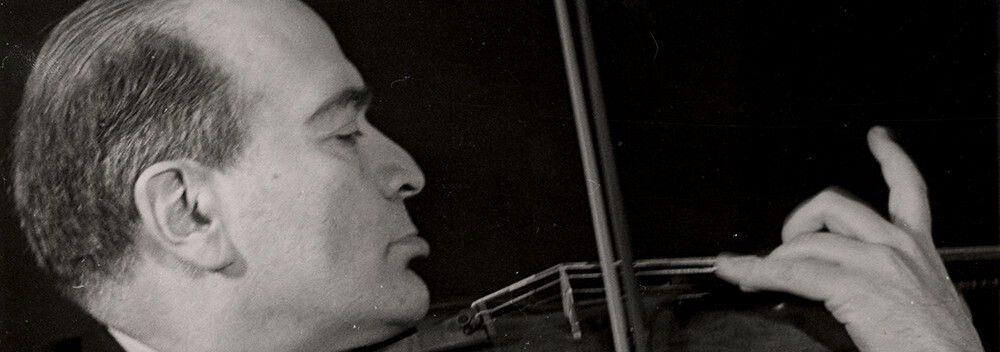
Portrait of Bronislaw Huberman. Photographer Roman Vishniac. Gift of Mara Vishniac Kohn.
Schor's career therefore provides an opportunity to examine the broader ecosystem of Jewish musical creativity during the early twentieth century. He represents a generation of musicians whose work connected local cultural life to larger currents of Jewish artistic expression. A comparable, but more recognizable figure to Schor is Mikhail Gnesin, most known internationally for his eponymous school from where musicians like Yevgeniy Kissin graduated. Despite different receptions, the two figures occupied comparable positions within the educational infrastructure of Jewish musical culture. Both belonged to a generation that understood composition and pedagogy as mutually reinforcing pursuits. Gnesin's influence extended through conservatory teaching and the training of younger musicians, while Schor's legacy appears rooted in the practical work of musical education and transmission and the foundation of the Moscow Trio, of which he was the pianist. Their careers remind us that the history of Jewish music was shaped not only by celebrated composers and virtuosi but also by teachers who cultivated musical literacy and sustained artistic communities across generations.
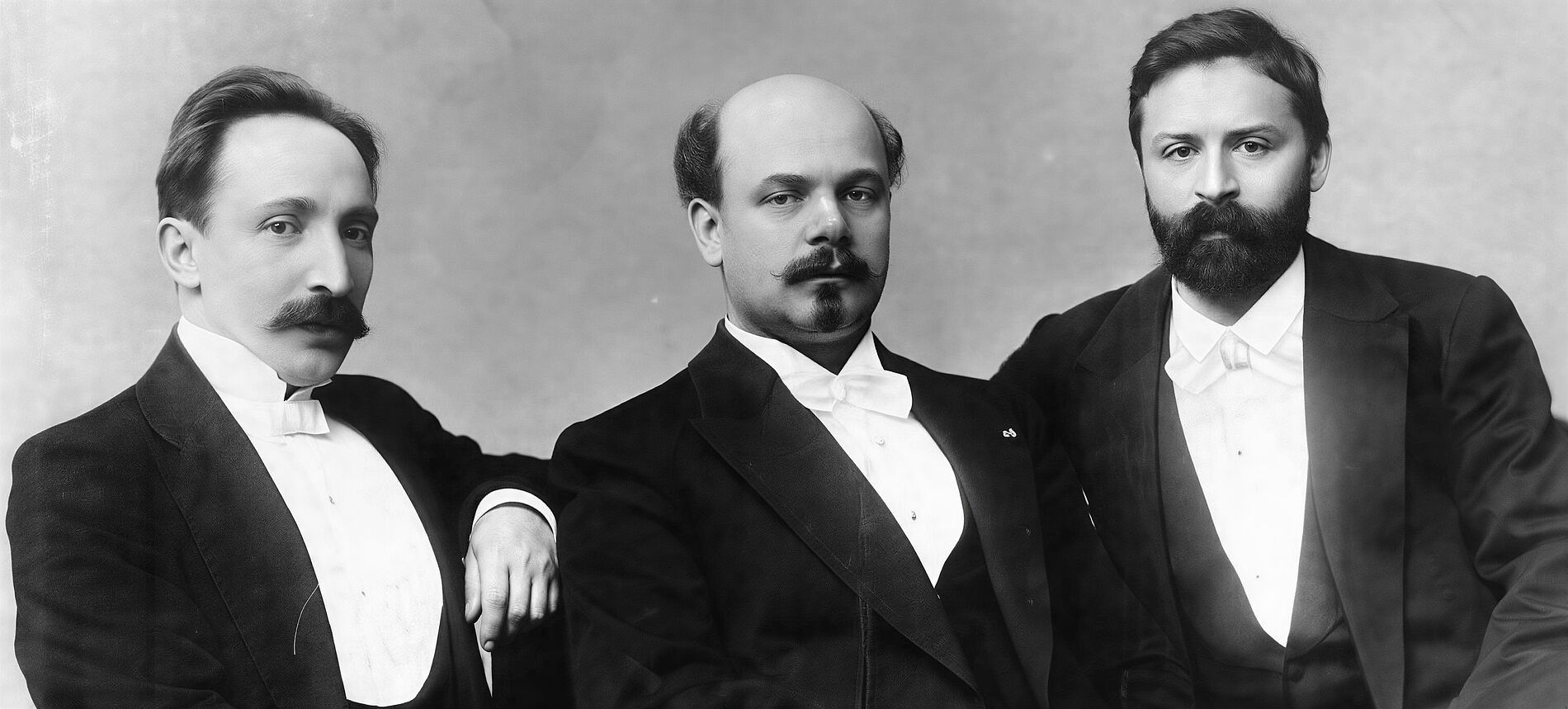
Musicians from Moscow trio: David Krein, Rudolf Ehrlich and David Schor
One of the most compelling contexts for Schor may be the broader migration of Jewish musicians from the Russian Empire to Palestine during the first half of the twentieth century. This movement included not only scholars like the aforementioned Abraham Zvi Idelsohn but also composers, cantors, educators, and performers who carried the musical traditions of Eastern Europe into a new cultural environment and were key to the creation of subsequent cultural institutions for the eventual state of Israel. Their migration transferred a substantial portion of Jewish musical life from the cities and towns of the former Pale of Settlement to Jerusalem, Tel Aviv, and other emerging centers. Seen from this perspective, Schor's relocation to Palestine places him within a larger history of cultural adaptability including the emigres of Central Europe directly fleeing the rise of National Socialism. These émigré musicians did not merely preserve inherited traditions. They adapted them to new institutions, audiences, and social realities. Schools, conservatories, choirs, and community organizations became vehicles through which Eastern European Jewish musical culture continued to evolve outside Europe. The world they documented largely vanished in its original setting, yet elements of its musical life survived through migration. Figures such as Idelsohn and Schor occupied a crucial position in that process, carrying fragments of one world into the construction of another. The archives that preserve their work today document not only loss, but continuity.
The history of Holocaust-era music from the former USSR is perhaps even more convoluted than in Western and Central Europe, complicated by Sovietization and displacement which continued long after the Second World War. Similarly, the “interwar” period of the West is extended in the Russian context with additional flashpoints of destruction including the Revolution, collectivization and Sovietization often with disastrous results and famine, the Soviet terror, and Soviet antisemitism which persisted after 1945 further suppressing the reception of Jewish and minority composers. Like Vishniac’s works which visually capture a vanished world, so to do composers, performers, and musicologists who documented fragments or captured a vanishing world of Jewish professionalism, excellence, and virtuosity between 1880 and 1939. Their histories intersect with larger narratives of flight and cultural preservation in the first half of the twentieth century. Finally, what is extremely compelling and worth further research with new digitized collections, is research off the page of the musical score, in the personal archives of performers like Schor to better understand musical networks, daily realities, experiences of emigration, and the impact of lesser-known individuals to Russian and Soviet Jewish musical culture.
Alexandra Birch, June 2026
Sources
[1] Vasily Grossman, The Hell of Treblinka (Moscow: Foreign Languages Publishing House, 1946), 29.
[2] Albert Weisser, The Modern Renaissance of Jewish Music (New York: Da Capo Press, 1986), 15-29.
[3] Irene Heskes, The St. Petersburg Society for Jewish Folk Music (New York: Tara Publications, 1993), 11-25.
[4] Joel Engel, Jewish Folksongs, vols. 1-2 (St. Petersburg: Society for Jewish Folk Music, 1909-1912).
[5] Heskes, The St. Petersburg Society for Jewish Folk Music, 33-56.
[6] Gabriella Safran, Wandering Soul: The Dybbuk's Creator, S. An-sky (Cambridge, MA: Harvard University Press, 2010), 248-255.
[7] "Joel Engel," Pro Musica Hebraica, accessed June 1, 2026, Pro Musica Hebraica composer profile.
[8] Marina Frolova-Walker, Russian Music and Nationalism: From Glinka to Stalin (New Haven: Yale University Press, 2007), 301-316.
[9] Anna Shternshis and Psoy Korolenko, “Yiddish Glory: A Singing Archive of Jewish History,” Philosophical Letters: Russian-European Dialogue 3, no. 3 (2020): 192–215.
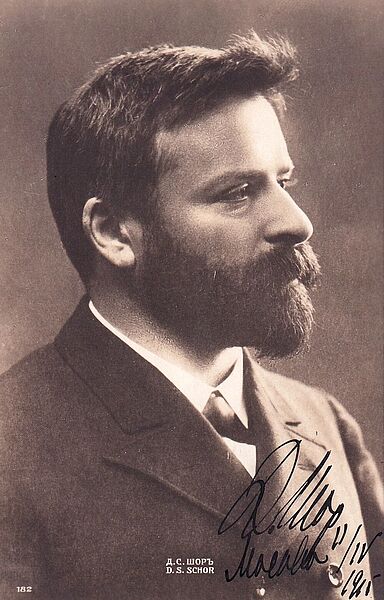
David Schor
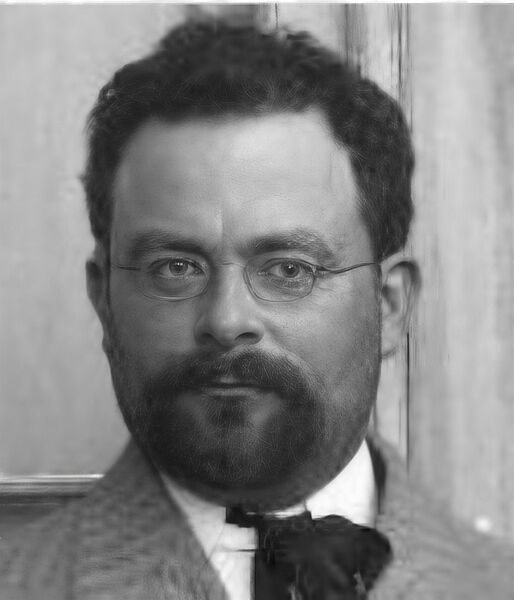
Abraham Zevi Idelsohn
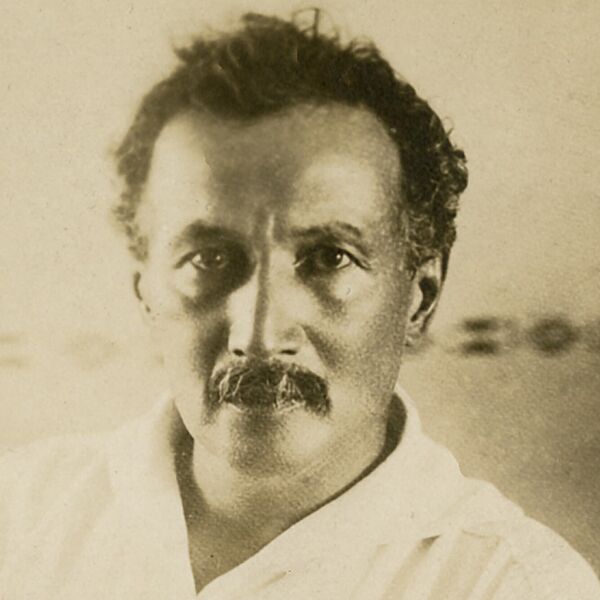
Joel Engel