



Hermann Ludwig Schlesinger
A Musician's Flight from Nazi Germany
Conductor, pianist and composer Hermann Ludwig Schlesinger left Germany in 1937 on a fortuitous Argentine tour after which he remained in Buenos Aires working as a conductor at the Jewish Theatre there. He was born in Berlin on January 31, 1896, the youngest of four children of merchant Paul Schlesinger and his wife Julie Eugenie Schlesinger, née Loewenbach. He had three older siblings: Walter Georg, Gertrud, and Ernst Ludwig, all born in Berlin between 1884 and 1890.
Schlesinger completed his secondary education at the Friedrichs-Gymnasium in Berlin before enrolling at the Stern'sches Konservatorium in 1918. Over the next five years, he studied piano with Walther Carl Meissner, orchestral conducting with Felix Robert Mendelssohn, and music theory with Georg Schünemann. While studying, he also taught piano at the conservatory from 1921 to 1923.
Schlesinger adopted the stage name Hermann Ludwig around 1919. Either in 1919 or 1920, he first conducted the Blüthner-Orchester in Berlin, an ensemble founded in 1907 and sponsored by the piano manufacturer of the same name. Klaus Pringsheim, musical director of the Berlin Reinhardt theatres, engaged him as conductor. From 1923 to 1925, Schlesinger also conducted the orchestra at the Grosses Schauspielhaus in Berlin.
In 1925, Schlesinger moved to the Münchener Volkstheater, where he remained until 1928. During this period, he also worked for two years at the Munich UFA studios. He returned to Berlin in 1928 and conducted the orchestra at the UFA-Palast am Zoo until 1930, a major cinema owned by Universum Film AG where significant German film premieres took place.
Schlesinger discovered film composition during this period. He wrote music for and conducted the orchestra in the documentary "Emden III fährt um die Welt. Ein 'Seetörn' in einem Vorspiel und sieben Etappen," directed by Ernst Angel. The following year, he composed the score for the silent film "Andreas Hofer," directed by Hanns Prechtl. In 1930, he returned to Munich, where his contract with the Münchener Volkstheater was renewed. He also conducted the chamber orchestra of Bavarian Radio and the orchestra for the film "Peter Voss, der Millionendieb," directed by André Dupont, produced by Münchner Lichtspielkunst AG.
After the Nazis seized power in early 1933, Schlesinger was no longer permitted to use his stage name. In May or June 1934, loud protests erupted against the conductor, and he was dismissed that same day. His salary was paid through the end of his contract on August 31, 1934.
Schlesinger could no longer find permanent employment and subsequently participated in events organized by Jewish cultural associations in Berlin, Danzig, Stettin, Breslau, Harzburg, and Cologne. He apparently returned to his hometown of Berlin, where he taught at the Jüdische private Musikschule Hollaender, which the heirs of the Stern'sches Konservatorium had founded on April 15, 1936, after its "Aryanization." During this time, he lived with the family of his sister Gertrud Fabian.
Schlesinger appeared in the 1938 publication by Hans Brückner and Maria Christa Rock, a dangerous list of Jewish musicians that became a dictionary. He also appeared in another antisemitic publication, "Lexikon der Juden in der Musik," compiled by Theo Stengel and Herbert Gerigk in 1940.
Departure from Germany
In September 1936, Bruno Arno engaged Hermann Ludwig as conductor for his ballet in Switzerland and the Netherlands. Schlesinger then moved to the Netherlands. On February 12, 1937, he signed what was presumably a sham six-month contract for a guest performance tour in Argentina with the Bruno Arno Ballet in connection with the Teatro Casino in Buenos Aires, which enabled him to leave Europe. He had to bear the costs of the journey himself, and there is no evidence of Ludwig's participation in the ballet performances.
He left the Netherlands, travelled to France, and boarded the ship Campana in Marseille on February 20, 1937. He arrived in Argentina (Buenos Aires) on March 11, 1937.
Behind him, Schlesinger left his family. His parents remained in Berlin, living at Sybelstrasse 6 in Berlin-Charlottenburg, where Hermann had spent his final days before departing.
From 1938 onward, Schlesinger worked as a conductor at the Jewish theatre (Ídisher Folks Teater). On June 24, 1938, he conducted the orchestra at the Lasalle Theatre for the production of "Boitre, the Robber," a play by Moyshe Kulbak directed by David Licht. This marked the beginning of the collaboration between David Licht and Ludwig, which would lead to many more productions.
On July 1, 1938, "Los amores del maestro compositor Franz Schubert" was performed at the Teatro Avenida in Buenos Aires. The orchestral arrangements were by Ludwig, who also conducted. As part of his work at the Ídisher Folks Teater, he founded and conducted a chamber orchestra of Austrian and German emigrants. He also worked with the Compañía de grandes espectáculos.
His arrival occurred during a dark period in Argentine immigration policy. On July 12, 1938, Minister of Foreign Affairs José María Cantilo signed the strictly confidential Circular 11, instructing Argentine consuls worldwide to deny visas to anyone considered undesirable or expelled from their country of origin. Diplomats understood this referred primarily to Jews expelled by the Nazis and Italian fascists. Decree 8972 of 1938 further restricted immigration, requiring foreigners to apply for landing permits at consulates with detailed personal information.
Presumably on the recommendation of director Max Wächter, whom he knew from the Ídisher Folks Teater, Schlesinger worked from 1939 as arranger and musical director for operetta galas and cabarets of the Deutschsprachige Bühne in Argentinien. During this time, he also set Yiddish texts by Itzik Manger, Menashe Varschavsky, and Yitskhok Perlov to music and composed several instrumental works. He appeared as an accompanist for song recitals from 1940. At the end of December 1941, he married Margarethe Goldfeld.
In 1942, Schlesinger began giving concerts within the framework of the Jüdische Kulturgemeinschaft, each with renowned soloists. When Jean Gilbert's "Dorine und der Zufall" (texts by Fritz Grünbaum and Wilhelm Sterk) was performed in 1943 at the Freie Deutsche Bühne directed by P. Walter Jacob, under the musical direction of Enrique Wolfgang Vacano, Ludwig took over the piano part.
The following year, he conducted a series of symphony concerts with works by Wolfgang Amadeus Mozart, Georg Friedrich Handel, Ludwig van Beethoven, Joseph Haydn, and Franz Schubert, also with outstanding soloists. Organist Julio Perceval was the soloist in a concert that Ludwig conducted in June 1944 in the prestigious Asociación Wagneriana. The following month, he conducted symphony concerts at the Teatro Gran Rex, with pianists including Alexander Borowsky and Nybia Mariño Bellini.
Ludwig's Post-war Years
After the end of World War II, Schlesinger, who adopted Argentine citizenship, remained in Argentina. In 1945, he participated in several productions, including Gioachino Rossini's "Barber of Seville" with the Gran compañía de comedias musicales. In April 1946, the Freie Deutsche Bühne performed "Ball im Savoy" by Paul Abraham, based on a libretto by Alfred Grünwald and Fritz Löhner-Beda. Ludwig held the musical direction for this and other productions and also went on tour with the ensemble.
In the 1950s, he conducted operettas at the Deutsche Bühne in Buenos Aires. He also continued to conduct chamber concerts for the Jüdische Kulturgemeinschaft and remained connected to Yiddish theatre. He conducted the orchestra at the Teatro Soleil, where actors such as Gitta Galina, Max Perlmann, and Maurice Schwartz (as a guest) performed. From 1951 to 1958, he was employed seasonally at the Teatro Soleil in Buenos Aires.
During his career, he made recordings for RCA Victor and radio recordings for Radio León. In addition to his musical activities, Ludwig wrote articles for the "Jüdische Wochenschau."
His theatrical music for Johann Wolfgang Goethe's "Urfaust," composed in 1964, was performed in May of that year during the state visit of Heinrich Lübke, the first official visit by a German head of state to Argentina.
In the mid-1950s, Schlesinger initiated compensation proceedings for himself and his mother. He applied for compensation for damage to property and for professional and economic advancement. For his mother, he could claim damage to freedom.
Almost his entire family perished in the Holocaust. On June 19, 1942, the Nazis entered the building at Sybelstrasse 6 in Berlin-Charlottenburg, where the Schlesinger family lived. His sister Gertrud died on June 17, 1942, at the Jüdisches Krankenhaus Berlin of a heart attack, likely upon learning of the deportation of her husband Kurt Fabian and their son Werner Israel Fabian. They were transported on June 24, 1942, to the Maly Trostenets concentration camp in Minsk, where they died between June and December of that year. Werner Israel, born in Berlin on September 29, 1914, had been—like his uncle Hermann—a music teacher and orchestra conductor.
Hermann's mother Eugenie died in Terezin in 1943, three months after being deported in October 1942. His brother Ernst Ludwig was declared dead on May 8, 1945. Ludwig lost his mother, his sister, his brother, and many of his nieces and nephews.
In 1960, his first wife died after almost ten years of illness. That same year, he married Erna Dreifuss.
Hermann Ludwig Schlesinger died in Buenos Aires on September 6, 1978.
On June 18, 2018, a memorial ceremony took place at Sybelstrasse 6 in Berlin-Charlottenburg. Thirteen Stolpersteine—commemorative brass plaques embedded in the sidewalk—were installed at the last residence of the Schlesinger family, placed by artist Gunter Demnig as part of his project to honour victims of National Socialism. Descendants and neighbours of the building contributed to the project.
Sources
Silvia Glocer, Hermann Ludwig:Un músico en el teatrom, Our Memory No. 40, November 2022
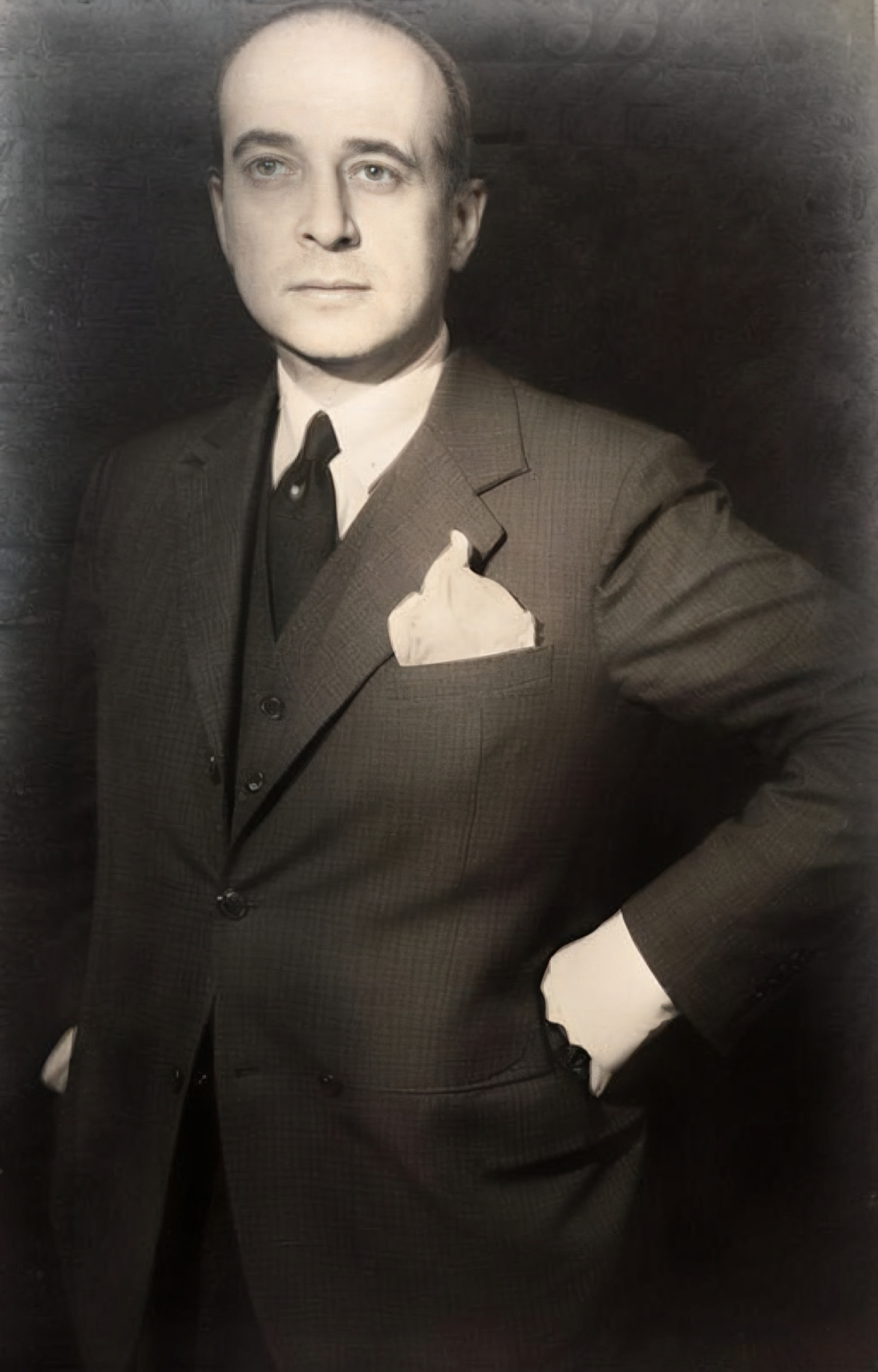
Herman Ludwig. LexM - University of Hamburg