




Choisel
Les 27 Otages, and Musical Resistance in Brittany
With the Nazi invasion of France in May of 1940, subsequent collapse of the Third Republic, and organization of the Vichy government under Marshal Philippe Pétain, Nazi authorities established dozens of temporary prisoner of war camps across occupied France to hold the hundreds of thousands of French and Allied soldiers captured in the campaign. In Châteaubriant, they concentrated prisoners at several sites, including the racetrack at Choisel. While German authorities initially controlled the camp, French officials and gendarmes increasingly assumed responsibility for its administration throughout the war. When the Germans transferred the remaining prisoners of war to Germany in January 1941, Choisel remained in operation, but its function changed fundamentally.[1] In regional memory, Choisel is primarily associated with the execution of 27 Resistance members at an adjacent quarry, but the legacy of the camp, of shifting priorities of internment and deportation, and of changing prisoner populations is reflective of larger systems of detention in occupied France.
After Pétain’s assumption of power in July 1940, his government moved rapidly against Communists, trade unionists, former Popular Front activists, and other political opponents. French authorities created internment camps for these groups and increasingly used administrative detention to suppress political opposition. Choisel became one of these sites. During the first months of 1941, the authorities confined several different populations there, including nomadic families and common-law prisoners. Beginning in April of 1941, they brought political prisoners into the camp. Communist militants, trade unionists, and former Popular Front activists arrived from prisons and other internment sites throughout the spring and summer of 1941, gradually transforming Choisel into a predominantly political camp. By October, approximately six hundred prisoners lived there.[2]
Within Choisel, the political prisoners quickly developed a substantial communal life within the camp. They organized classes, taught languages, cultivated gardens, staged theatrical performances, and created musical ensembles. Music occupied a place within this larger effort to preserve intellectual and social life under internment. Prisoners formed choirs, organized singers and “bigophone” ensembles, and incorporated music into the camp's Sunday entertainments. These activities did not initially constitute a distinct musical response to persecution. Rather, they belonged to the everyday cultural practices through which prisoners maintained relationships, political identities, and a degree of autonomy within a system designed to isolate and control them.[3]
The meaning of this cultural life changed as the occupation grew more violent. Following the German invasion of the Soviet Union in June 1941, the French Communist Party intensified its armed resistance against the occupation, and German authorities responded with increasingly systematic reprisals against political prisoners. On August 21, a Communist militant assassinated a German officer in Paris, prompting the occupation authorities to develop a policy of hostage executions. When Communist Resistance fighters killed Lieutenant Colonel Karl Hotz, the German military commander in Nantes, on October 20 1941 , German authorities demanded a major reprisal. Vichy officials provided lists of political prisoners from which the Germans selected hostages. On October 22, German soldiers entered Choisel and removed twenty-seven prisoners, accused of Communist and resistance activity. They gathered these 27 prisoners (Les Otages) in a barracks and gave them time to write their final letters before transporting them to the nearby quarry at La Sablière where they were all executed between 3:50 and 4:10 that afternoon. Among them was seventeen-year-old Guy Môquet whose final touching letter to his mother and sympathetic age and resilience contributed to his particular and poignant recognition among the entire group. In addition to the regional history surrounding their murder and the significance of Choisel to the resistance, the execution of Les Otages is also musically notable, and again an indication of activities and musical resistance in other camps.[4]
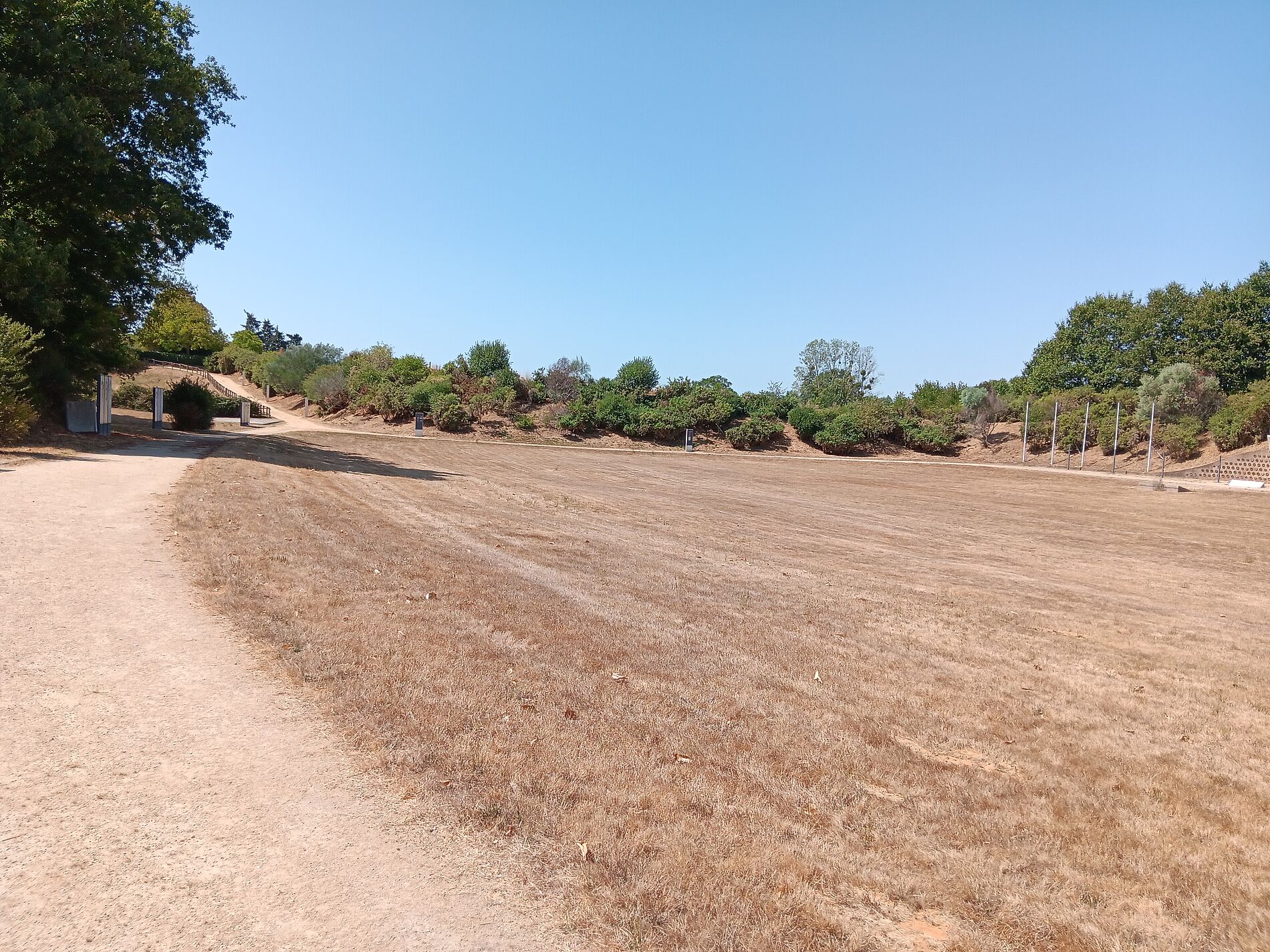
A view of the quarry where the 27 were executed, from the path which leads to it. Alexandra Birch.
The executions at Châteaubriant on 22 October 1941 transformed the musical life of the Choisel camp from a practice of collective culture into an unmistakable act of resistance. First, the condemned men were gathered in a barracks on the afternoon of 22 October, and given time to write final letters to their families. A January 1942 report prepared for Interior Minister Pierre Pucheu provides one of the most detailed contemporary accounts of what followed. As the prisoners left the barracks, they sang La Marseillaise and L’Internationale, and prisoners throughout the camp took up the songs. The twenty-seven then passed between two lines of French gendarmes before being loaded into three German trucks. The singing did not stop at the camp gates. According to the report, the prisoners continued to sing as they were taken toward the quarry at La Sablière, where they were to be executed.[5] A later account by Bernard Le Cornu, the subprefect of Châteaubriant, preserves a more extensive repertoire, recalling that the prisoners sang L’Internationale, Le Chant du Départ, and La Marseillaise throughout the journey and shouted “Vive la France!” before each volley.[6] The sequence is corroborated by testimony from within the camp. One surviving account describes the first sound of La Marseillaise rising from the condemned prisoners as the German trucks approached, followed by the prisoners in the camp taking up the song. As the three groups of nine men climbed into the trucks, they continued singing and gestured farewell to those watching from the barracks. When the convoy finally left Choisel, the voices remained audible along the road beside the camp.[7] A local witness, Pierre Martin, later recalled hearing La Marseillaise from behind the closed canvas of the trucks as they passed through the town, an especially striking testimony because the song had been forbidden by the German occupation authorities. Another witness, Mme Robert, remembered hearing the same song from the covered trucks as they passed the Naudin farm beside the quarry, realizing from the singing that the German threat had become reality.[8] Sonically, the isolated quarry intended to hide the executions away from the camp would serve as a megaphone, amplifying the voices of Les Otages. At La Sablière, the twenty-seven prisoners were executed in three groups at 3:50, 4:00, and 4:10 p.m. Accounts differ somewhat in their recollection of the final repertoire, but they consistently describe the men singing La Marseillaise and refusing to submit silently to the firing squad. The musical response continued within Choisel after the trucks disappeared. The prisoners who remained behind had not merely heard their comrades sing; they had answered them, turning the song into a collective act that connected the condemned men to the wider camp.
This pattern reappeared less than two months later, when nine additional hostages were taken from Choisel on 15 December. Among them was Fernand Jacq, the physician and Communist activist who had helped organize the camp's Breton choir. As the nine men departed for their execution at La Blisière, prisoners at Choisel again sang La Marseillaise. Some then sang Bro Gozh ma Zadoù, the Breton national anthem, while others sang L’Internationale in Breton.[9] The repertoire now encompassed the French nation, Breton cultural identity, and international Communism, revealing the multiple political and cultural identities of prisoners. These aspects of musical resistance in Choisel reflect the multiplicities of experiences in resisting National Socialism in France and speak to the regional and personal subjectivities prisoners hoped to preserve of their own identity. In October, singing had accompanied the twenty-seven men out of Choisel and toward their deaths, in December, it accompanied Jacq and his fellow hostages while also invoking the regional musical culture he had helped cultivate inside the camp. Music therefore created continuity between everyday cultural life at Choisel and the extraordinary circumstances of political martyrdom, allowing prisoners to accompany one another across the physical boundaries of the camp and the final boundary between imprisonment and death.
Fernand Jacq and the Breton choir
Music did not disappear from Choisel after the executions of 22 October. On the contrary, the camp’s cultural life continued, and among its most active organizers was Fernand Jacq, a physician from Huelgoat and Communist militant who had been arrested on 3 July 1941 and interned in the political section of the camp. Jacq threw himself into the cultural life of Choisel, teaching Breton to his fellow prisoners and establishing a Breton choir.[10] His musical work formed part of the broader intellectual and cultural world that prisoners constructed inside Choisel, where education, language instruction, music, theater, and other collective activities allowed internees to maintain forms of social and intellectual life despite their confinement. Sunday entertainments included theater, bigophones, singers, choirs, and circus performances, suggesting that music was not an isolated activity but an established part of the camp’s communal life.[11] The Breton choir nevertheless carried a distinctive significance. Jacq was deeply rooted in Breton language and culture, and teaching and singing Breton inside a French internment camp created a space in which regional identity could persist alongside the political identities that had brought many prisoners to Choisel. The significance of that work became starkly apparent when Jacq himself was selected as one of nine hostages for execution at La Blisière on 15 December 1941. As the nine men were taken from the camp, the prisoners responded in song: La Marseillaise, followed by Bro Gozh ma Zadoù, the Breton national anthem, and L’Internationale in Breton.[12] The repertoire was therefore not incidental to Jacq’s story. The man who had established a Breton choir at Choisel was taken to his death while his fellow prisoners sang the Breton anthem and a Breton-language version of the international Communist hymn alongside the French national anthem. The episode connects the everyday musical culture Jacq had helped create with the increasingly explicit political meaning of music at Choisel after the October executions. The choir had not been created as a soundtrack for martyrdom. It belonged to the prisoners’ effort to preserve education, community, and cultural identity. Yet when one of its organizers was led to his death, the musical culture he had helped establish became a language through which those who remained could accompany him and assert identities that imprisonment had failed to erase.
The pattern established on 22 October with Les Otages was repeated on 15 December of the same year, when the Germans again removed hostages from Choisel for execution. This time nine prisoners were selected, including Fernand Jacq, and taken to La Blisière in the forest of Juigné, where they were shot that afternoon. As the prisoners departed, those remaining in the camp again responded collectively through song. They began with La Marseillaise, as they had when the twenty-seven left for La Sablière in October, but the repertoire then turned toward the musical identities cultivated within Choisel itself: some prisoners sang Bro Gozh ma Zadou, while others sang L’Internationale in Breton. The parallel is striking. In October, singing connected the twenty-seven condemned men to the wider camp; in December, it again transformed the departure of hostages into a collective act of solidarity. But the repertoire had also become more explicitly connected to Jacq’s own cultural work. The Breton choir he had established at Choisel now formed part of the musical response to his removal and execution.
Music after the executions
The musical life cultivated at Choisel did not end with the camp's closure in May 1942. As the authorities dispersed its prisoners to other internment sites, they carried with them the practices of collective cultural life that had developed during their confinement. Political prisoners from Choisel were transferred principally to Voves, while others went to Rouillé and Aincourt, linking the history of Choisel to a wider network of French internment camps.[13] At Voves, music became an established part of camp culture. Prisoners organized both a choir and an orchestra, directed by the musician Odilon Arrighi, while theatrical performances and other cultural activities continued alongside political organization and clandestine resistance. Rouillé likewise developed an orchestra and musical performances, demonstrating that organized music making was not unique to Choisel but part of a broader culture that political prisoners recreated wherever conditions permitted.[14] Music also retained its more explicitly political function as repression intensified. When twenty-eight prisoners were removed from Voves in May 1942, those who believed they were being taken to execution departed singing La Marseillaise, only to discover that they were being transferred to Compiègne.[15] Across these camps, music thus moved between education, entertainment, regional identity, political solidarity, and resistance. At Choisel, the Breton choir, bigophone society, and collective singing had helped prisoners construct a community under confinement. At Voves and Rouillé, similar practices acquired new forms as prisoners were transferred, regrouped, and increasingly subjected to deportation and execution.[16] Music offered no protection from these processes, but it provided a remarkably durable means of maintaining community across them. The songs, ensembles, and performances that survived from one camp to another reveal not a single repertoire of “resistance music,” but a mobile musical culture through which French political prisoners continued to teach, remember, organize, and resist.
Alexandra Birch, September 2026
Sources
[1]Ministère des Armées et des Anciens combattants, “22 octobre 1941. Les fusillés de Châteaubriant,” Chemins de mémoire, accessed August 22, 2026. Chemins de mémoire, “22 octobre 1941. Les fusillés de Châteaubriant”
[2] Ministère des Armées et des Anciens combattants, “22 octobre 1941. Les fusillés de Châteaubriant”; Fondation pour la Mémoire de la Déportation, “Châteaubriant,” Mémorial des camps, accessed August 22, 2026. Fondation pour la Mémoire de la Déportation, “Châteaubriant”
[3] Comité Départemental du Souvenir des Fusillés de Châteaubriant, Nantes et de la Résistance en Loire-Inférieure, “Le camp de Choisel–Châteaubriant,” accessed August 22, 2026. Comité Départemental du Souvenir, “Le camp de Choisel–Châteaubriant”
[4] Ministère des Armées et des Anciens combattants, “1941. La politique des otages en France occupée,” Chemins de mémoire, accessed August 22, 2026. Chemins de mémoire, “1941. La politique des otages en France occupée”
[5] Denis Peschanski and Thomas Fontaine, “1941. La politique des otages en France occupée,” Chemins de mémoire, Ministère des Armées et des Anciens combattants, accessed August 22, 2026. The article identifies the January 1942 report of the inspector general’s deputy of the administrative services to Pierre Pucheu and summarizes its account of the twenty-seven prisoners leaving Choisel singing La Marseillaise and L’Internationale. Chemins de mémoire: 1941. La politique des otages en France occupée
[6] Bernard Le Cornu, Un préfet sous l’Occupation allemande: Châteaubriant, Saint-Nazaire, Tulle (Paris: France-Empire, 1984). Le Cornu’s account, quoted by the French Ministry of the Armed Forces, records that the prisoners sang L’Internationale, Le Chant du Départ, and La Marseillaise during the journey to the execution site and shouted “Vive la France!” before the firing squads. Ministère des Armées, “La Marseillaise: a song of war, a song of freedom”
[7] Pierre Martin, “Les camions qui chantaient,” in Telles furent nos jeunes années, quoted in “L’Histoire de l’Amicale Laïque de Châteaubriant de 1939 à 1945,” Amicale Laïque de Châteaubriant, accessed August 22, 2026. Martin recalled hearing La Marseillaise from the covered trucks carrying the prisoners from Choisel. Amicale Laïque de Châteaubriant, “L’Histoire de l’Amicale Laïque de Châteaubriant de 1939 à 1945”
[8] J.-M. Durand-Souffland, “À qui appartiennent les fusillés de Châteaubriant?” Le Monde, October 16, 1981. The article preserves the recollection of Mme Robert, who heard men singing La Marseillaise from behind the canvas of the first truck as it passed the Naudin farm near La Sablière. Le Monde, “À qui appartiennent les fusillés de Châteaubriant?”
[9] Archives départementales du Finistère, “Concours National de la Résistance et de la Déportation: Dossier Fernand Jacq,” accessed August 22, 2026. The dossier cites an account in Cameroun libre describing the singing of La Marseillaise, Bro Gozh ma Zadoù, and L’Internationale in Breton when the nine Choisel prisoners departed for execution at La Blisière on December 15, 1941. Archives départementales du Finistère, Dossier Fernand Jacq.
[10] Archives départementales du Finistère, “Concours National de la Résistance et de la Déportation: Dossier Fernand Jacq,” 1 J 448, accessed August 22, 2026. Archives départementales du Finistère, Dossier Fernand Jacq.
[11] Comité Départemental du Souvenir des Fusillés de Châteaubriant, Nantes et de la Résistance en Loire-Inférieure, “Le camp de Choisel–Châteaubriant,” accessed August 22, 2026. Comité Départemental du Souvenir, Le camp de Choisel–Châteaubriant.
[12] Archives départementales du Finistère, “Dossier Fernand Jacq,” 1 J 448. The archival dossier reproduces an account from Cameroun libre describing the singing of La Marseillaise, Bro Gozh ma Zadoù, and L’Internationale in Breton as the nine hostages departed Choisel for La Blisière. See also Joris Brouard, “Fernand Jacq,” Musée de la Résistance en ligne, which identifies the Archives départementales du Finistère, 1 J 448, as its principal source. Musée de la Résistance en ligne, “Fernand Jacq”
[13] Ministère des Armées, “22 octobre 1941. Les fusillés de Châteaubriant,” Chemins de mémoire. The page documents the transfer of Choisel's prisoners to Voves, Aincourt, and other camps following the closure of Choisel in May 1942. Chemins de mémoire, “22 octobre 1941. Les fusillés de Châteaubriant”
[14] Musée de la Résistance de Châteaubriant, Résister par l'art et la culture, panneau 12, exhibition text. The exhibition discusses the musical activities of the internment camps, including choirs, orchestras, and musical parades, and identifies Odilon Arrighi's orchestra at Voves and an orchestra at Rouillé. Musée de la Résistance de Châteaubriant, “Résister par l'art et la culture”
[15] Mémoire Vive, “Maurice Bertouille – 45233,” accessed August 22, 2026. The biographical dossier records the May 20, 1942 transfer from Voves and the prisoners' singing of La Marseillaise when they believed they were being taken to execution. Mémoire Vive, “Maurice Bertouille”
[16] Amicale de Châteaubriant-Voves-Rouillé-Aincourt, “Une émouvante cérémonie au camp de Voves,” May 14, 2023. The Amicale's account identifies an orchestra, theater troupe, choir, university, and sporting activities at Voves. Amicale de Châteaubriant, “Une émouvante cérémonie au camp de Voves”
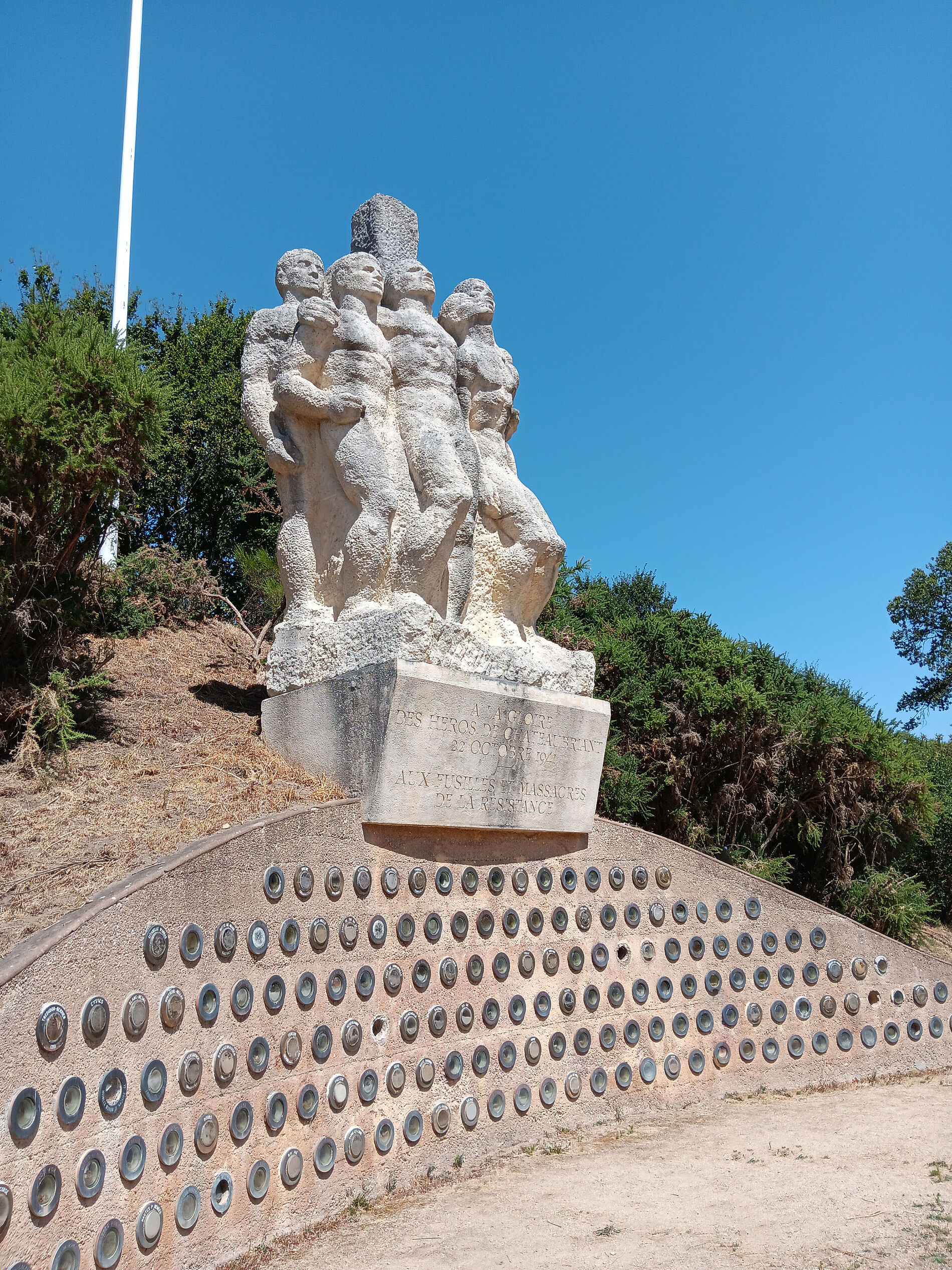
The official memorial within the quarry at the execution site. Alexandra Birch.