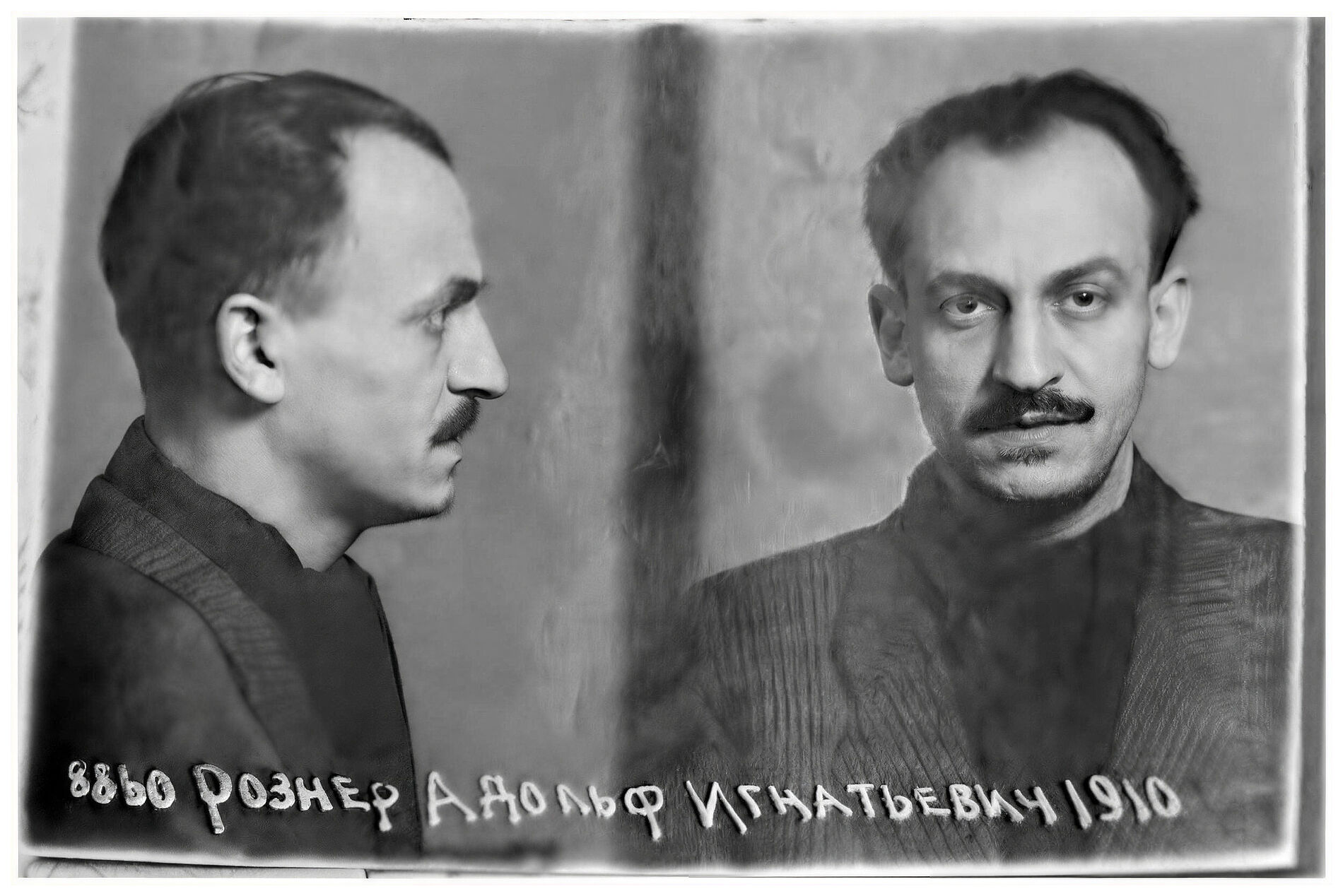
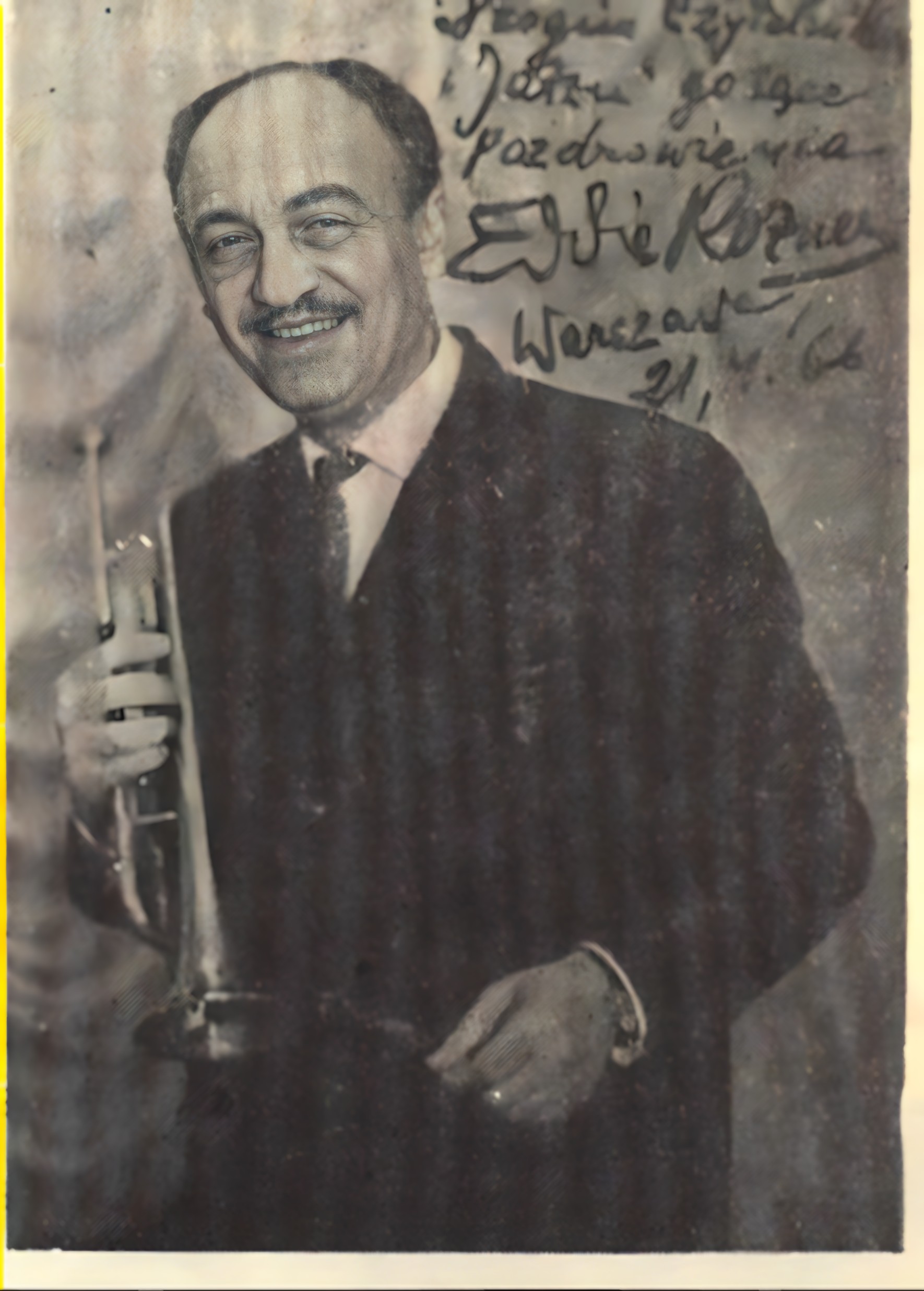
Adolf Rosner (1910–1976), known professionally as Eddie or Ady Rosner, was one of the most accomplished European jazz trumpeters of the 1930s. Born in Berlin to a Polish-Jewish family and trained at the Stern Conservatory, he made his name with the German hot-jazz band Weintraubs Syncopators before forming his own orchestra in Warsaw. His career was twice cut apart by the political upheavals of the twentieth century: first when the rise of National Socialism forced him out of Germany, and again when the German invasion of Poland in September 1939 drove him eastward into the Soviet Union. In the USSR he became, for a brief period, the highest-paid jazz musician in the country and a personal favourite of Joseph Stalin. After the war he was arrested by Soviet security services, sentenced without public trial to ten years in the Gulag, and held in labour camps in Siberia and the Far East until 1954. The Austrian musicologist Elisabeth Kolleritsch has described Rosner's biography as a case study in how "political protection" functions inside totalitarian systems — protection that, as Rosner discovered, can be withdrawn as suddenly as it is granted.
From Berlin to Warsaw
Rosner had already established himself as a leading European jazz trumpeter before the war began. After studying violin and trumpet at the Stern Conservatory in Berlin, he joined Weintraubs Syncopators around 1930, one of the best German professional bands of the period and a regular presence in the Berlin film studios; the group recorded music for some twenty films between 1930 and 1933, including the score for Der blaue Engel (The Blue Angel). The music journalist Maximilian Preisler has noted that Rosner stood out among his German contemporaries because, in Preisler's words, "he was able to swing, that was very rare for German jazz musicians."
After the Nazi seizure of power in 1933, Rosner — a Polish Jew playing what was officially condemned as racially degenerate music — was no longer able to perform in Germany. He was severely beaten by SA men in a Berlin pub in the spring of 1933 and made arrangements for his parents and three sisters to emigrate. Initial attempts to settle in Scandinavia and Belgium failed because of visa problems, and by late 1935 he had moved via Zurich and Prague to Warsaw. In Poland he assembled a thirteen-piece swing band that became, in the words of Pierre-Henri Salfati's 1999 documentary, "wildly popular." The orchestra played extended residencies at the Cyganeria café in Krakow and at the Esplanada and Palais de Danse in Warsaw, where its regular audience included the pianist Władysław Szpilman. The band toured Monte Carlo, the Benelux countries and Scandinavia, and in 1938 spent three months at the ABC Theatre in Paris on a bill with Maurice Chevalier, Lucienne Boyer and Marie Dubas. During that engagement the band recorded a number of sides for Columbia, including "Caravan," "Bei mir bist du schön," "On the Sentimental Side" and "Midnight in Harlem." A 1934 encounter with Louis Armstrong while both men were touring produced the much-repeated exchange of inscribed photographs — Armstrong addressing Rosner as "the white Louis Armstrong" and receiving in return one signed "to the black Eddie Rosner."
In 1939, while in Warsaw, Rosner married the Jewish singer Ruth Kaminska, daughter of the well-known Yiddish stage actress Ida Kaminska. The couple survived the German bombing of Warsaw in the cellar of the Esplanade nightclub. As the situation in the city grew more dangerous, Rosner gathered his wife, her family and several of his musicians and moved east into the territory recently occupied by the Red Army under the terms of the Molotov–Ribbentrop Pact. The historian Gertrud Pickhan has argued that Rosner's choice was straightforward: "After his experiences with the Nazi-regime it is not surprising, that he believed to have been arrived in freedom."
State Jazz and the Patronage of Stalin
The years between 1939 and 1945 were the most commercially successful of Rosner's career, although the conditions that made them so were entirely a product of the war. After crossing into Soviet-occupied territory the band reassembled in Białystok, then moved on to Lviv and Minsk. Following a performance in Minsk, Panteleimon Ponomarenko, First Secretary of the Belorussian Communist Party and a jazz enthusiast, proposed that Rosner's group be reconstituted as the State Jazz Orchestra of the Belorussian Republic. The S. Frederick Starr study Red and Hot records that Ponomarenko arrived at Rosner's dressing room with his bodyguards to make the offer in person. The Soviet authorities saw jazz, at that point, as a useful instrument of cultural policy. A USSR State Jazz Orchestra had already been founded in 1938, and the Belorussian ensemble formed in 1939 was part of a deliberate programme of jazz "Sovietisation" running in parallel with similar bodies in other republics.
Based in Minsk but constantly on tour, the orchestra appeared throughout the Soviet Union and made numerous recordings; Kolleritsch describes the band's version of "St. Louis Blues" as "a milestone of European Jazz." During the summer of 1941 the orchestra was ordered to play in Sochi in an apparently empty hall; only afterwards were the musicians told that Stalin had been listening from a balcony, and that he had liked what he heard. Rosner was named an Honoured Artist of the Belorussian SSR in 1944, and after the German invasion of the USSR the band toured from Armenia to Siberia in its own railway sleeping car, performing for Red Army troops and party officials and occasionally travelling to the front lines on flatbed trucks. Starr's assessment is unsparing: "It is doubtful that any jazz musician on earth has ever been recompensed more generously within his society than Eddie Rosner in the Soviet Union during wartime." Rosner earned as much as 100,000 roubles a year at a time when an average worker earned about 2,000; he and his wife were given a four-room apartment opposite the Kremlin, fitted with Afghan carpets and a grand piano. The repertoire combined American standards with theatrical staging — two musicians in a camel costume crossed the stage during performances of Juan Tizol's "Caravan" — and the band's image, white tuxedos and pastel double-breasted suits, was self-consciously modelled on Western jazz visuals. Rosner himself appeared with a pencil moustache modelled on Harry James, his idol, and an American Beuscher cornet.
Arrest, Sentence and the Magadan Years
The political climate began to shift almost as soon as the war ended. From 1946 the Soviet press launched a series of campaigns against "cosmopolitan" influence in the arts; even Sergei Prokofiev and Dmitri Shostakovich were censured. Foreign and Jewish artists were particularly exposed. Defamatory articles about Rosner began appearing in the party press, denouncing him in terms such as "fawning servility" and "third-rate cabaret trumpeter." Mike Zwerin, writing in the International Herald Tribune, summed up Rosner's own view of the situation succinctly: "It didn't help being a Jew playing Negro music, even if your name was Adolph."
Rosner had hesitated longer than most. According to the historian Yakov Basin, Rosner missed the main window of the official repatriation programme for former Polish citizens, partly because his life in Minsk was comfortable — a large apartment, a personal Ford that had been a gift from Ponomarenko — and partly because his marriage to Ruth Kaminska was unravelling and the couple intended to divorce only after they had reached Warsaw. By the time he applied, the registration period had closed and his approach to the Polish embassy in Moscow received no reply. In Lviv, where would-be repatriates had gathered, an accompanist named Berezovsky introduced him to one Dresner, a member of the Polish Repatriation Commission, who agreed to process the papers for 20,000 roubles. Rosner refused to leave the USSR under a false name but paid the sum and returned briefly to Moscow; on 11 November 1946 he travelled back to Lviv with Ruth and their daughter and received their passports. On 28 November, before the family could depart, he was arrested. Ruth later told Basin that she suspected the owner of the apartment in which they had been staying — who disappeared on the day of the arrest, along with the pillows in which the family's jewellery had been sewn — of informing on them. Rosner was interrogated on 7 December and on the same day transferred to Moscow on the personal orders of the Minister of State Security, Viktor Abakumov, who conducted the initial questioning at the Lubyanka. The protocols preserve the standard formulae of the period; Rosner is recorded as confessing to "a most serious crime against the Soviet authorities, which consisted of my intention to flee to Poland." A later complaint he wrote against his interrogators put it differently: "In a completely demoralised state, I signed everything. I even signed some documents retroactively. The investigator threatened to keep me in prison for up to five years if I didn't sign." Ruth was at first left at liberty and was eventually arrested as well. She was held in the Lubyanka, force-fed during a hunger strike — an episode she described as having left her with lifelong physical effects — and refused to sign a statement implicating her husband. She was sentenced to five years of exile in Kazakhstan. On 7 July 1947 a "troika" of the OSO special council sentenced Rosner under Article 58-1a of the RSFSR Criminal Code, "treason," to ten years in the camps; his sentence was backdated to 13 December 1946. His personal connection to Stalin made no difference. The remaining musicians of the Belorussian State Jazz Orchestra were largely left alone, in part because Rosner named no one under interrogation. A liquidation commission was appointed to dissolve the orchestra; two items on the inventory were listed as undelivered — "one trumpet, valued at 4,000 roubles, in the possession of E. Rozner," and "one black dress with bolero, valued at 3,500 roubles, in the possession of Ruth Rozner." Rosner was then transferred via a series of stations to Magadan, in the Kolyma region of the Far East.
In Magadan the camp commander — variously named in the sources as Alexander Deverenko or Derevyanko — had heard Rosner perform before the war and was, in Starr's phrase, proud to have him as a "guest." He permitted Rosner to assemble first a quartet and then a larger ensemble, drawing on jazz musicians held at other camps in the region. Rosner reconstructed many of his pre-war arrangements from memory. From the summer of 1947 the group toured Kolyma under armed escort in an American truck, performing for camp administrators, guards and their wives, and was rewarded with food, decent accommodation and exemption from forced logging work. Eventually the ensemble was incorporated into the musical section of the Magadan camp theatre, known as Maglag, whose troupe also included the well-known pre-war singer Vadim Kozin. Rosner composed and arranged extensively; in 1950 he wrote a suite entitled For Peace Throughout the World, for which he was promoted to head of the Central Cultural Brigade. He survived a near-fatal incident in which he was "sentenced" by criminal prisoners, and a bout of scurvy that briefly prevented him from playing the trumpet. His privileged position in the camp helped him become one of the first political prisoners in the country to be fully rehabilitated after Stalin's death. When Lavrentiy Beria was denounced as a foreign spy in 1953, Rosner — who had a radio in his quarters, virtually unheard of in the Gulag — pointed out to the camp authorities that Beria had personally signed the order for his incarceration, and asked them to forward a statement to Moscow on that basis. He was released on 22 May 1954.
Rehabilitation, Decline and Return to Berlin
After his release Rosner settled in Moscow and assembled a large variety orchestra under the auspices of MosEstrada, eventually expanding it to as many as sixty-four players. In 1956 the band appeared on screen in the popular Soviet comedy Carnival Night, performing alongside Lyudmila Gurchenko, whose rendition of "Five Minutes" became a national hit. For some years the orchestra was one of the leading variety ensembles in the country, and Rosner was sometimes referred to as the "Tsar of Soviet swing." In 1962 Benny Goodman, on the official US tour of the Soviet Union that followed the period of political thaw, met with him in Moscow.
The rehabilitation was incomplete. Soviet press organs were instructed not to mention Rosner's name in critical writing, and he was kept out of the major concert halls of the capital. By the late 1960s the orchestra was being squeezed out of public life by the emergence of rock and pop styles, and in 1971 Rosner was effectively forced into retirement and his orchestra disbanded. A short-lived attempt to form a new ensemble under the Gomel Philharmonic came to nothing. His repeated applications to emigrate to Berlin were refused, and during the official visit of US President Richard Nixon to Moscow in 1972 he went so far as to enter the American embassy to ask for the President's intervention. In January 1973 he was finally granted a passport and travelled with his second wife, Galina, and two daughters to West Berlin. His recording contracts in the USSR were cancelled, his royalties confiscated, and his name effectively erased from official Soviet musical history. Rosner died of a heart attack in West Berlin in August 1976, supported by a small pension, all his claims for compensation having been rejected. He is buried in the Jewish cemetery in the Charlottenburg-Wilmersdorf district.
Public interest in Rosner began to revive only in the 1990s. Alexey Batashev, the Russian jazz historian and founder of the Moscow Jazz Club, dedicated a Kazakh festival to Ruth Kaminska, who had herself been exiled there under Stalin, and organised a memorial concert at Moscow's Tchaikovsky Hall in which a reconstituted Rosner Orchestra performed scores transcribed from old 78 rpm recordings — the original parts having been destroyed. Pierre-Henri Salfati's documentary Le Jazzman du Goulag (The Jazzman from the Gulag, 1999) won an International Emmy Award in the Documentary Feature category, and in 2010 the historian Gertrud Pickhan and the journalist Maximilian Preisler published a full-length biography in German, Von Hitler vertrieben, von Stalin verfolgt. Der Jazzmusiker Eddie Rosner. In 2018 the City of Berlin unveiled a commemorative plaque at Gormannstraße 11 in the Mitte district, sponsored by the Eddie Rosner and Oskar Strock Heritage Society to mark the forty-fifth anniversary of his return to Germany.
Sources
Basin, Yakov. "Eddie Rosner: The Arrest and the Camps." 1998. Reproduced online.
Berlin Global. "Berlin Celebrates Eddie Rosner." Accessed via www.berlinglobal.org/index.php.
Jewish Białystok. "Eddie Rosner Revival, Take Two." Reproduction of an article by Mike Zwerin, 2002. www.jewishbialystok.pl/index.php.
Jazz House. Zwerin, Mike. "Eddie Rosner Revival, Take Two." www.jazzhouse.org/library/.
Jazz Music Archives. "Eddie Rosner." www.jazzmusicarchives.com/video/eddie-rosner/16508.
Kolleritsch, Elisabeth. "Jazz in Totalitarian Systems (Nazi Germany and Former USSR): The Life of the Trumpet Player Eddie Rosner." European Scientific Journal, Special edition, Vol. 2 (May 2015): 256–263.
Mus-Col. "Adolf Rosner." mus-col.com/en/the-authors/37318/.
Pickhan, Gertrud, and Maximilian Preisler. Von Hitler vertrieben, von Stalin verfolgt. Der Jazzmusiker Eddie Rosner. Berlin-Brandenburg: be.bra Verlag, 2010.
Salfati, Pierre-Henri, and Natalia Sazonova, directors. Eddie (Adi) Rosner — The Jazzman from the Gulag. Arte/WDR, 1999.
Starr, S. Frederick. Red and Hot: The Fate of Jazz in the Soviet Union. Oxford: Oxford University Press, 1983.
Sztetl.pl (Virtual Shtetl, POLIN Museum of the History of Polish Jews). "Rosner, Eddie." Entry based on L. T. Błaszczyk, Jews in the musical culture of Polish lands in the 19th and 20th centuries: Biographical dictionary (Warsaw, 2014). sztetl.org.pl/pl/biogramy/3631-rosner-eddie.
Timenote. "Eddie Rosner." timenote.info/en/Eddie-Rosner.