




Harold Byrns
Harold Byrns was a German-Jewish conductor, orchestrator and composer born Hans Bernstein in Hanover in 1903. Trained in Berlin under Erich Kleiber, Leo Blech and Walter Gieseking, he had established himself in the opera houses of northern Germany by the early 1930s. The rise of National Socialism cut that career short: he left for Italy in 1933, moved on to the United States in 1936, and on arrival changed his name from Bernstein to Byrns in the belief that a recognisably Jewish surname would close doors to him in American musical life. In Los Angeles he orchestrated for the film studios, worked on Broadway, founded the Los Angeles Chamber Symphony, and became a notable advocate for the music of Schoenberg, Mahler and other émigré composers. After the war he resumed a conducting career in Europe, while continuing to orchestrate piano and vocal works on commission from figures including Karajan and Fischer-Dieskau. He played a direct role in securing Alma Mahler's consent for performances of Deryck Cooke's realisation of Mahler's Tenth Symphony. He died in Berlin in 1977.
Byrns was born Hans Bernstein on 13 September 1903 in Hanover, then part of the Kingdom of Prussia. His father, Arthur Bernstein, had founded a chamber music society in the city, and the son followed him into music. He studied at the Stern Conservatory in Berlin with the pianist Walter Gieseking and the conductors Erich Kleiber and Leo Blech, and subsequently worked as assistant to both Kleiber and Blech. Before 1933 he held conducting posts in Lübeck, Oldenburg and Berlin, the latter including engagements at the Staatsoper and the Deutsche Oper.
In 1933 Bernstein left Germany for Italy, where he spent three years as a guest conductor in various Italian cities. In 1936 he moved on to the United States and later took American citizenship. On arrival he abandoned the name Hans Bernstein and adopted the anglicised Harold Byrns. According to the conductor himself, the change was made because he believed a person with a Jewish-sounding name could not build a conducting career in America. Michael Haas, in Music in Exile, notes the broader pattern among Jewish émigrés in Britain and the United States of shortening or anglicising names to ease assimilation, and singles out the Bernstein-to-Byrns change as a particularly pointed example, given that Leonard Bernstein would soon disprove the assumption on which it was based.
Settling in Los Angeles, Byrns worked as an orchestrator for the film studios, much of it uncredited. His film-related output included work on Portrait of Jennie (1948), Cover Up (1949), The Killer That Stalked New York (1950), The Girl on the Bridge (1951), Pickup (1951), Above and Beyond (1952) and The Wild North (1952), among others. By 1948 he was orchestrating for MGM.
His work also extended to the New York stage. In February 1941 he arranged the music for Anton Dolin's Ballet Theatre production of Adam's Giselle on Broadway. In 1945 he orchestrated Lerner and Loewe's musical The Day Before Spring, having been recommended for the work by Maurice Abravanel, who regarded him as a major orchestrator.
In 1949 Byrns founded the Los Angeles Chamber Symphony, an ensemble of around thirty players drawn from the leading musicians of the Hollywood studios, with the American Art Quartet as its principals. Contemporary critics drew a comparison between his earlier Harold Byrns Chamber Orchestra and the Boyd Neel String Orchestra in Britain. The new orchestra received support from across the émigré and Hollywood communities: Arthur Rubinstein gave a benefit concert on the lawn of his Beverly Hills home in 1949, performing a Mozart piano concerto with Byrns and the orchestra before an audience that included the Stravinskys and a large number of film actors.
During a period in which the Los Angeles Philharmonic under Alfred Wallenstein largely avoided new orchestral music, Byrns programmed works by the émigré composers who had settled in southern California, among them Schoenberg, Stravinsky, Toch, Hindemith and Eric Zeisl. The critic Mildred Horton described his contribution as a serious and worthwhile addition to local musical life. In 1949 he made the first recording of Bartók's Music for Strings, Percussion and Celesta, and he later recorded Stravinsky's Violin Concerto with Ivry Gitlis. In 1950 he gave the premiere of George Antheil's Serenade No. 2.
Byrns became closely identified with the music of Arnold Schoenberg. He gave the first Los Angeles performance of Schoenberg's Chamber Symphony, Op. 9, and in October 1949 conducted a concert with the Los Angeles Chamber Symphony to mark the composer's 75th birthday, including the First Chamber Symphony; both Schoenberg and Stravinsky were in the audience. In 1971 he conducted Moses und Aron at the Deutsche Oper.
After the war Byrns resumed conducting in Europe. He returned to Berlin, where he appeared at the Deutsche Oper and the Komische Oper, and worked as a guest with several symphony orchestras, in particular the radio orchestras of Hanover and Turin (RAI). He gave Mahler concerts with the Vienna Symphony and on Italian radio. On 17 October 1954 he conducted the first public performance of Erich Wolfgang Korngold's Symphony in F sharp major, in a broadcast on Austrian radio; the performance was described as poorly rehearsed, and a full concert premiere of the work did not take place until November 1972, under Rudolf Kempe in Munich. In the same year, 1954, he conducted the first performance of Berthold Goldschmidt's Sinfonietta with the Suisse Romande Orchestra.
Byrns orchestrated several early works by Gustav Mahler, including six songs from Lieder und Gesänge, recorded by Giuseppe Sinopoli as part of his complete Mahler cycle and described by reviewers as skilful and idiomatic. He became a personal friend of Alma Mahler-Werfel, whom he had probably met through his work on Mahler's music. When Deryck Cooke produced his performing version of the unfinished Tenth Symphony, Alma initially withdrew her consent for performances, having come to feel that the score was a private love letter from her husband to her. Byrns travelled to New York to see her, taking a recording of Cooke's BBC studio performance and a copy of the newly completed score. He went through the score with her, after which she asked to hear the recording twice in succession. She wrote to Cooke shortly afterwards to lift her objection and grant him full permission for performances anywhere in the world. For his work on Mahler, Byrns received the Kilenyi Mahler Medal of Honor from the Bruckner Society of America.
Byrns built a parallel career as an orchestrator of piano and vocal music. For Otto Klemperer's debut in Copenhagen in 1947 he arranged a suite from Purcell's The Fairy Queen. Herbert von Karajan commissioned him to orchestrate piano pieces by Robert Schumann. Dietrich Fischer-Dieskau commissioned orchestrations of Mahler songs, for which Byrns also supplied English translations. Both Fischer-Dieskau and his son Martin Fischer-Dieskau, later chief conductor in Canada and Taiwan, studied conducting with him. In 1973 the premiere of Nicolas Nabokov's opera Love's Labour's Lost in Brussels used Byrns's complete orchestration.
Byrns was married to Helene Wilhelmine (née Hahlo), whose first husband had been Ernst Salm. Helene's son from that earlier marriage, Peter Salm (1919–1990), came with her to the United States in 1938 and later became Professor Emeritus of Comparative Literature and German at Case Western Reserve University in Cleveland, with a specialism in Goethe; he had served in the U.S. Army Counter Intelligence Corps from 1942 to 1946 and was the conduit through whom Schoenberg reached relatives in postwar Europe. He has occasionally been described as Byrns's son in older sources — including in the Schoenberg correspondence catalogue — but the dates and the 1938 passenger record showing Ernst Salm as his father indicate that he was Byrns's stepson. Byrns later married Ursula Dorothea Byrnes. He died in Berlin on 22 February 1977 and is buried there.
Music and the Holocaust, 2026
Sources
Crawford, Dorothy L. A Windfall of Musicians: Hitler's Émigrés and Exiles in Southern California. New Haven: Yale University Press, 2009.
Haas, Michael. Music in Exile: The Composers of the Third Reich. New Haven: Yale University Press, 2013.
Johnson, Stephen. The Eighth: Mahler and the World in 1910. London: Faber & Faber, 2020.
Simeone, Nigel (ed.). The Leonard Bernstein Letters. New Haven: Yale University Press, 2013.
"Harold Byrns." Wikipedia. en.wikipedia.org/wiki/Harold_Byrns
"Harold Byrns." Wikidata, Q9286512. www.wikidata.org/wiki/Q9286512
"Hans (Harold) Byrnes (Bernstein) (1903–1977)." Geni. www.geni.com/people/Hans-Harold-Byrnes/6000000041100546466
"Byrns, Harold." Alma Mahler Collection, Penn State University Libraries. libraries.psu.edu/about/collections/alma-mahler/gratulanten/musik/byrns-harold
Montes-Bradley, Eduardo. "How an Alban Berg Recording Travelled from Vienna to Buenos Aires by Way of the Conductor Alma Mahler Trusted." 3 May 2026. www.montesbradley.com/post/how-an-alban-berg-recording-traveled-from-vienna-to-buenos-aires-by-way-of-the-conductor-alma-mahler
Bohlman, Philip V., and Ryan Minor. "The Dispersion of Hitler's Exiles: European Musicians as Agents of Cultural Transfer." OREL Foundation Journal. orelfoundation.org/journal/journalArticle/the_dispersion_of_hitlers_exiles_european_musicians_as_agents_of_cultural_t
"Harold Byrns." Discogs. www.discogs.com/artist/1516831-Harold-Byrns
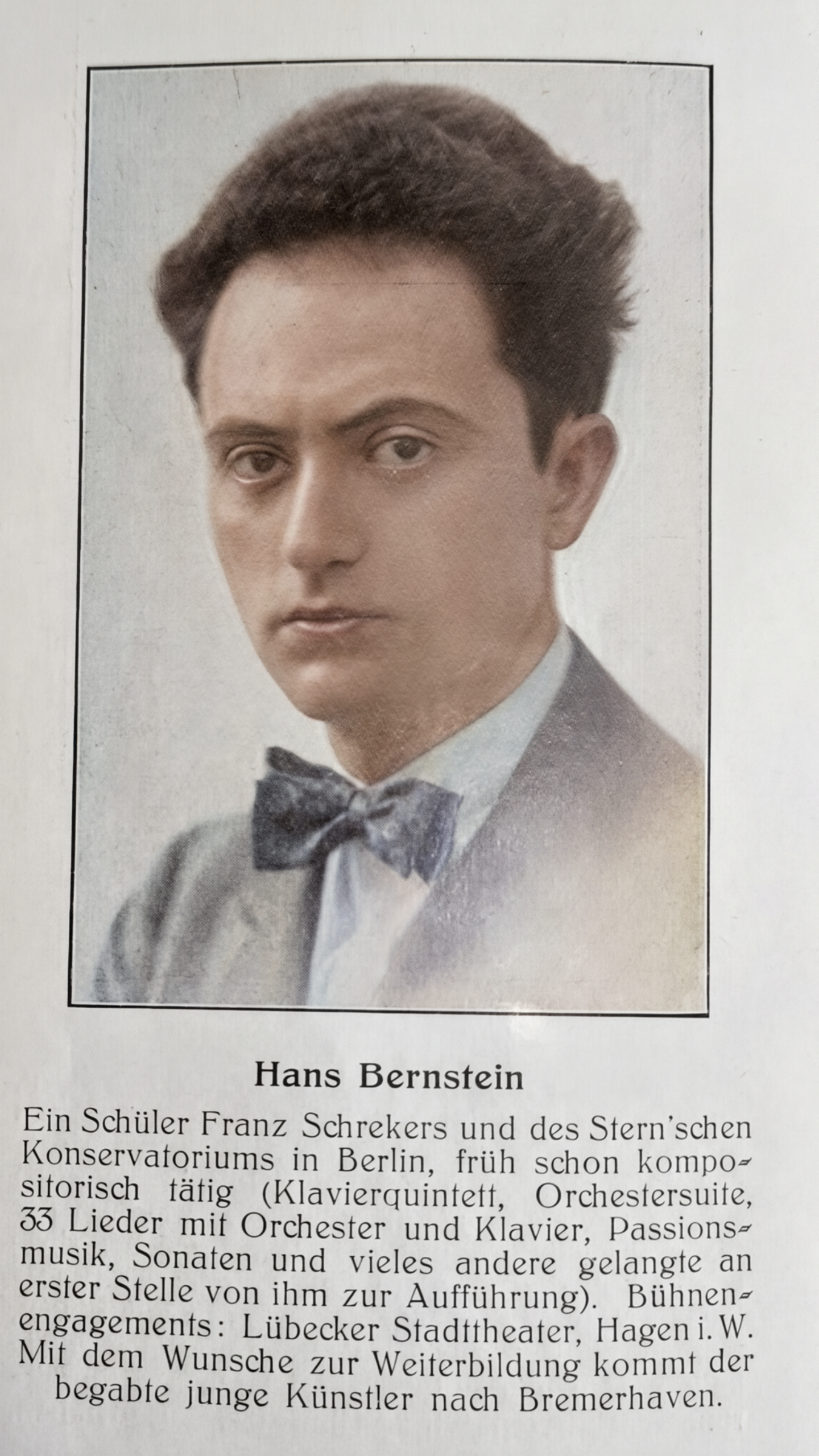
A student of Franz Schreker and the Stern Conservatory in Berlin, he began composing at an early age (Piano Quintet, Orchestral Suite, 85 songs with orchestra and piano, Passion music, sonatas, and much more were premiered by him). Stage engagements: Lübeck City Theater, Hagen im Weserland
With the desire to further his education, the talented young artist comes to Bremerhaven. 1925.