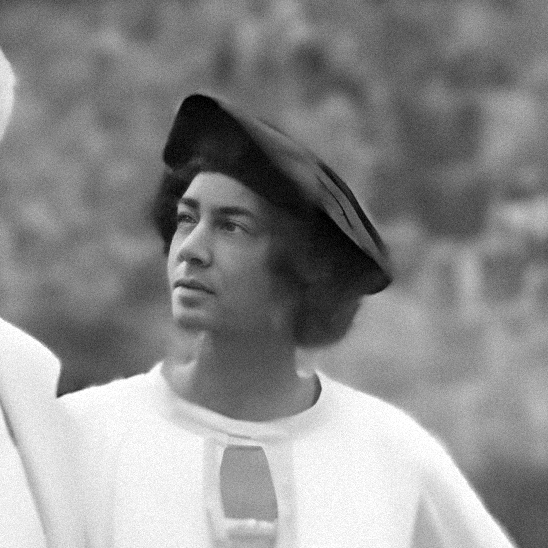



Eva Hauptmann (1894–1986)
Eva Hauptmann, born Eva Bernstein in Munich in 1894, was a violinist and teacher whose family stood close to the centre of German musical and literary life, and close to Bayreuth. Her grandfather, the Munich music director Heinrich Porges, had championed the works of Richard Wagner; she met her husband, the son of the dramatist Gerhart Hauptmann, in Bayreuth; and when the Nazi regime expelled her from the Reich Music Chamber in 1935 because of her Jewish descent, one of those she turned to for help was Winifred Wagner. Neither these connections nor her Protestant baptism restored her right to work. Barred from teaching and performing, she withdrew into private life in Hamburg, and from April 1944 until the end of the war was made to sew Wehrmacht uniforms in a tailor's workshop under appalling conditions. Her mother, the writer Elsa Bernstein, was deported to the Theresienstadt ghetto in 1942, despite the protection of the Wagner family. Both women survived, and after 1945 Eva Hauptmann returned to teaching, becoming a professor at the Hamburg music academy, where her students included Christoph Eschenbach and Justus Frantz.
A Munich childhood
Eva Bernstein was born on 9 November 1894, the eldest daughter of Max Bernstein (1854–1925), a lawyer, theatre critic and author of light plays, and the writer Elsa Bernstein, née Porges (1866–1949). A younger sister died a few months after birth; her brother, Hans Heinrich, was born in 1898. Under the pseudonym Ernst Rosmer, Elsa Bernstein wrote more than fourteen plays. Her fairy-tale drama Königskinder (The Royal Children) was performed on 130 stages, sold almost 200,000 copies as a book and was set as an opera by Engelbert Humperdinck. From the 1890s the Bernsteins ran a Sunday salon in their Munich apartment, attended by writers including Thomas Mann, Rainer Maria Rilke, Hugo von Hofmannsthal, Theodor Fontane and Gerhart Hauptmann, and by the musicians Hermann Levi and Richard Strauss. The family's tie to Bayreuth came through Elsa's father, Heinrich Porges, the Jewish music director in Munich who had promoted Wagner's works.
Eva never attended school. She was educated privately by the secondary school teacher Dr Hans Mertel, wrote poetry from an early age, drew well, and took piano and violin lessons; between the ages of ten and sixteen her teachers included Heinrich Kaspar Schmid of the Munich Academy of Music. She first appeared in public concerts at the age of fourteen. In 1910 her mother gave up her career to devote herself to her daughter's education, and the two moved to Vienna, where Eva studied violin with Otakar Ševčík at the Imperial Academy of Music and Performing Arts, theory with Richard Stöhr and chamber music with Arnold Rosé. In 1912 mother and daughter went to Paris, where Eva studied violin with Jules Boucherit and music theory with Nadia Boulanger, and in 1915 she moved to Berlin to study with Carl Flesch, whose études she later used regularly in her own teaching. Concert tours followed to Austria, Switzerland, Sweden and Belgium, with conductors including Wilhelm Furtwängler, Arthur Nikisch, Bruno Walter and Felix Weingartner. In 1917 she gave a chamber music recital with Bruno Walter at the Odeon in Munich.
Bayreuth, marriage and Hamburg
In Bayreuth in 1918 Eva Bernstein met Klaus Hauptmann (1889–1967), the third son of Gerhart Hauptmann, and they married in 1919. Their son Michael was born in 1920 and their daughter Barbara in 1922. From 1922 the family lived a secluded life in the Allgäu, and Eva Hauptmann withdrew from public concert life, playing only in church or for friends, sometimes accompanying herself at the piano in her own compositions, such as couplets.
In 1924 the family moved to Hamburg, where Klaus Hauptmann had found employment, and the following year she began teaching at the Vogt Conservatory on Rothenbaumchaussee. In December 1927 she passed the state examination as a certified violin teacher. She also founded a chamber orchestra, which she directed from the harpsichord or piano. Few solo appearances are documented from these years, an exception being Mendelssohn's Violin Concerto, which she performed in 1929 in the Hamburg Philharmonic Orchestra's public concert series; she also gave concerts with the pianists Conrad Hansen and Vera Cassirer.
Expulsion and the appeal to Winifred Wagner
Eva Hauptmann came from an assimilated Jewish family and had been baptised a Protestant, but under Nazi racial law her ancestry was decisive. On 22 August 1935 she was expelled from the Reich Music Chamber under Paragraph 10 of the First Implementing Regulation of the Reich Chamber of Culture Law, on the grounds of her Jewish heritage. On 4 September 1935 the Vogt Conservatory dismissed her without notice, and she was also obliged to give up her private pupils, among them the future rabbi Zev Gotthold, who emigrated in 1936. Her former teacher Heinrich Kaspar Schmid, by then former director of the Munich Conservatory, wrote to Peter Raabe, president of the Reich Music Chamber, on 8 September 1935, pointing to her "German sentiments". It made no difference.
She also wrote to Winifred Wagner, the widow of Wagner's son Siegfried, director of the Bayreuth Festival and a personal friend of Adolf Hitler. Winifred Wagner's reply, dated 27 April 1937, offered advice on how to frame a petition to the Führer's private chancellery:
"First and foremost, emphasize the high percentage of your Aryan blood, because as far as I remember, you are blond, fair-skinned, etc. Include a picture—there's a regulation stating that appearance is very often decisive in decisions of your kind. Then I would gather all your Aryan ancestors—but still highlight your grandfather's contributions to Wagner. It all sounds terribly silly, what I'm writing to you, but you should know that I would gladly help you."
The letter, written almost two years after the expulsion, shows that efforts to have her case reconsidered were still continuing in 1937, and that Winifred Wagner considered the Porges family's service to Wagner worth putting forward. The ban was not lifted.
Silence, forced labour and Theresienstadt
Eva Hauptmann withdrew from public life. She played at home concerts with the Hamburg composer and pianist Ilse Fromm-Michaels, and for family and friends, often performing Chopin or accompanying herself in songs by Schubert. She read widely, learned Greek and improved her English. Occasionally she gave violin lessons in secret, among others to the young Thomas Brandis.
Her brother Hans Heinrich emigrated to the United States in 1933, but the Hauptmanns did not leave Germany. As Gerhart Hauptmann's daughter-in-law, Eva Hauptmann probably enjoyed a degree of protection. Her mother did not. Elsa Bernstein, who had been blind since her early fifties, was first forced to leave her Munich apartment for a smaller one, and on 25 June 1942 she was deported to the Theresienstadt ghetto, despite her influential friends and the protection of the Wagner family in Bayreuth. There she was housed in one of the so-called "prominent houses".
From April 1944 Eva Hauptmann was herself conscripted for forced labour. Until the end of the war she sewed Wehrmacht uniforms, suits and coats under appalling working conditions for the tailor Max Scheelke on Valentinskamp in Hamburg. Her husband's deportation to a labour camp was prevented at the last minute by his employers, Fritzel and Arthur Binder of the August Bolten shipbroking firm.
After the war
Elsa Bernstein left Theresienstadt in June 1945, three years after her deportation, and moved to Hamburg to live with her daughter in the Eppendorf district. In the four years before her death on 12 July 1949 she wrote down her memories of Theresienstadt on a Braille typewriter and kept up an extensive correspondence. Eva Hauptmann said of her mother's will to live: "She was fortunate enough to be important to herself."
Eva Hauptmann resumed teaching at the School of Music and Theatre of the Free and Hanseatic City of Hamburg, which had absorbed the Vogt Conservatory in 1942. When the school became a state music academy in 1950 she became a lecturer, and in 1955 she was appointed professor. Her pupils included Thomas Brandis, Christoph Eschenbach, Justus Frantz, Bernhard Gmelin and Andreas Röhn, and her Friday morning lectures on literature were particularly popular. In the 1950s she applied for restitution in Hamburg, and the claim was granted. She retired in 1970. Klaus Hauptmann had died in 1967; Eva Hauptmann died in Würzburg on 23 September 1986. On 27 November 1994, marking the centenary of her birth, the Hamburg University of Music and Theatre and North German Radio held a memorial concert in her honour.
Sources
Bake, Rita. 'Bernstein, Elsa'. Das jüdische Hamburg. www.dasjuedischehamburg.de/inhalt/bernstein-elsa (accessed 9 November 2026).
Bernstein, Elsa. Das Leben als Drama: Erinnerungen an Theresienstadt. Edited by Rita Bake and Birgit Kiupel. Dortmund: edition ebersbach, 1999.
'Eva Hauptmann'. Wikipedia (German). de.wikipedia.org/wiki/Eva_Hauptmann (accessed 9 November 2026).
Fetthauer, Sophie. 'Eva Hauptmann'. In Lexikon verfolgter Musiker und Musikerinnen der NS-Zeit, edited by Claudia Maurer Zenck and Peter Petersen. Hamburg: Universität Hamburg, 2012. www.lexm.uni-hamburg.de/object/lexm_lexmperson_00002586 (accessed 9 November 2026).
Hochschule für Musik und Theater Hamburg and Norddeutscher Rundfunk. Eva Hauptmann zum 100. Geburtstag. Programme booklet for the memorial concert, Hamburg, 27 November 1994.
Kalliope-Verbund. 'Hauptmann, Eva (1894–1986)'. GND 116528338. kalliope-verbund.info/de/eac (accessed 9 November 2026).
Ranft, Marie Elisabeth. 'Eva Hauptmann'. In Lebenswege von Musikerinnen im „Dritten Reich" und im Exil, edited by Arbeitsgruppe Exilmusik am Musikwissenschaftlichen Institut der Universität Hamburg, 127–141. Musik im „Dritten Reich" und im Exil 8. Hamburg: von Bockel, 2000.