




Michael Tippet - A Child of Our Time
Michael Tippett's oratorio A Child of Our Time (1939–41) is a direct response to Kristallnacht, the Nazi pogrom of 9–10 November 1938, and to the event the regime used to justify it: the shooting of a German diplomat in Paris by Herschel Grynszpan, a 17-year-old Polish-Jewish refugee whose family had just been expelled from Germany. Tippett, a pacifist who was imprisoned as a conscientious objector while the work awaited performance, wrote both the music and the text. He made Grynszpan the unnamed central figure of a modern Passion and, in place of the Lutheran chorales of Bach's Passions, set five African American spirituals. The work was first performed in London in March 1944 under the German-Jewish émigré conductor Walter Goehr and became Tippett's most frequently performed composition.
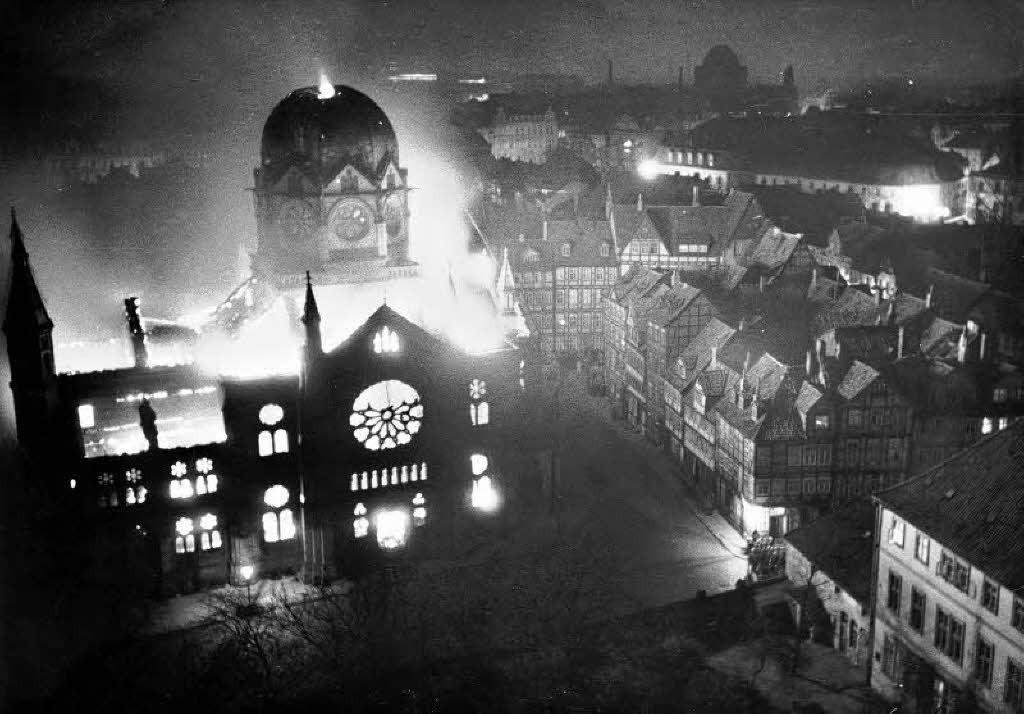
Burning of the synagogue in Hanover, Germany, night of 9 November 1938
Kristallnacht and Herschel Grynszpan
Herschel Grynszpan was born in Hanover on 28 March 1921 to Polish-Jewish parents and never held German citizenship. By 1938 he was living, without legal papers, in Paris. On 26 October 1938 the Gestapo began the so-called Polenaktion, arresting around 12,000 Jews of Polish nationality living in Germany and expelling them across the Polish border. Grynszpan's family was deported on the night of 27 October and forced to walk to the frontier at Zbąszyń, where Poland at first refused to admit many of the deportees.
On 7 November Grynszpan went to the German embassy in Paris and shot the diplomat Ernst vom Rath, who died of his wounds on 9 November. Nazi leaders used his death as the pretext for a coordinated pogrom across Germany and annexed Austria on the night of 9–10 November. More than 90 Jews were killed, over 30,000 Jewish men were arrested and sent to concentration camps, and hundreds of synagogues were burned along with thousands of Jewish homes and businesses. Grynszpan was held in France until the German invasion; he was handed over to Germany in July 1940 and his fate remains unknown. West Germany declared him dead in 1960.
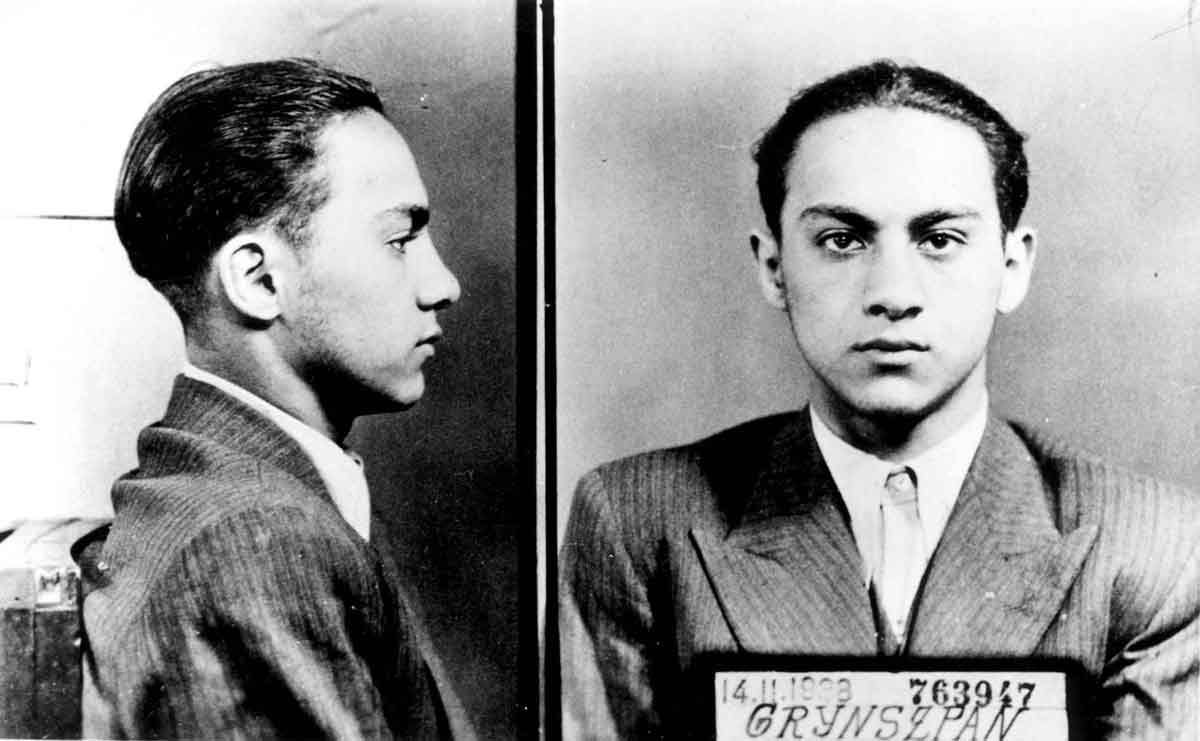
The arrest mugshot of Herschel Grynszpan by French police, November 1938.
Tippett, then 33, had been planning a dramatic work on the 1916 Easter Rising in Dublin, but the events of late 1938 led him to a new subject. In a leaflet circulated before the premiere, he described the oratorio as springing "from an impassioned protest against the conditions that make persecution possible" and set out the pattern he saw in Grynszpan's story, in which
an outcast is thrown up for one moment by the forces of history and by his personal fate, as protagonist opposite the tyrant, the “man of destiny.” … The boy, whose act springs from the persecution of his people, is himself an instrument by which it is re-doubled. — Michael Tippett, pre-concert leaflet, 1944
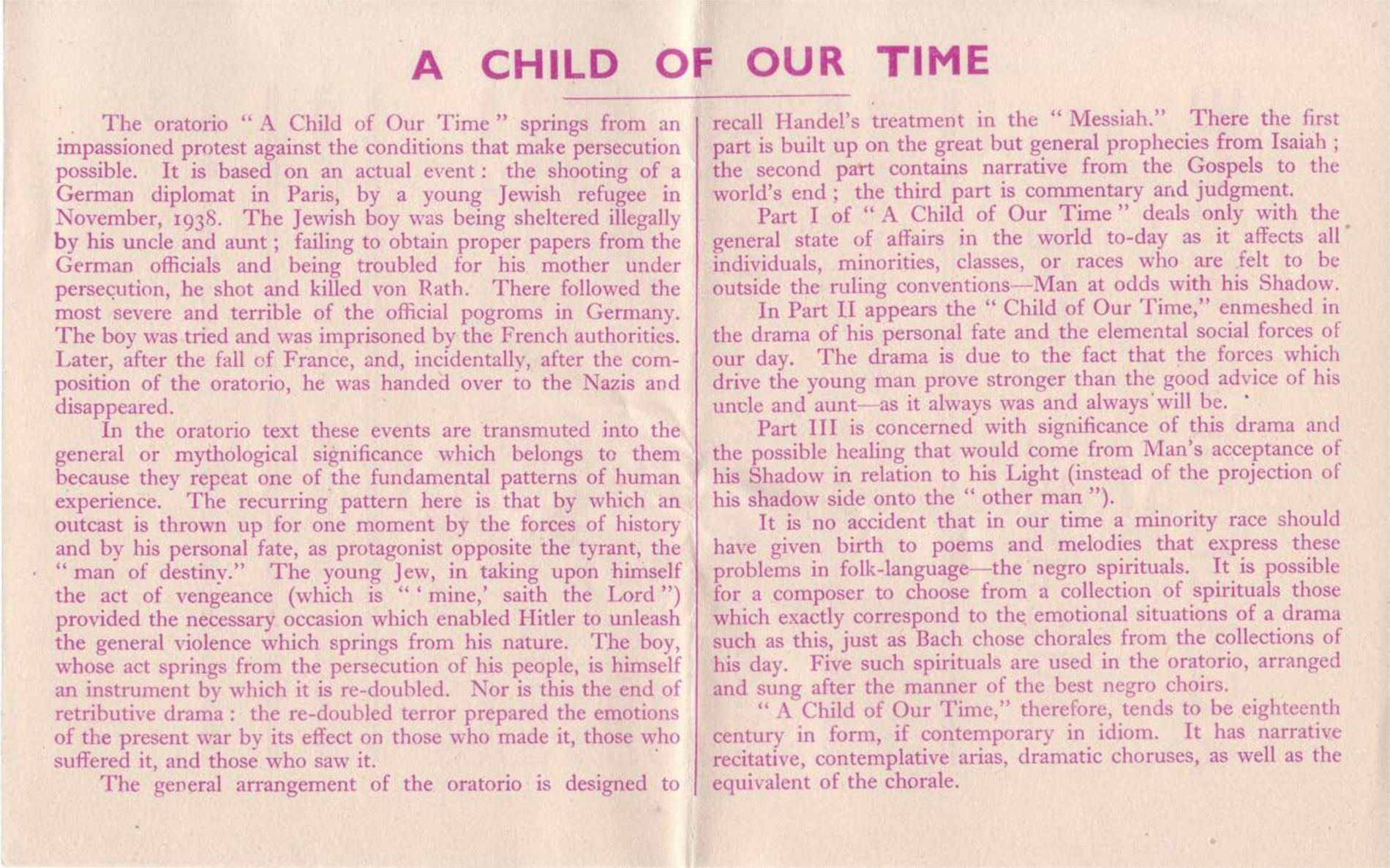
Tippett’s account of the oratorio, from the leaflet distributed before the premiere, 1944.
To give the story a wider application, the libretto names no one. Paris becomes "a great city", Grynszpan "the boy" and vom Rath "the official".
Writing the oratorio
Tippett began composing on 3 September 1939, the day Britain declared war on Germany, three days after completing a period of Jungian analysis with the anthropologist John Layard. He had first approached T.S. Eliot to write the text. Eliot asked for "a precise scheme of musical sections", and after reading Tippett's detailed draft advised him to write the words himself, on the grounds that a poet's verse would either distract from the music or be "swallowed up by it". Tippett took the advice and wrote all his own texts from then on.
The form combines two models. The three-part plan follows Handel's Messiah: Part I is prophetic, Part II narrative and Part III meditative. The musical forms within it – recitatives, arias, choruses and a bass soloist acting as narrator – follow Bach's Passions, to which Tippett added the operatic scena and the orchestral interlude. Tippett summed up the result as "eighteenth century in form, if contemporary in idiom". According to the 1944 leaflet, Part I "deals only with the general state of affairs in the world to-day as it affects all individuals, minorities, classes, or races who are felt to be outside the ruling conventions – Man at odds with his Shadow." Its opening chorus sets the tone:
The world turns on its dark side. It is winter. — Part I, opening chorus
Part II follows the boy: his uncle and aunt's warnings, his mother's plight on the border, the shooting, the reprisals and the boy in prison. Part III, in Tippett's words, is concerned with "the possible healing that would come from Man's acceptance of his Shadow in relation to his Light". Drawing on Jung's idea that a healthy personality must acknowledge its darker side as well as its lighter one, the work moves towards an ensemble in which the tenor sings:
I would know my shadow and my light, so shall I at last be whole. — Part III, General Ensemble
The spirituals
Tippett had considered using Lutheran chorales, as Bach had, but judged them too specifically Christian for a work he wanted to reach listeners of any belief or none. The solution came when he heard the spiritual "Steal Away" on the radio. He sent to the United States for a collection of spirituals, studied recordings by the Hall Johnson Choir as a model for the call-and-response between soloist and chorus, and chose five. In the work they act as the chorales do in Bach, points where the congregation – here the audience – steps outside the story to reflect on it. Tippett saw in songs created by enslaved African Americans a voice for anyone
rejected, cast out from the center of our society onto the fringes: into slums, into concentration camps, into ghettos. — Michael Tippett
The score instructs that the spirituals "should not be thought of as congregational hymns, but as integral parts of the Oratorio", and that they should not be sentimentalised but sung with "a strong underlying beat and slightly 'swung'".
Prison and premiere
In October 1940 Tippett became Director of Music at Morley College in south London, shortly after a bomb had almost destroyed its buildings. He recruited several refugee musicians to its staff, among them Walter Goehr, who took charge of the college orchestra. Tippett completed A Child of Our Time in 1941, but no performance followed immediately.
Tippett had registered as a conscientious objector. In June 1943, after he refused his tribunal's condition that he undertake full-time civil defence, fire service or agricultural work, arguing that music was his most useful contribution to society, he was sentenced to three months' imprisonment. Ralph Vaughan Williams, who was not a pacifist, appeared as a witness on his behalf. Tippett served two months in Wormwood Scrubs, where he rehearsed the prison orchestra.
The premiere took place at the Adelphi Theatre in London on 19 March 1944. Walter Goehr conducted the London Philharmonic Orchestra and the Morley College Choir, augmented by the London Region Civil Defence Choir. The soloists were Joan Cross (soprano), Margaret MacArthur (alto), Peter Pears (tenor) and Roderick Lloyd (bass). Schott published the vocal score the same year. In the days before the concert Tippett gave two lectures on the work for the London Philharmonic Arts Club, on 14 and 16 March, and a leaflet setting out his account of the oratorio was widely distributed. The composer Antony Hopkins wrote the programme note, which followed the same lines.
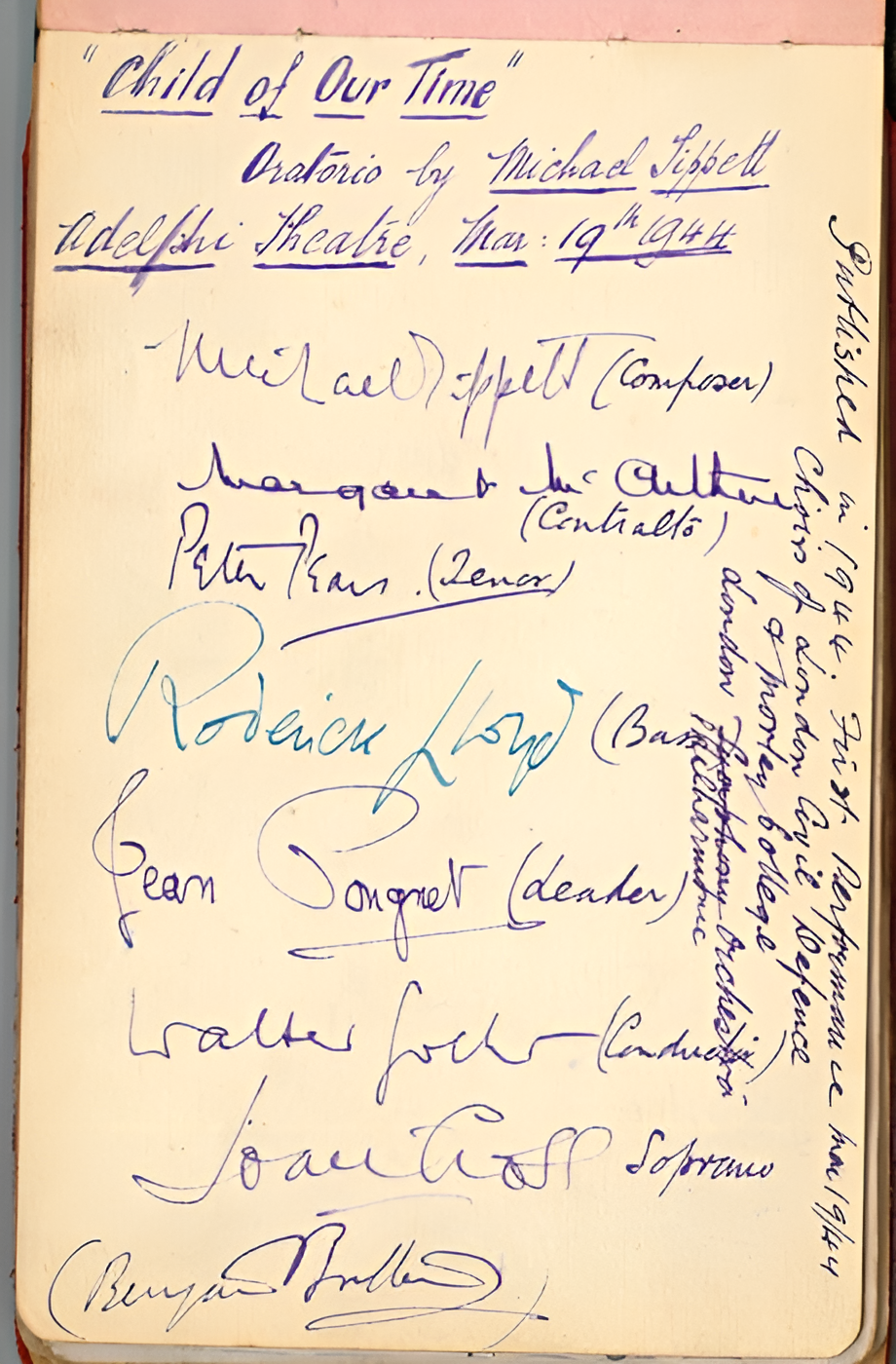
Autograph page from the March 19, 1944 world premiere of "A Child of Our Time" at the Adelphi Theatre, originally collected by a member of the London Regional Civil Defence Choir. Photograph by the late Mervyn Bryn Jones (1938–2018), son of the original chorister. Reproduced for non-commercial educational commentary.
The musicologist Anne Marshman has shown that most of the critics who reviewed the premiere drew on this pre-concert material. Their verdicts were nevertheless mixed. The Times found the work "strikingly original in conception and execution", and William Glock, writing in The Observer, called it "the most moving and important work by an English composer for many years". Edwin Evans in The Musical Times praised the simplicity of the text but found its emotion "singularly cool", and was not persuaded by the spirituals.
The BBC broadcast the oratorio on 10 January 1945, and the following month Tippett conducted it at the Royal Albert Hall. In 1947 he conducted it in Budapest, sung in Hungarian. When the work was first performed in Israel, Grynszpan's father attended. Tippett recorded it himself in 1991, aged 86, with the City of Birmingham Symphony Orchestra, and the oratorio remains in the repertoire of choral societies and orchestras in Britain and abroad.
| Date | Event |
| 26–29 October 1938 | Polenaktion: around 12,000 Polish Jews expelled from Germany; Grynszpan family taken to Zbąszyń |
| 7 November 1938 | Herschel Grynszpan shoots Ernst vom Rath in Paris |
| 9 November 1938 | Vom Rath dies |
| 9–10 November 1938 | Kristallnacht pogrom across Germany and Austria |
| 3 September 1939 | Tippett begins composing A Child of Our Time |
| July 1940 | Grynszpan handed over to Germany |
| October 1940 | Tippett becomes Director of Music at Morley College |
| 1941 | Oratorio completed |
| 21 June–21 August 1943 | Tippett imprisoned in Wormwood Scrubs |
| 19 March 1944 | Premiere, Adelphi Theatre, London, conducted by Walter Goehr |
Sources
"A Child of Our Time." Wikipedia. https://en.wikipedia.org/wiki/A_Child_of_Our_Time (accessed 3 November 2026).
"Herschel Grynszpan." Wikipedia. https://en.wikipedia.org/wiki/Herschel_Grynszpan (accessed 3 November 2026).
"Michael Tippett." Wikipedia. https://en.wikipedia.org/wiki/Michael_Tippett (accessed 3 November 2026).
"Darkly Spiritual Challenge to Injustice." The New York Times, 27 January 2012. Reproduced at https://bcco.org/wp-content/uploads/2023/11/SmithNYT_Tippett.pdf (accessed 3 November 2026).
Marshman, Anne. "Pre-emptive Hermeneutics: Tippett’s Early Influence on A Child of Our Time’s Reception." Context 29 & 30 (2005): 17–29. https://bcco.org/wp-content/uploads/2023/11/Marshman_Tippet_Influence_on_Premiere.pdf (accessed 3 November 2026).
Men Who Said No. "Michael Tippett." https://www.menwhosaidno.org/people/N_tippett_m.html (accessed 3 November 2026).
Tippett, Michael. "A Child of Our Time." Pre-concert leaflet. London, 1944. Britten-Pears Library, Aldeburgh; Lambeth Archives (Minet Library).
Sir Michael Tippett Foundation. "Biography." https://www.tippettfoundation.org.uk/biography (accessed 3 November 2026).
Wigglesworth, Mark. "Tippett: A Child of Our Time." https://www.markwigglesworth.com/writing/tippett-a-child-of-our-time/ (accessed 3 November 2026).
Further reading
Gloag, Kenneth. Tippett: A Child of Our Time. Cambridge Music Handbooks. Cambridge: Cambridge University Press, 1999.
Kemp, Ian. Tippett: The Composer and His Music. London: Eulenburg, 1984.
Tippett, Michael. Those Twentieth Century Blues: An Autobiography. London: Hutchinson, 1991.

Photo portrait of the composer Sir Michael Tippett, October 2013