



Shanghai
Between 1938 and 1941, around 20,000 Jews fleeing Germany, Austria, and Poland reached Shanghai. A port city occupied by Japan since 1937, Shanghai was the only place in the world that admitted them without a visa or an immigration quota at the time. Among them were over 400 professional musicians, around 450 according to the musicologist Sophie Fetthauer, who found work in the city's cafés, nightclubs, ballrooms, synagogues and concert halls. From early 1941, the refugees were also supported by ORT, which ran almost 200 vocational courses for around 3,500 people over eight years – more than one in seven of the refugee population. Following Japan's entry into the war in December 1941, the community was cut off from American aid. In February 1943, the Japanese authorities, acting on German insistence, confined stateless refugees to a restricted area of the Hongkew (now Hongkou) district. ORT's school on Jansen Road was located within this area, as were the bars and restaurants where many of the refugee musicians performed. Both had to rely on their own resources until the Japanese surrendered in September 1945. Following the war, the community dispersed to Palestine, Israel, North America, and Australasia. ORT's operations in Shanghai ceased in early 1949, and nearly all of the city's Jewish population had departed by 1956.
A city without visas
Shanghai had a Jewish community long before the refugees arrived. A small, wealthy Sephardic community of Iraqi origin, numbering 400–500 people, had lived there since the mid-nineteenth century. In the early twentieth century it was joined by Russian Jews, many of whom had fled the October Revolution; this community numbered 3,000–4,000. Its Ashkenazi congregation, Ohel Moshe, was founded in 1907 and in 1927 moved into a remodelled three-storey building on Ward Road (now Changyang Road) in Hongkew.
After the Battle of Shanghai in 1937 Japan occupied the Chinese parts of the city, but the International Settlement and the French Concession remained under the control of the European powers. Nazi Germany was encouraging German and Austrian Jews to emigrate while most countries closed their borders to them; Shanghai and the Dominican Republic were the exceptions. Refugees had been arriving since 1933, and their numbers rose sharply after the Kristallnacht pogrom of 9–10 November 1938. By the end of 1939, when large-scale immigration was halted, around 20,000 had reached the International Settlement. They came mainly from Germany, Austria and Poland, and included Polish intellectuals, Zionist leaders, and the rabbis and students of the Mir Yeshiva. At its peak the Jewish population of Shanghai numbered 30,000.
The established communities and the American Jewish Joint Distribution Committee (JDC) set up five large refugee camps housing more than 3,000 people. Despite their poverty the refugees built a full communal life: schools, hospitals, Yiddish and German-language newspapers, a radio station, a Zionist movement and religious services of every affiliation from liberal to Orthodox. Ohel Moshe became their principal synagogue. Two Jewish elementary schools taught Hebrew and Chinese among other subjects, and the Shanghai Jewish Youth Association School offered mathematics, physics, Hebrew and Chinese.
Musicians in exile
The musicians among the refugees faced a market very different from the one they had left. Fetthauer, who since 2014 has led a research project on musicians' exile in Shanghai between 1938 and 1949, has traced about 450 of them. Many were absorbed into the city's entertainment industry. Some adapted by playing the American and Chinese swing that Shanghai audiences wanted; others continued to offer the light music, or Unterhaltungsmusik, they had played in Europe. The bars and restaurants of Hongkou, where most of the refugees settled, became known as 'Little Vienna' and 'Little Berlin'.
Synagogue musicians were in a position of their own, working as both clergy and performers. The refugee cantors, among them David Hes, Jakob Kaufmann, Chaim Jakob Klein, Hirsch Kwiat, Tobias Lerner, Juda Löb Kreutzer and Mendel Lewkowitz, organised themselves in an Association of Jewish Precentors, which functioned in part as a professional cooperative. Fetthauer reads their repertoire in synagogue and concert as a deliberate marking-off of their tradition rather than an adaptation to local conditions. Musical life was also recorded by the refugees themselves: the reviews written for the refugee press by the critics Gertrude Herzberg, Alfred Kahn and Fritz Kuttner are among the main documents of the scene, and the letters of the musician family of Josef and Paula Fruchter, edited by Fetthauer in 2024 under the title Hier muß sich jeder allein helfen ('Here everyone has to help himself'), describe it from within. Not every musician left when the war ended. Oskar Manczyk and his wife Clara stayed on in China, and Oskar is thought to have been the last of the musicians who had fled Nazi Germany to remain there.
ORT in Shanghai, 1941–1945

Charles Rozenbes with ORT Shanghai colleagues, Shanghai, China, 1941-1943. Photo credit: Photo Willinger. Archive Ref. psa0865
ORT's work in Shanghai began in early 1941, when Charles Rozenbes, a member of its central board, was sent to set up programmes in the city. By the end of the year he had courses running in several locations. ORT had two schools in the city: one at the Ohel Rachel Synagogue on Seymour Road (now Shanxi Bei Lu) and another at 475 Jansen Road in Hongkew. The organisation operated locally as the Society for Promotion of Handicrafts and Agriculture for Jews in East Asia. Its six-month courses began with the building and metal trades and widened over the following years into domestic, clerical and technical skills, from cooking and bookbinding to driving and wireless operating. Pupils at the ORT school also studied Japanese and engineering.
The courses addressed a problem that confronted most adult refugees: the skills that had supported them in Europe had little value in Shanghai. The sources consulted for this article record no musicians among ORT's students or instructors, and the musicians Fetthauer has traced appear largely to have stayed in their profession, changing their repertoire rather than their trade. But the two groups lived in the same district and under the same conditions, and both depended on self-organisation, the ORT courses as a society for promoting handicrafts and the cantors as a cooperative.
Conditions worsened sharply after the Japanese attack on Pearl Harbor in December 1941. Japan occupied the foreign concessions and the whole city, and the community was cut off from communication with the United States and from American charitable funds; the US government prohibited the transfer of private and JDC money, and many refugees had to sell their belongings to buy food. In February 1943, at the insistence of the Germans, the Japanese authorities established the 'Restricted Sector for Stateless Refugees' – the Shanghai ghetto – in an impoverished part of Hongkew, and most of the refugees were forced to move there. Some died from disease and malnutrition. Washington allowed funds to be transferred again only in December 1943.
Based in Jansen Road, ORT Shanghai kept its courses going through the ghetto period, providing practical skills and what ORT's own record calls moral encouragement. It was now completely cut off from World ORT and had to rely on its own resources. In 1945 Allied air raids damaged its building so badly that it later collapsed, and the school moved into a metalwork factory.
After the war, 1945–1949
The Japanese surrendered Shanghai in September 1945 and the city was occupied by American troops. Many ORT graduates, and some students still on courses, found work with the US forces. World ORT re-established contact with the Shanghai school, and money sent in 1946 allowed it to move into a more suitable building in Dalny Road, where its programmes were brought together. The courses ranged from building, welding and spray-painting to fashion design, hairdressing and bookkeeping, with English lessons aimed specifically at craftsmen. A display of designs from the fashion design course was photographed in 1946. Rozenbes's own history of the school, a 24-page booklet titled ORT in China 1941–1947, recorded 506 students in 13 training workshops and two vocational high schools, taught by 69 instructors, at the end of April 1947.
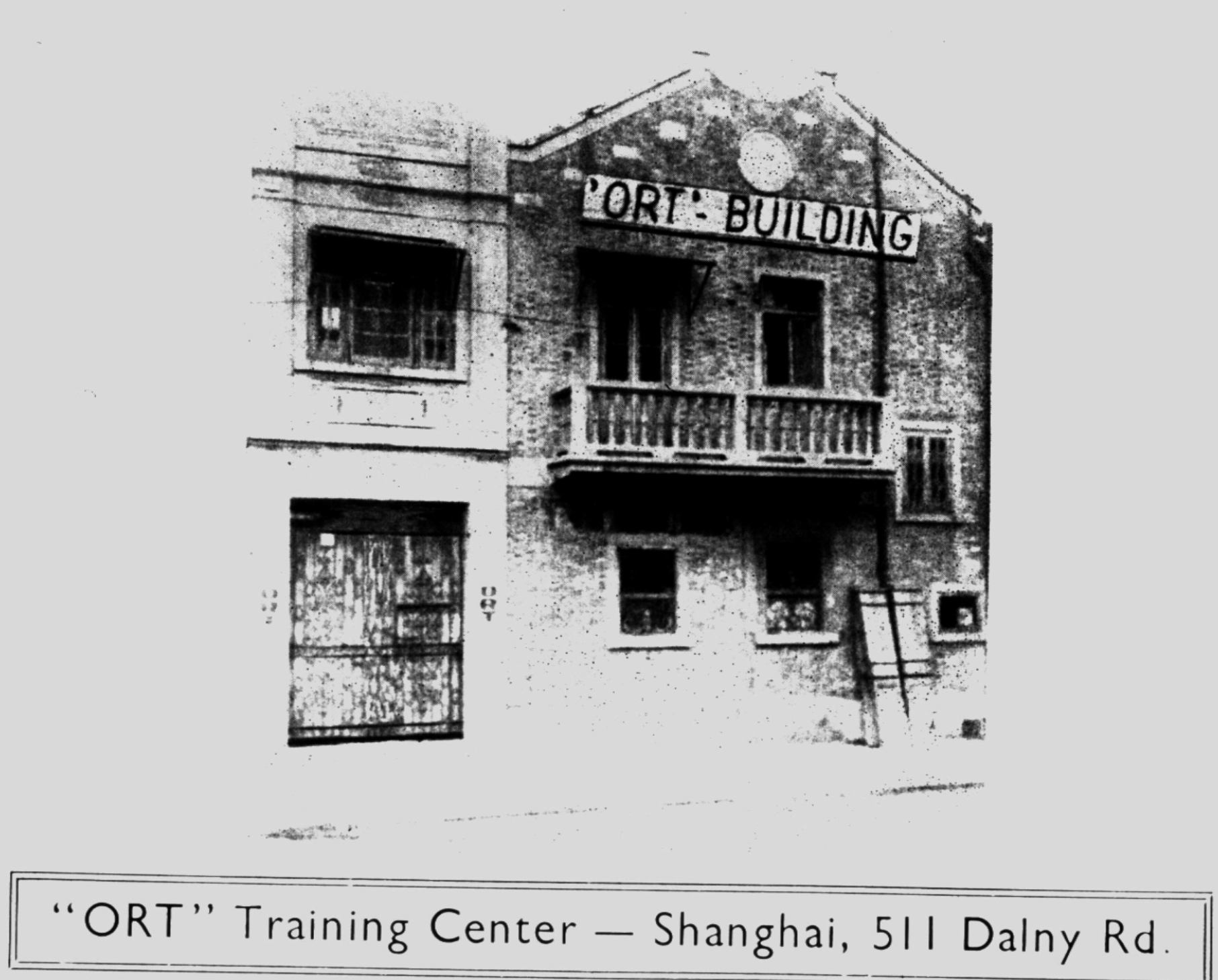
The ORT Training Centre, 511 Dalny Road, Shanghai. YIVO Institute for Jewish Research. ORT Shanghai records. Record group 243.
A visitor to the school described a carpentry class building doors, windows and furniture, and an industrial art class that supplied decorations for a JDC nursery, where the children's daily hot meal was cooked by girls from the ORT cooking course. The bookbinding course showed how far the refugees' professional lives had been overturned:
“In the bookbinding course former lawyers, businessmen and even a philosopher are successfully studying to acquire manual skills and produce beautiful pieces of excellent craftsmanship.”
Emigration had begun as soon as the war ended. Rozenbes himself left for Australia in June 1947, and M. Rechenberg succeeded him as director. ORT's attention turned to those preparing to leave, and it began to teach at the Shanghai Jewish School (SJS) and the Shanghai Jewish Youth Association School. At the SJS, ORT vocational classes were built into the senior curriculum: dressmaking from 8 September 1947, carpentry from 8 October 1947, and gardening from 26 January 1948, opened with a tree-planting ceremony attended by all the schoolchildren. In March 1948 ORT moved out of Dalny Road into a hut supplied by the JDC and erected in the grounds of the SJS in Seymour Road. It continued to work with adults: a bookbinding course ran for tuberculosis patients at the Refugees' Hospital from 19 January to 15 April 1948, bookbinding and necktie-making were taught to the elderly residents of the Joint-House, and in the autumn of 1948 an intensive carpentry course was organised for young men expecting to emigrate to Israel shortly. Rechenberg described the school's purpose in broader terms than trade training:
“Our training...was more than a mere teaching of a trade. Many of our pupils had suffered and undergone great hardships, and often have broken down under this strain. We tried to assist them morally, we tried to give them a new outlook and a new way of thinking, and thus to build up their character and personality.”
By 1948 the Jewish population of Shanghai had fallen from 30,000 to about 10,000, and ORT's work with Holocaust refugees in the city closed in early 1949. After the Communist victory in the Chinese civil war that year the remaining Jews were forced out, and almost all had emigrated by 1956. Among those who went to Australia was the family of Peter Witting, who had kept a diary in English and German of his life in the Shanghai ghetto until the family emigrated in 1947. One of the photographs he later gave to Yad Vashem shows him with other pupils of the Shanghai Jewish Youth Association School learning to build radios. His mother, Anne Witting, insisted in her letters on calling herself and her fellow Jews 'immigrants' rather than 'refugees'.
Ohel Moshe was confiscated after 1949, used as a psychiatric hospital and as offices, and in 2007 was restored by the Hongkou district government and opened as the Shanghai Jewish Refugees Museum. In 2014 a 34-metre copper memorial wall engraved with the names of 13,732 Jewish refugees was unveiled there. Ohel Moshe and Ohel Rachel are the only two of the old city's synagogues still standing.
Sources
Fetthauer, Sophie. 'Jewish Refugee Musicians in Exile in Shanghai during World War II'. Lecture announcement and poster, Vassar College, 28 March 2023. www.vassar.edu/news/events/2023/jewish-refugee-musicians-exile-shanghai-during-world-war-ii and www.vassar.edu/sites/default/files/2023-03/Fetthauer-Project-Poster.pdf (accessed 29 October 2026).
Fetthauer, Sophie, ed. Hier muß sich jeder allein helfen: Paula, Josef and Frieda Fruchter: Letters from a Viennese family of musicians in exile in Shanghai 1941-1949 (Sophie Fetthauer, von Bockel Verlag 2024)
Jewish Historical Society of Delaware. 'Shanghai Sonatas – Demarcation and Cooperation: Jewish Cantors in Shanghai Exile'. Lecture by Sophie Fetthauer, 16 November 2022. jhsdelaware.org (accessed 29 October 2026).
Jewish Museum Berlin. 'Émigré: Music from the Jewish Exile in Shanghai'. jmberlin.de/en/concert-emigre (accessed 29 October 2026).
Rechenberg, M. ORT Shanghai: Society for Promotion of Handicrafts and Agriculture for Jews in East Asia. Activities for the Years 1947–1948. Shanghai, 1949. World ORT Archive, d02a001. ortarchive.ort.org/fileadmin/d/china/d02a001.pdf (accessed 29 October 2026).
'Shanghai Jewish Refugees Museum'. Wikipedia. en.wikipedia.org/wiki/Shanghai_Jewish_Refugees_Museum (accessed 29 October 2026).
United States Holocaust Memorial Museum. 'The Archives of the World ORT Union Head Office'. RG-68.219 (2019.190.1), via EHRI Portal. portal.ehri-project.eu/units/us-005578-irn699652 (accessed 29 October 2026).
World ORT. 'ORT's Work during the Second World War'. ORT and the DP Camps. dpcamps.ort.org/history/orts-work-during-the-second-world-war/ (accessed 29 October 2026).
World ORT. 'Shanghai'. ORT and the DP Camps. dpcamps.ort.org/camps/shanghai/ (accessed 29 October 2026). Quotes American ORT Federation Bulletin (January 1949), p. 4.
World ORT Archive. 'China (Shanghai)'. ortarchive.ort.org/browse-regions/asia-and-oceania/china-shanghai (accessed 29 October 2026).
World ORT Archive. World ORT Union information bulletin, 'From Shanghai'. Ref. f236001. ortarchive.ort.org/fileadmin/d/world_ort_headquarters/f236001.pdf (accessed 29 October 2026).
YIVO Institute for Jewish Research. ORT Shanghai records. Record group 243, from the English language newspaper “The China Press” 18 Nov 1946.
Yad Vashem. 'Shanghai'. This Month in Holocaust History: July 1942. www.yadvashem.org/holocaust/this-month/july/1942-2.html (accessed 29 October 2026). Includes Yad Vashem Photo Archives 4648/2.