



David Boder and the Songs on the Wire
In July 1946, American psychologist David Boder set sail for Europe with a wire recorder and two hundred spools of steel wire. His intention was to record the stories of those left stranded by the war. Over the course of about two months, he travelled through displaced persons camps, children's homes, refugee hostels, and vocational schools in France, Switzerland, Italy, and Germany. He conducted around 130 interviews in nine languages. These recordings are the earliest known sound recordings of Holocaust survivors. Although Boder had not travelled to collect songs, he asked about them from the outset. What he heard altered the course of his project, and from late August onwards, he began setting aside separate spools for singing. The result is the world's first sound archive of Holocaust songs — not transcribed lyrics or written melodies, but the voices of people who had carried these songs out of the ghettos and camps just a year or two earlier. However, it is also an archive shaped at every point by Boder himself, who was trained neither in music nor in folklore, and who never wrote down his reasons for collecting songs. Eleven of the recordings are published on this website. A striking number of them were made in places run by ORT, whose schools and workshops Boder repeatedly used as recording venues, interviewing its staff and pupils at length.
For musicologists, Boder's recordings are significant not only for the songs themselves, but also for the way they are performed. Unlike songbooks and later recollections, the wire recordings capture the voices of survivors at the moment of recollection, preserving their languages, accents, hesitations, melodies, rhythms and imperfections. They therefore provide evidence of not only what survivors remembered singing, but also how those memories were performed and communicated in the immediate aftermath of the Holocaust.
The Man and the Machine
Boder was born Aron Mendel Michelson in Libau, Latvia, in 1886. After studying psychology under Wilhelm Wundt in Leipzig and Vladimir Bekhterev in St. Petersburg, he moved westward across several countries and settled in Chicago. There, he obtained an MA from the University of Chicago in 1927 and a doctorate from Northwestern in 1934. While teaching at the Lewis Institute (later part of the Illinois Institute of Technology), he began planning the trip and announced each spool as an 'Illinois Institute of Technology wire recording'.
The wire recorder was a relatively new invention. Sound was stored as magnetic variations on a thread of steel wire wound between spools, and the equipment was just portable enough to be carried into a hostel dormitory or a workshop. However, it was not discreet. Boder's spool announcements are full of apologies for the conditions in which he was working. Recording Adam Krakowski at the ORT school in Paris on 30 July, he noted, " 'There is some interference. A typewriter is knocking in the other room, and noise comes from...' Elsewhere, the wire itself intrudes: in one interview, a section of noise in the recording is described in the transcript as sounding like an aeroplane passing overhead.
He sailed on the USS Brazil in late July, working at a rate of between two and five interviews a day — occasionally up to nine — and finished in early October with more than ninety hours of material. Most of the people he recorded were Eastern European Jews, primarily Polish. Around twenty were Western European Jews, and twenty-one were not Jewish at all. Thirty-three were twenty-five or younger.
Boder was neither a musician nor a folklorist. The papers he left at the Illinois Institute of Technology document his career in experimental psychology, covering topics such as laboratory apparatus, visual pattern discrimination and a 1942 paper on Nazi science. Above all, his work focused on the psychology of language. His best-known pre-war work, 'The Adjective-Verb Quotient: A Contribution to the Psychology of Language, proposed measuring a speaker's state by counting parts of speech. He travelled to Europe to study the effect of extreme suffering on personality, using language as his instrument.
This sheds some light on his interest in songs. When Boder told a singer not to worry about their voice, but to ensure the words were clear, he was asking for the text to be delivered audibly; it was the melody that carried it. He was also willing to override a speaker's preferred medium. Eighteen-year-old Israel Unikowski, who lived at the Château de Boucicaut outside Paris, had written his life story and wanted to read it aloud. Boder's spool announcement records his refusal, stating that the young man "should prefer to speak from a previously prepared written account of his life". However, we insisted exclusively upon verbal reports without notes or memoranda. He is rather reluctant to do it, but he was convinced by Dr Reich and myself to at least try.' What Boder wanted was speech, and a song was a form of speech that had remained intact.
The recordings bear the hallmarks of this approach. They preserve lyrics well, tunes less well, and almost nothing about how the songs had been performed in the camps — whether in unison or alone, how fast, and on what occasions. Joseph Toltz and Anna Boucher, who have worked most closely with the material, note that Boder 'never explicitly accounts for the historical value of this aspect of his project', and describe 'the absence of tangible methodology left by Boder' as an obstacle to studying it. He recorded the songs assiduously and left no explanation as to why.
Asking people to sing
Boder was not a neutral instrument. The songs exist because he requested them in a specific way, and what he requested shaped what he received. His standard question paired songs with poems — were there poems or songs in the camp? This framed both as products of the camp rather than whatever people happened to have been singing. He often asked this question near the end of an interview, after the narrative had been completed, suggesting that it was a regular part of his routine rather than something that had arisen from the conversation. Sometimes he built on what he had already been told. On 5 August, for example, when he asked Rita Benmayor about Auschwitz, he opened with, 'They say that there were songs in Auschwitz that the girls would sing.' Forty-six of the interviews touch on musical experience in some form.
When someone knew a song, Boder had a tried-and-tested method of recording it. He insisted that singing ability was irrelevant and that only the words mattered. The following exchange with nineteen-year-old Auschwitz and Buchenwald survivor Ludwig Hamburger, recorded at the ORT school in Geneva on 26 August, is characteristic:
"Do you know any poems from Buchenwald?" — "No. I know a song." — "Well, would you sing it a bit." — "I . . . I am not much of a singer." — "No, you do not have to be, so long as the words are heard clearly. Yes?"
Hamburger sang the Buchenwaldlied through — "When the day awakens / And the sun is laughing / The columns go forth / From the day's toil / Through the grey of the morning" — and explained that the last line had been altered after liberation. Boder then asked for something specific: "Yes. Try one. I want to have. . . . Can you remember 'It Burns'?" Hamburger said "One moment. [He thinks.]", and offered a different song instead, one he introduced as coming from his deportation: "On a heym, on a dakh" ("Without a home, without a roof"), which ends "Because, without a home and without a roof, / We wandered throughout the night!" That recording is published on this site. Boder closed the spool: "This concludes the interview with Mr. Ludwig Hamburger. At Geneva, August the 26th, 1946, at the ORT School. An Illinois Institute of Technology wire recording."
Boder kept the answers that produced nothing, too, and they are part of the record. Most were not final. On 4 August, Bertha Goldwasser told him that the Maquis had composed beautiful songs, and then said that she could not sing one: 'I can't sing. I have no voice," and then said that she could not remember it. He asked her four times, lowering the bar with each request: first to sing quietly, then to hum it, then to make sure the words were clear, and finally to just try. She sang a Resistance song in French, followed by a song from Ravensbrück. After each one, she said that there were more words that she had lost. Three days later, Henja Frydman described how the deportees had sung the Marseillaise on their way out of Drancy. When asked if she remembered any of those songs, she fell silent. The transcript only records that she appeared to shake her head. When pressed by Boder, she sang a verse to the tune of the 'Warszawianka' and then a song that she had written with a friend in prison.
The pressure was not applied evenly. Janine Binder said the songs in her camp had all been in Polish, but that did not deter Boder — 'Still... One verse...' — and this time nothing came. 'By that time, I had already forgotten everything.' Benmayor said 'no' twice, then moved straight on to her uncle in Hartford. At the end of her thirty-minute account of the Warsaw ghetto and Bergen-Belsen, Helena Neufeld gave the one answer that corrected the question rather than failing it. There had been songs at Belsen — "very few" — but none had been composed there. "No, no, no, no," she said, but then added, "Of course, people wrote verse." There had been creation in the camp, but it had not taken the form Boder was asking about.
The ORT School, Geneva, 26 August 1946
Boder spent the last week of August in Geneva, where he recorded at the ORT school across several days. On 26 August, he interviewed pupils Sigmund Reich (aged twenty) and David Hirsch, as well as Hamburger. The following day, he recorded Yanusch Deutsch, aged seventeen and a half, at what he termed the 'ORT School of Mechanics', as well as Abraham Kimmelmann, whose three-and-a-half-hour interview is the longest in the collection. On 28 August, he interviewed the staff, including the workshop chief, Joseph Freinhoffer, and the school secretary, Mrs Borgman. Freinhoffer, a Swiss national who had worked as a technical instructor at a vocational school in Zurich, informed Boder that the school had opened at the end of April 1944, and that it now had thirty-six boys. He also offered a comparison: 'When it comes to effort, the students here, who have come out of the camps, work harder than those I have taught in Zurich, those students who live with their parents and grew up in comfortable circumstances.' Boder also recorded Arthur Breslauer (fifty-four) and Malka Johles (forty-six) in what he described as 'the knitting shop in the ORT knitting training shop in Geneva'.
On the same day that Hamburger sang the 'Buchenwaldlied' at the ORT school, Wolf Nehrich sang it at a community home for displaced Jewish refugees elsewhere in Geneva. Nehrich had gone further than merely remembering it: "Ich hab es hier aufgeschrieben sogar. Ich kann es auswendig auch' ('I've even written it down here. I know it by heart as well'). He told Boder that the camp commandant had requested a song and offered a hundred cigarettes in exchange for it. In fact, the song had been commissioned in December 1938 by Lagerführer Arthur Rödl, who promised a prize that was never paid. Hermann Leopoldi wrote the music and Fritz Löhner-Beda wrote the lyrics in three days. Rödl then had the prisoners rehearse the song with the camp orchestra for hours.
For Boder, the fact that two men in one city sang the same camp song into the same machine on the same day seems to have settled something. Joseph Toltz and Anna Boucher, who have studied the song material most closely, date this change to Boder's visit to the Geneva ORT and DP centre. The practice of asking individuals to sing during interviews stopped, and organised group sessions took its place. Boder described his method of recruiting singers in a way that suggests the machine did most of the persuading. He would eat with the displaced persons, play back a recording of them talking or singing together, and then, as he put it, 'the wonder of hearing their own voices recorded knew no bounds. Then I would explain my project and ask for volunteers.'
Song on spools
From September, the songs were recorded on their own wires, as Boder's announcements plainly stated. Closing an interview with the painter Bernard Warsager in Tradate, Italy, on 1 September, he noted, 'This is the end of spool number 104. We are moving on to spool 106, as spool 105 contains the songs we recorded this afternoon."

David Boder at the Tradate DP Camp, Northern Italy. Still frame taken from film USHMM 4234.
The Geneva songs had gone onto spools 84, 89 and 90, recorded at a dormitory occupied mostly by what Boder called "Buchenwald children", at 6 Rue de Prenie. He noted in a footnote that the back windows of the dormitory faced the buildings of the League of Nations. Closing spool 84 he recorded what had displaced the interview: "The spool had only about 18 indicator minutes of Kimmelmann's interview. The rest were the songs."
Spool 9–105 contains the Tradate session, comprising around a dozen Yiddish songs. Among them are "Dort in dem lager" ("There in the camp"), "Di shif 'Seder'", which is about the British blockade of Palestine, a Treblinka song, Gebirtig's "Undzer shtetl brent", and "Yeder geshikhte hot ayn ende", which was written in Buchenwald to the tune of "Arum dem fayer". Four of these songs are published on this site. On 8 September, in Bellevue outside Paris, he recorded children and caregivers from Lena Küchler's orphanage singing mainly in Hebrew, including "Shir haPalmakh" and Bialik's "Lo bayom velo balayla". In Munich, he recorded Mennonite hymns at the Flak Kaserne, as well as Latvian and Lithuanian folk songs and a Rosh Hashanah service at Camp Lohengrin. In Wiesbaden, he recorded part of a service at the Friedrichstrasse synagogue. The final spool in Paris contains the note: 'Spool 169B contains some incidental conversations and songs taken during the last evening of my stay in Paris. Boder.'
There had been singing earlier, too, before the method became systematic. On 31 July, at the Château de Boucicaut in Fontenay-aux-Roses, where around forty-five boys evacuated from Buchenwald were living, Boder recorded group and solo singing and introduced it with unusual frankness:
'It starts with rather dissonant singing, but the melody can probably be recognised and the words eventually translated, if that hasn't been done already. The interviewee is Kalman Eisenberg, who later sings the solo song.'
Regarding the house itself, he noted that the boys were learning a trade under the direction of ORT. It was at Boucicaut, two days later, that he recorded Israel Unikowski, who sang three songs in succession — "Es brent", "Do tif in a vald" ("There, deep in a forest") and "Shtil, shtil" — the second of them published here. Boder ended the spool with a note that stands for the working conditions of the whole trip:
"He sang the last three songs in a very low voice and what we hear here, of course, is amplification. We try to work the machine under best possible conditions, but we have no soundproof rooms, and we are working on fifty cycles."
Boder was also keeping track of particular songs in his own collection. When Israel Unikowski performed Gebirtig's 'Es brent' at the Château de Boucicaut on 2 August, Boder added a handwritten footnote: 'This song is attributed to the Polish-Jewish songwriter Gebirtig.' See also the unnumbered spool marked 'Hénonville Songs', where this song was sung by Guta Frank. See also Geneva Songs, Spool 84, and Tradate Songs, Spool 105.' Having heard the same song performed by four different people in four different places, he recognised it when he heard it again three weeks later, which is why he asked Hamburger for it by name. This is also why the "Es brent" published on this site cannot be tied to a session: there are four possible recordings. The footnote also inadvertently reveals how the Hénonville songs were lost. That spool was 'without a number'. It carried only a written label.
Hénonville
Between 12 and 13 September, Boder worked at Hénonville, a château located fifty kilometres from Paris which had been allocated to displaced Jews. His speech announcements describe the arrangement there three times over. When introducing Udel Stopnitsky, aged thirty-one, he described it as "an extremely religious kibbutz, which has now been given over to displaced Jews, and which is home to an ORT school of agriculture and various trades". The following day, introducing Isaac Ostland, he described it as "a home maintained by the Agudah, together with the ORT. Its main inhabitants are a Hasidic group led by their rabbi." Opening spool 125, he set out the details at length: 'It is a cooperative arrangement between the World ORT, which handles the teaching of various trades and agriculture, and the Agudah, which maintains the place and seems to own this wonderful château. It was once owned by a wealthy Frenchman and has been left in a state of disrepair." The interviewee on that reel was Solomon Horowitz, the community's rabbi, who described how the community spent its Sabbaths: 'On Saturday, no work is done, but the whole day is spent singing and dancing. People dance together. ... We sing together, we eat together, and lectures about the Torah are given.'
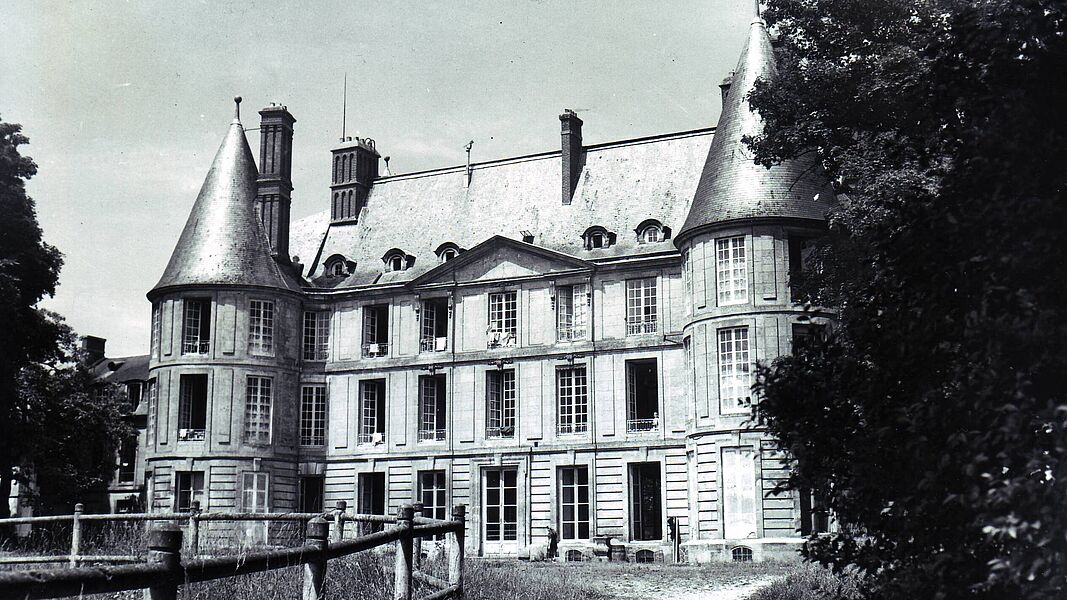
Hénonville château was allocated to displaced Jews and was where ORT ran its school of agriculture and various trades.
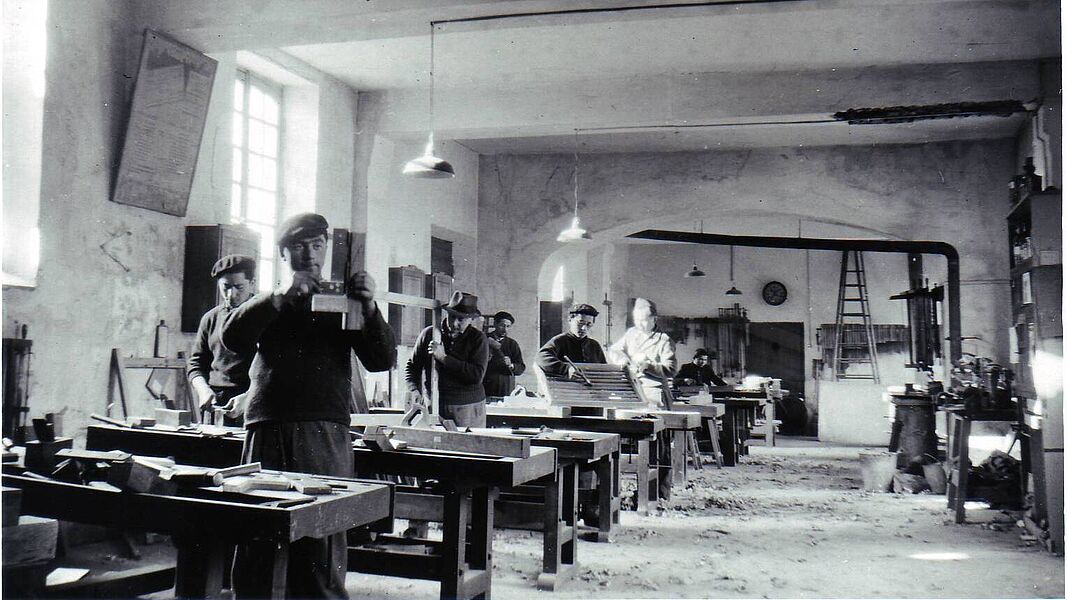
One of the trades taught in the school was carpentry.

Some of the chateau's grounds were used for agricultural training.
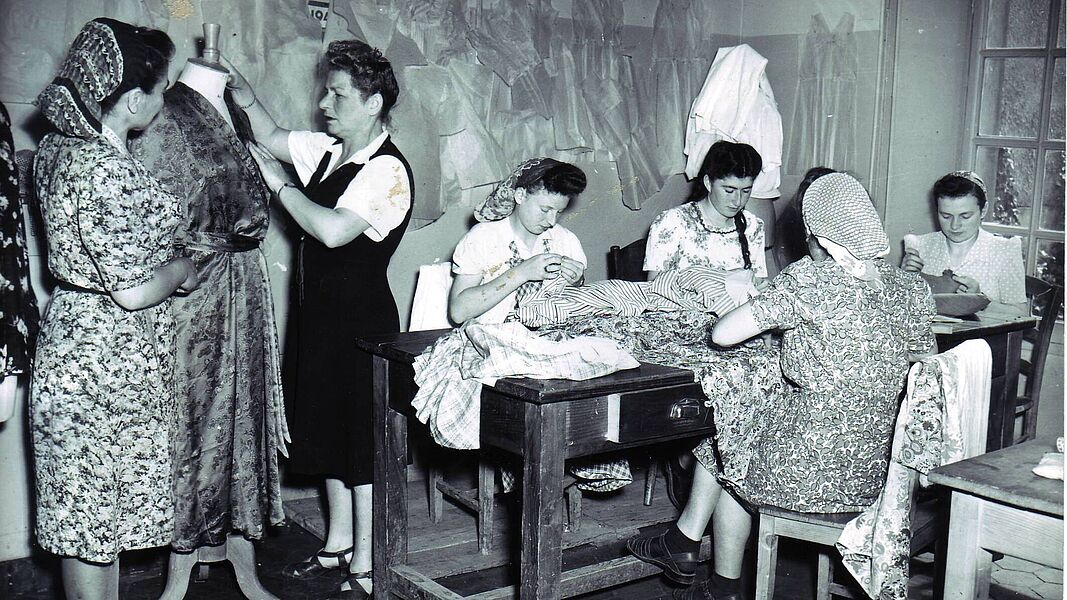
Other skills taught at the school included sewing and dressmaking.
The twenty-two-minute Hénonville song session contains six songs. Joel Prizant — catalogued by the United States Holocaust Memorial Museum as Dzhuel Prizant — performed three of them: "Dos yidishe lid", also known as "Golus-lid", written by Anshel Schorr and Sholom Secunda; a cantorial piece titled "Aheym"; and Nokhem Sternheim's "Fraytik oyf der nakht". Malka Rosenberg sang David Meyerowitz's "Ikh for aheym" ("I'm going home"). Guta Frank — the spelling Boder used himself, though the museum catalogue gives Gute and the scholarship Gita — sang two: Gebirtig's "Undzer shtetl brent", written in 1938 after the Przytyk pogrom, and a German song, "Unser Lager steht am Waldesrande", from the Brande forced labour camp in Silesia.
The mixture is worth noting. Three of the six were American Yiddish theatre numbers from the 1920s; one was a Polish Yiddish song from the interwar period; one was a pre-war warning song adopted by the ghettos; and one originated in a labour camp. Two of the songs were sung a year after liberation by people living in a religious kibbutz where ORT taught agriculture and trades; these songs were about going home.
ORT in the interviews
ORT is not incidental to the collection. Boder recorded at the Paris ORT school on 29 and 30 July, and again on 16 August. He interviewed pupils including Adam Krakowski, Marko Moskovitz — whom he described as "a young man" and a "pupil of the ORT" — as well as Samuel Isakovitch, Polia Bisenhaus, Raisel Roset, Boleslaw Czolopicki, Leon Shachnovski, Malfis Marson, and a Spanish refugee who was only recorded as "Rudo", and who was "taking classes at the ORT Schools in Paris". He also recorded the school's director: "a interview taken from Mr. Bramson, the director of ORT school at 12 Rue de Saules in Paris."
The World ORT Union conference held in Paris in August brought a number of ORT officials within reach of his microphone. Among them was Jacob Oleiski, aged forty-six and born in Šakiai, Lithuania. He had been the principal of the Kaunas ORT school since 1929 and had organised vocational training in the Kovno ghetto. He had also survived the Stutthof and Dachau concentration camps and opened the first ORT course in a displaced persons camp at Landsberg in October 1945. He told Boder, "I have the mandate of the ORT Union society and I am the director of the ORT society in the entire American zone." Rachel Gurmanova, who had been secretary of the central committee of ORT in Poland since 1921, began her account by insisting on the context: 'First, I must talk about my work in the ORT. I spent all my time in the ORT, and it was there that I spent the whole time of the occupation." Boder also interviewed Jacob Wilf, a Katowice delegate; Fira Monk, an executive secretary in the Paris office; and Feneger, who was collaborating with ORT to train Jewish sailors and fishermen.
By the time he reached Wiesbaden on 26 September, Boder knew the organisation well enough to supply its name himself. When he asked Judah Golen about agricultural training, Golen interrupted: 'Isn't that done with the ORT — in conjunction with the ORT?'
Displaced persons had their own view of the agencies, and this is reflected in the songs they wrote at the time. Alongside laments and Zionist anthems, the camps produced satirical material aimed at the Joint Distribution Committee (the 'Joint'), the United Nations Relief and Rehabilitation Administration (UNRRA) and the ORT — the bodies on which daily life depended and which, being close at hand, made convenient targets.
What happened to the wires?
Boder spent the rest of his life working on the material. Between 1947 and 1957, he transcribed and translated seventy of the interviews into English, publishing eight of them in I Did Not Interview the Dead in 1949. He also issued the Topical Autobiographies himself between 1952 and 1957 and published an analytical essay entitled 'The Impact of Catastrophe' in 1954. He died in December 1961.
The whereabouts of his original 1946 spools remained unknown for decades. A duplicate set, which was deposited with the National Institute of Mental Health and is now held by the Library of Congress, was incomplete: eleven spools were missing. In the 1980s, the Library of Congress transferred its collection to open-reel tape and digitised it. Digital audio tapes reached the Illinois Institute of Technology in 1999, where they were converted to WAV files in 2007 and 2008. One hundred and eighteen interviews with 121 interviewees are now published alongside synchronised transcripts on the Voices of the Holocaust website. The song sessions were never part of that set.
Boder's original spools were sent to the University of Akron in 1967, but there was no machine capable of playing them there for decades. In around 2014, James Newhall, a multimedia producer at the university, found a wire recorder on eBay with the help of his colleague Litsa Varonis. With the guidance of electrical engineer Orestes Varonis, he then rebuilt the recorder using modern components. In the summer of 2016, Jon Endres opened a tin labelled 'Henonville? Songs". It had been catalogued in the 1960s as 'Heroville Songs', which is why it had remained unnoticed until then. 'These are the missing songs that Boder recorded from those survivors,' said Endres, 'recorded more than 60 years ago.'
Musicologist Bret Werb, working at the United States Holocaust Memorial Museum, identified Gute Frank and her work. While the words of the Brande camp song had been documented, the melody had not been heard. David Baker, the director of the Cummings Center, noted that prisoners had been made to sing such songs 'as they ran to their forced labour sites and back each day', and that the aim of the recovery was to be able to supply the tune. In April 2017, the museum made digital copies from the Akron originals.
Eleven songs from the Boder recordings are published on this website, with an additional one published by the United States Holocaust Memorial Museum. Toltz and Boucher estimate that these represent less than a sixth of Boder's recorded songs, not including the two religious services he recorded in Germany. Most of what he collected in late summer 1946 has yet to be heard outside of an archive.
Sources
Boder, David P. I Did Not Interview the Dead. Urbana: University of Illinois Press, 1949.
'David Boder'. Voices of the Holocaust. Illinois Institute of Technology. https://voices.library.iit.edu/david_boder
'Project Notes'. Voices of the Holocaust. Illinois Institute of Technology. https://voices.library.iit.edu/project_notes
Voices of the Holocaust. Illinois Institute of Technology. Interview transcripts and audio: https://iit.aviaryplatform.com/collections/231
Boder, David P. 'The Adjective-Verb Quotient: A Contribution to the Psychology of Language'. The Psychological Record 3 (1940), 310–343. https://doi.org/10.1007/BF03393230
'David Pablo Boder papers, 1930–1957'. University Archives and Special Collections, Illinois Institute of Technology. https://findingaids.library.iit.edu/repositories/2/resources/573
Voices of the Holocaust interview records, Illinois Institute of Technology: Jacques Bramson (16 August 1946, ORT School, Paris), https://voices.library.iit.edu/interview/bramsonJ; Kalman Eisenberg (31 July 1946, Château de Boucicaut, Fontenay-aux-Roses), https://voices.library.iit.edu/interview/eisenbergK; Judah Golen (26 September 1946, Wiesbaden), https://voices.library.iit.edu/interview/golenJ; Rachel Gurmanova (17 August 1946, Paris), https://voices.library.iit.edu/interview/gurmanovaR; Ludwig Hamburger (26 August 1946, ORT School, Geneva), https://voices.library.iit.edu/interview/hamburgerL; Solomon Horowitz (12 September 1946, Hénonville), https://voices.library.iit.edu/interview/horowitzS; Jurek Kestenberg (31 July 1946, Château de Boucicaut), https://voices.library.iit.edu/interview/kestenbergJ; Adam Krakowski (30 July 1946, ORT School, Paris), https://voices.library.iit.edu/interview/krakowskiA; Marko Moskovitz (30 July 1946, ORT School, Paris), https://voices.library.iit.edu/interview/moskovitzM; Wolf Nehrich (26 August 1946, Geneva), https://voices.library.iit.edu/interview/nehrichW; Jacob Oleiski (20 August 1946, Paris), https://voices.library.iit.edu/interview/oleiskiJ; Isaac Ostland (13 September 1946, Hénonville), https://voices.library.iit.edu/interview/ostlandI; Udel Stopnitsky (12 September 1946, Hénonville), https://voices.library.iit.edu/interview/stopnitskyU; Israel Unikowski (2 August 1946, Château de Boucicaut), https://voices.library.iit.edu/interview/unikowskiI; Bernard Warsager (1 September 1946, Tradate), https://voices.library.iit.edu/interview/warsagerB
'Songs recorded in Henonville DP camp'. United States Holocaust Memorial Museum, RG-91.2015, accession 2017.325. https://collections.ushmm.org/search/catalog/irn719266
'Songs of Bellevue'. United States Holocaust Memorial Museum, RG-91.2265. https://collections.ushmm.org/search/catalog/irn620183
'Songs of Tradate'. United States Holocaust Memorial Museum, RG-91.2266. https://collections.ushmm.org/search/catalog/irn620184
'Dr. Boder and the Missing Songs'. Cummings Center for the History of Psychology, University of Akron, 2 September 2016. https://centerhistorypsychology.wordpress.com/2016/09/02/dr-boder-and-the-missing-songs/
'Lost songs of the Holocaust found in University of Akron archives'. University of Akron press release, February 2017. https://www.eurekalert.org/news-releases/629496
Endres, Jon. 'The Henonville Wire Spool: A Document Found'. Proceedings from the Document Academy 4:2 (2017). https://ideaexchange.uakron.edu/docam/vol4/iss2/10/
Rosen, Alan. The Wonder of Their Voices: The 1946 Holocaust Interviews of David Boder. Oxford: Oxford University Press, 2010.
Toltz, Joseph, and Anna Boucher. 'Out of the Depths: Complexity, Subjectivity and Materiality in the Earliest Accounts of Holocaust Song-Making'. East European Jewish Affairs 48:3 (2019), 309–330. https://doi.org/10.1080/13501674.2018.1559695
'Music amongst Displaced Persons'. Music and the Holocaust. World ORT. https://holocaustmusic.ort.org/memory/dp-camps/
'Buchenwaldlied'. Music and the Holocaust. World ORT. https://holocaustmusic.ort.org/places/camps/central-europe/buchenwald/buchenwaldlied/
'On a heym, on a dakh'. Music and the Holocaust. World ORT. https://holocaustmusic.ort.org/memory/dp-camps/on-a-heym-on-a-dakh0/
'Do tif in a vald'. Music and the Holocaust. World ORT. https://holocaustmusic.ort.org/memory/dp-camps/do-tif-in-a-vald/
'Jacob Oleiski'. ORT in Lithuania. World ORT. https://ortinlithuania.ort.org/jacob_oleiski.htm
'Landsberg'. ORT and the DP Camps. World ORT. https://dpcamps.ort.org/camps/germany/us-zone/us-zone-v/landsberg/

David Boder at the Wire Recorder. Courtesy of Professor Yair Aharonowitz.