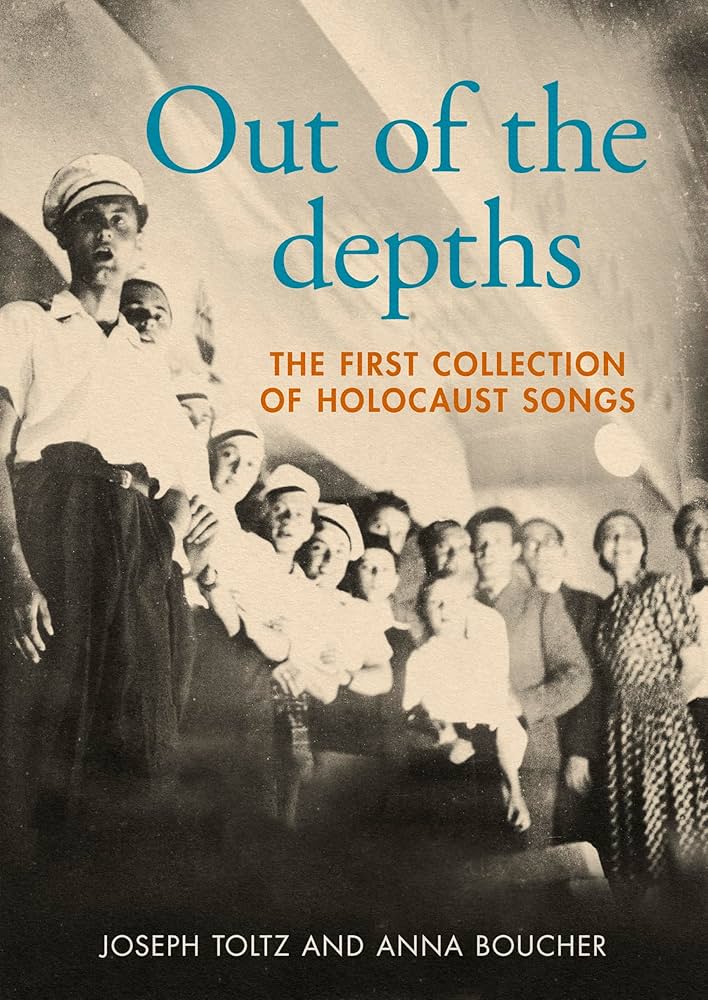



Out of the Depths
A Lost Songbook from the Camps and Ghettos
In June 1945, before the full scale of the Holocaust's destruction had become clear, a small team of Jewish survivors in Bucharest, Romania began an extraordinary project. While documenting the persecution experiences of around a thousand Jewish refugees, they started collecting songs that had been composed and sung in the Nazi camps and ghettos of occupied Poland. The resulting pamphlet, Mima'amakim — meaning "Out of the Depths" — was printed on poor-quality, acidic paper in a run of just 500 copies. Almost all of them were lost. The songbook contained twenty compositions, several written by children and teenagers, alongside short biographies of their authors. Its editor, a Polish survivor named Yehuda Eismann, described the work as a "memorial stone for Polish Jewry." His wife Flora designed the cover. For decades, the booklet and the songs it preserved were essentially forgotten.
Then, in 2013, a copy turned up in the belongings of a recently deceased Polish-born Holocaust survivor living in suburban Sydney, Australia. The woman, identified as "Olga R," had carried the pamphlet from Bucharest to Poland and eventually to the other side of the world, where it sat undisturbed among her possessions. Her family did not read Yiddish and had no idea what it was. They passed it to Joseph Toltz, an ethnomusicologist and lecturer at the Sydney Conservatorium of Music, University of Sydney, who recognised it immediately as a collection originating from the camps and ghettos of Poland between 1939 and 1944. A curator from the United States Holocaust Memorial Museum in Washington DC later confirmed its provenance. Olga R's copy, as far as anyone knows, is one of only a handful to have survived, and reportedly in the best condition of any known copy in the world. It also carried a handwritten dedication from Eismann himself — Olga R had been personally involved in gathering both the songs and the survivor testimonies that accompanied the original project.
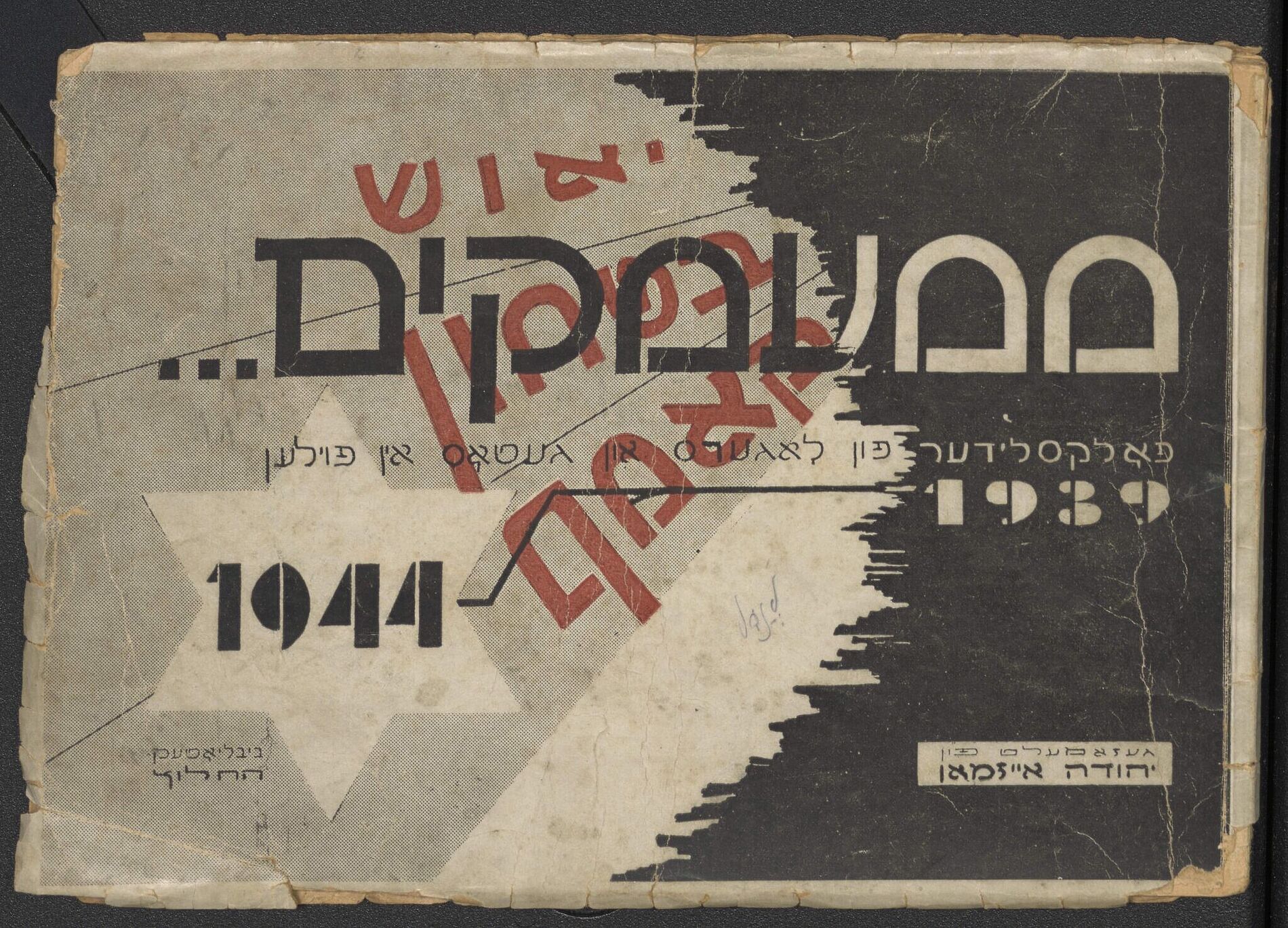
The cover of Out of the Depths, design by Flora Eisman
The Songs and Their Makers
What made this discovery particularly significant was the nature of the material. Unlike many Holocaust testimonies, which were written years or even decades after the events they describe and often by scholars or intellectuals, most of the songs in the pamphlet were composed either inside the camps and ghettos or within weeks of liberation, by people from all backgrounds — engineers, tailors, electricians, and poets, as well as children. As Toltz put it: "Many of the testimonies we have about the Holocaust tended to have been written much later, and often by intellectuals. But most of these songs were either written in the camps or put to paper one to two months after the Holocaust ended, by people from all walks of life. So they felt extremely fresh."
The songs collected in the pamphlet range widely in tone, subject, and formal approach, reflecting the diversity of experience and temperament among their authors. Several engage directly with the annihilation of specific communities. Wolf Sambol, an electrician from Rava-Ruska, composed Dos eybike lid (The Eternal Song) as an elegy for his hometown. Before the Second World War, slightly more than half the population of Rava-Ruska — at least 6,000 people — was Jewish. Beginning in March 1942, transports were sent to the nearby Belzec extermination camp, and approximately 5,000 Jews were shot during a liquidation action between 7 and 11 December 1942. Nearly the entire Jewish population was murdered through mass shootings and deportations; by the war's end, no viable Jewish community remained. According to the academic study of the pamphlet by Anna Lotz, Sambol died in Israel in 1997, and the text of his song was later replicated in the Rawa Ruska Yizkor Bukh in 1973 — the memorial book compiled by survivors to record the destroyed community. His song is thus both a work of personal mourning and a communal document.
Another song, The Third Pogrom, was written by Ayzik Flaysher, a thirteen-year-old orphan, who sang about hiding in a freezing attic after the Nazis took his father. He stated that his "brothers were shot... sisters lost." The fact that a child of thirteen could articulate such loss in song form speaks to the pervasiveness of violence and the extreme compression of childhood experience under Nazi occupation. A separate anonymous song, Treblinke (Treblinka), sung in the ghetto of Biala Podlaska, describes the deportations from Polish towns to the Treblinka death camp in stark, declarative language. Its author and composer are unknown. Treblinka began operation as a death camp in July 1942, and during less than two years of existence, over 850,000 Jews were killed in its gas chambers, most of them immediately upon arrival. The song's final stanza envisions a future discovery of what it calls "the largest grave in the world" where "Jews millions, rest in that soil, / In Treblinka, in Treblinka." According to the United States Holocaust Memorial Museum, the song survives in a number of variant forms, and its musical origins lie in the tango Oración, composed by the Argentine tango director Eduardo Bianco. The borrowing of a dance melody for a song about mass death is itself a striking feature of the ghetto song tradition, in which existing popular tunes were frequently adapted for radically different purposes.
Other songs in the collection deploy dark, sardonic humour as a form of defiance. In Camp March, Sholem Goldberg — the only songwriter the researchers were unable to trace — mocked the conditions of internment through the voice of someone enduring starvation rations: "Soup, it has no fault / salt and fat and taste are missing. / It's worse than any diet. You really should try it." This mode of bitter comedy has parallels across the broader corpus of Holocaust camp songs. From the time the first concentration camps were established in 1933, camp guards routinely ordered detainees to sing while marching or exercising or during punishment actions, and prisoners who did not comply were beaten. The existence of self-authored songs like Camp March, with their ironic inversions and deliberate absurdity, can be understood partly as a response to this enforced relationship between music and subjugation — an attempt to reclaim the act of singing on the author's own terms.
All of the songs, whether sorrowful or sardonic, can be understood as acts of resistance. Music was performed in traditional-style concerts in the ghettos and sung during slave labour in the camps. There were debates among the imprisoned communities about whether creating art under such conditions was appropriate at all. In the Vilna Ghetto, some argued that "you can't create a theatre in a cemetery." But others recognised that performance helped people process what was happening to them. Co-author Anna Boucher, Associate Professor of Government and International Relations at the University of Sydney, has pointed out that the cultural and musical education of pre-war Jewish communities in Eastern Europe was considerable, and that many of the Jewish orchestras within the camps were more accomplished than those outside, simply because of the number of professional musicians who had been taken prisoner. She has also noted that while camp orchestras were often established at the initiative of the Gestapo — ensembles like the Women's Orchestra of Auschwitz were made to play for officers who enjoyed their Schubert — many of the songs in the collection were self-initiated and deliberately subversive. The Gestapo spoke German, not Yiddish or Polish, so singing in those languages was itself a quiet act of defiance. As Boucher put it: "Where books can be burned, as long as your memory is still functional and you've got a good ear, no one can steal a song from you or destroy it."
Twelve Years of Research
Toltz and Boucher spent over a decade tracking down the stories behind each of the twenty songs, in several cases managing to interview the surviving composers and lyricists themselves. The last of the contributors died in 2023; six of the twenty had perished in the camps. The search for the others revealed a remarkable story of post-war Jewish migration: contributors were eventually found as far away as Johannesburg and Madrid. When Toltz began to sing The Song of A Seamstress to one of the survivors, Janina Altman, she joined in, remembering every word.
The research also uncovered disturbing material that went beyond the actions of the Nazi state. A recurring theme in the songs was vigilante violence in the eastern territories — neighbours taking on the work of the Gestapo. When the researchers interviewed Ayzik Flaysher's wife, she described seeing her uncle's head paraded around a town square. Boucher has acknowledged plainly that the book was not easy to write, and that both authors had nightmares during the process.
One song in the collection, Ponar (meaning "lullaby"), has become widely known and is still sung at Holocaust Memorial Day services around the world. It was composed in the Vilna Ghetto by Tamir Kaczerginski, who was eleven years old at the time, and is considered the most musically sophisticated work in the pamphlet, with complex chord construction and harmonic variation. Like many of the songwriters Toltz and Boucher spoke to, Kaczerginski refused to claim personal ownership of the piece, regarding it as communal property. When asked to sign a copyright licence for the new book, he laughed and said: "Don't be ridiculous." Boucher has observed that these songs were written to be performed and shared, not to be controlled or made part of a copyright system.
Another song from the collection, The Partisan Song, also remains in active use and is still performed at memorial services internationally.
A New Edition
The new English-language edition of Mima'amakim, titled Out of the Depths: The First Collection of Holocaust Songs, is being published by Manchester University Press, which has described it as "a remarkable historical document." The book contains the songs' melodies and lyrics in a new English translation by Toltz, alongside the original Yiddish, as well as biographies of the composers drawn from the authors' original research. Introductory essays provide historical and musicological context.
In announcing the book, Boucher wrote that at a time of rising antisemitism, the work has taken on a significance that neither author anticipated when they began over a decade ago. She has described presenting the material at high schools, refugee services, Jewish community events, and the University of Sydney, and has suggested that the songs offer a way not only to teach about the Holocaust but also to speak to anyone from a refugee or war background who has been forced to leave a place they once loved. Pre-orders with Manchester University Press have reportedly been strong, and the book is expected in September 2025.
Toltz, who spent thirteen years as cantor and director of pastoral care at Australia's Emanuel Synagogue and has interviewed more than a hundred survivors over the course of his career, has said: "It is amazing to think that a tiny songbook, printed on poor quality paper, could not only survive transit from Bucharest back to Poland and then to Sydney, Australia, but that it could also provide so much information about Jewish life and suffering during the Holocaust."
Music and the Holocaust, 2026
Sources
Boucher, Anna. "This International Holocaust Remembrance Day..." LinkedIn, 27 January 2025. www.linkedin.com/posts/annakboucher_this-international-holocaust-remembrance-activity-7289434591340150784-R-E8/
"Music for Hope to Mark 75th Anniversary of Kristallnacht." Jewish Standard / Times of Israel, 2013. jewishstandard.timesofisrael.com/music-for-hope-to-mark-75th-anniversary-of-kristallnacht/
Toltz, Joseph, and Anna Boucher. "Out of the Depths: Complexity, Subjectivity and Materiality in the Earliest Accounts of Holocaust Song-Making." Taylor & Francis Online, 2018.
World ORT. Music and the Holocaust. holocaustmusic.ort.org