




Hans Winterberg
Hans (Hanuš) Winterberg (1901–1991) represents the complex interactions of twentieth-century musical life, shaped by changing borders, the destruction of the Second World War, loss of homeland, and emigration. His musical aesthetic links late-Romantic modernism like that of Gustav Mahler and Alexander von Zemlinsky to the experimentation of Alois Hába. The unsealing and organization of his manuscripts in the last twenty years have led to a reassessment of his work and its historical significance.[1]
Winterberg was born in Prague on March 23, 1901 and grew up in the city’s German-Jewish cultural and intellectual life. He studied at the Prague Conservatory including composition with Fidelio Finke, advanced counterpoint, conducting, and composition with Alexander von Zemlinsky, and microtonal theory with Alois Hába. Prague, like Vienna, had a vibrant and pluralistic musical culture between the wars linking conservative symphonic lineage like that of Dvořák through late romanticism and composers like Zemlinsky to the newest developments of Hába.[2] Winterberg, reflective of his generation, absorbed all three aesthetics, incorporating them into his writing in a contemporary revision of romanticism.
During the Second World War, Winterberg was arrested because of his Jewish ancestry, and he also forced his non-Jewish wife to divorce to protect her and his daughter. He was deported extremely late in the war – deported to Terezin (Theresienstadt) on January 26, 1945. Winterberg’s colleagues Gideon Klein, Hans Krása, or Viktor Ullmann were deported to Terezin earlier in the war, were forced to substantially contribute to the farcical camp life of Theresienstadt, and were eventually deported to the extermination camps where they were murdered. By contrast, Winterberg was liberated in May of 1945, and after a brief return to Prague, settled in Bavaria. He worked for the Bavarian Radio in Munich and taught at the Richard Strauss Conservatory. However, his survival did not significantly help the reception of his works which were mostly scattered or destroyed; even his estate remained under restrictions which affected publication of his works until the 2010s, when his works have started to see a revival and restoration.[3]
Winterberg’s output is substantial and reveals striking continuity from his prewar voice through late work. Among the piano works, the Piano Sonata No. 2 (1941) is a crucial wartime document: a rhythmically driven sonata whose harmonic language balances quartal/bitonal language like that of Hába with strong melodic motifs. Together the two create a modernism that resists complete serial creation, yet does not retreat to late-Romantic comfort. This synthesis reappears in his postwar orchestral writing, joined by an enlarged sense of color evidently honed by his radio work. In late pieces he folds in a cool, objective twelve-tone comportment without surrendering pulse or profile. The cycle Seven “Neo-Impressionistic” in Twelve-Tone (1973) for piano announces the synthesis in its very title: serially organized textures that shimmer and refract rather than declaim, with a Debussy-esque sensitivity to register and pedal that offsets the row’s atonality.[4] The orchestral Stationen (Stations, 1974), recorded by the Bamberg Symphony, extends the compositional modelling for piano to a larger form where panels of timbre, processional blocks, and a feeling for long-line accumulation that recalls the symphonic traditions of Central Europe reframed through postwar discipline.[5]
Chamber music scores from the 1930s and 1940s provide further insight into Winterberg’s musical style. Suites for violin and piano and other combinations show how Winterberg internalized Prague’s contrapuntal schooling: lines interlock cleanly, rhythmic cells drive the themes, and harmony functions less to confirm tonal centres than to set pressure against them. Orchestral scores preserved in radio archives including performances in Munich and Bamberg, now reissued, reveal Weinberg’s refined ear for wind choir blend, his command over a motoric ostinato and his integration of serialism against dramatic themes, use of silence, and rhythmic development.[6]
Winterberg should be viewed in the larger cultural and intellectual history between wars, particularly in Vienna and Prague. His time in Prague invites obvious parallels with Viktor Ullmann and Erwin Schulhoff, not because he imitates either, but because all three reconcile the rise of serial techniques with sharpened modern harmonies and a preference for the integration of multiple styles, including jazz. Ullmann and Weinberg share the same penchant for variation with short cells subjected to continuous transformation, though without Ullmann’s neoclassical irony. Winterberg’s chamber works and Ullmann’s sonatas (Violin Sonata, 1939) both employ this use of variation through cellular blocks, which also parallels the use of pieces of twelve tone rows as used by Schoenberg in melodic development. Like Schulhoff, Winterberg shares propulsive rhythm and an interest in texture as a carrier of meaning, yet without Schulhoff’s jazz idioms for a drier, more linear musical texture. Finally, from Zemlinsky he seems to take a sense of line that can float free of harmonic underlay without losing direction, while Hába’s classroom left more an ethos: an openness to new systems like microtonal and twelve tone writing, particularly to generate melodies. Sometimes performed alongside Bohuslav Martinů, Winterberg’s orchestral music often feels more grounded in motivic tightness and less in Martinů’s late idiom; the kinship lies in their shared clarity and rhythmic writing. Postwar affinities point toward Hindemith in contrapuntal economy and toward Bartók in percussive piano figuration. Recent scholarship has framed these convergences in terms of the music of exiles and modernism writ large: voices forged in one cultural grammar that, after 1933–45, spoke with an accent wherever they went. Winterberg’s “accent” is Prague’s: lucid, linear, rhythm-first.[7]
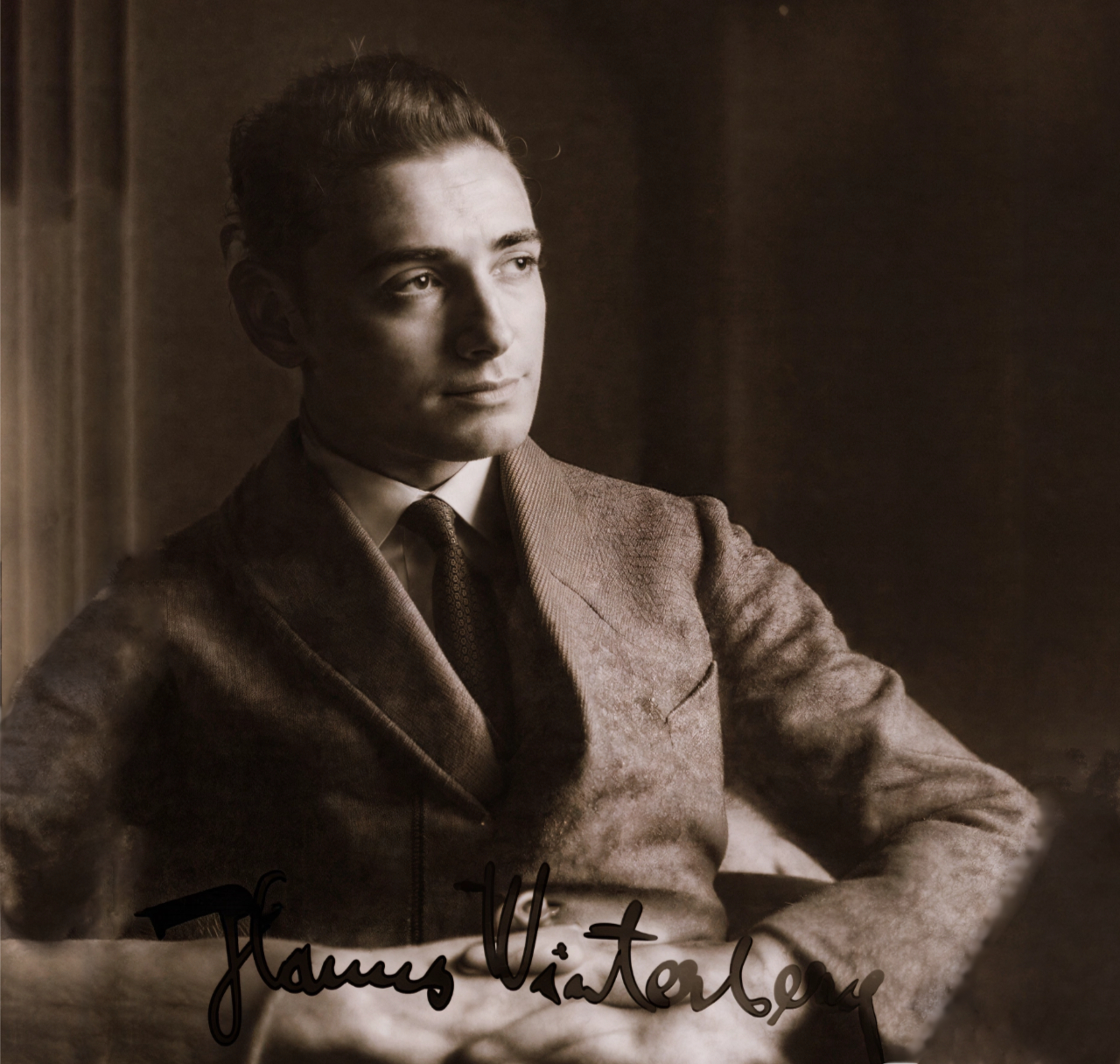
A signed portrait of Hans Winterberg from 1921.
The historical circumstances that suppressed Winterberg’s work are now part of its reception history, as is the restoration of his pieces. Institutions devoted to persecuted and exiled composers, such as archival centres, publishers and festivals, have played a key role in the composer’s recent resurgence by organising manuscripts, mediating rights and releasing recordings. As more materials have emerged, it is clear that Winterberg is neither a footnote to Terezín nor a belated late-Romantic, but a Central European modernist with a strong musical voice, clear motivic development, and rhythmically driven compositions which integrated serialism and new waves of musical modernism into a late-Romantic aesthetic. In the wake of National Socialism, recovery of Winterberg’s works is another refutation of the Nazi aesthetic rooted in Teutonic myth and völkisch Romanticism. Rather, Winterberg should correctly be placed among his teachers like teachers like Zemlinsky and Hába and interwar colleagues like Viktor Ullmann and Erwin Schulhoff.
By Alexandra Birch, March 2026
Sources
[1] Michael Haas, “Unlocking Winterberg: A Composer’s Return from Exile and Oblivion,” Forbidden Music (blog), May 5, 2025, https://forbiddenmusic.org/2025/05/05/unlocking-winterberg-a-composers-return-from-exile-and-oblivion/
[2] “From Prague to Bad Tölz: Fascinating Piano Music by Hans Winterberg,” Exilarte Center, November 19, 2023, accessed August 19, 2025, https://exilarte.org/en/from-prague-to-bad-tolz-fascinating-piano-music-by-hans-winterberg-i-november-19-2023
[3] “Hans or Hanuš Winterberg,” Glossen 46 (2020), accessed August 19, 2025, https://blogs.dickinson.edu/glossen/home-2/glossen-46-2020-current-issue/iii-kulturgeschichtliche-analysen-hans-or-hanus-winterberg/. blogs.dickinson.edu
[4] Michael Haas, “The Winterberg Puzzle’s Darker and Lighter Shades,” Forbidden Music (blog), May 27, 2021, https://forbiddenmusic.org/2021/05/27/the-winterberg-puzzles-darker-and-lighter-shades/.
[5] Michael Haas, Music of Exile: The Untold Story of the Composers Who Fled Hitler (New Haven, CT: Yale University Press, 2023), chap. 7 (“Case Study: Hans Winterberg and his Musical Return to Bohemia”)—located around page 250.
[6] Michael Haas, “Unlocking Winterberg: A Composer’s Return from Exile and Oblivion,” Forbidden Music (blog), May 5, 2025, https://forbiddenmusic.org/2025/05/05/unlocking-winterberg-a-composers-return-from-exile-and-oblivion/
[7] “Review of Music of Exile: The Untold Story of the Composers Who Fled Hitler,” Music & Letters (advance online publication, August 2025), academic.oup.com/ml/advance-article/doi/10.1093/ml/gcaf054/8233594.
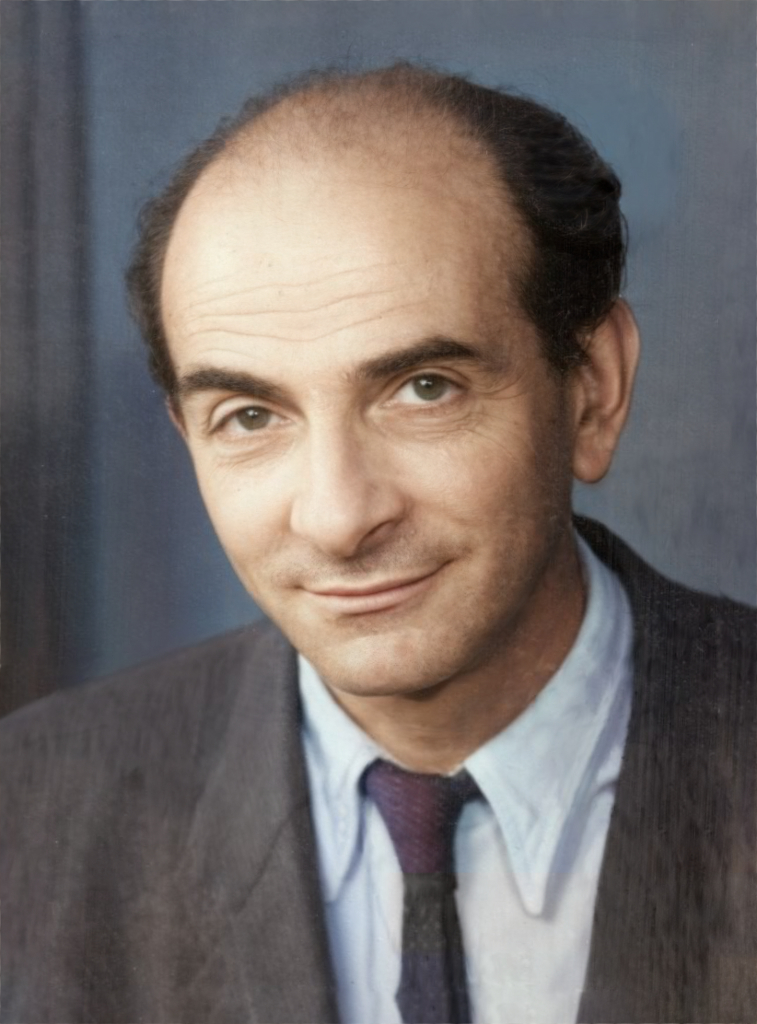
A passport photograph of Hans Winterberg in 1947. Colourised.